20 · BURIAL ASSEMBLAGE · ZAMBEZI
Missing grave goods The grave goods of Ingombe Ilede
Gold, copper, glass and other materials reveal the wealth of these burials and their trading connections.
ON THIS PAGE
History and context Evidence and facts Objects connected through time Further reading Where it is held Sources and references Comments Museum documentation · free public access, no account required.
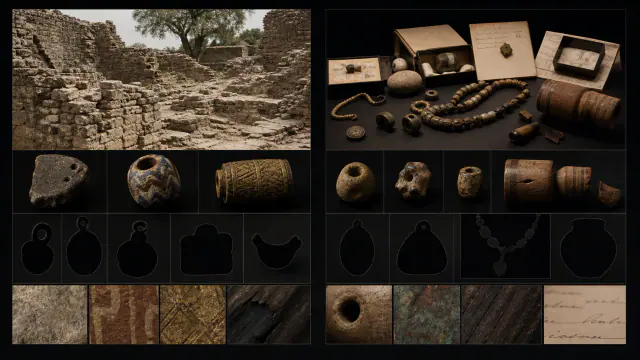
⛶ Enlarge imageEDITORIAL VISUALISATION DECLARED · AI-GENERATED IMAGE · TRACEKEEPERS Editorial visualisation · Contextual correspondence
Declared editorial visualisation, based on the cartography and sources of the fact sheet; it is not an exact historical frontier.
History and context High-status burials brought together gold, copper, bronze, iron, glass, shell and pottery linked to inland and Indian Ocean routes.
Researchers could not locate the principal beads in Livingstone and analysed a sample card held at MuseuMAfricA.
Evidence and interpretation Documented context and variety of materials; the nomination’s chronology and custodianship must be checked object by object.
Catalogue facts
Narrative date 13th–15th centuries according to the heritage overview
Location Confluence of the Zambezi and Lusitu, Zambia; collections in Livingstone and Johannesburg
Material Metals, glass, shell and pottery
Context Long-distance trade and the fragility of inventories
Curatorial reading The documented fact and its interpretation appear separately in the evidence block.
Dossier axis treasures
Research record BANTU · bantu-treasure-ingombe-ilede
Documentary coverage 3 museum, heritage, primary corpus or research sources for this stop. Glass6 Shell and mother-of-pearl10 Jewellery and adornment36 Ceramics56 Exchange and trade33 Funerary contexts64
The order uses the midpoint of each approximate date range; ranges can overlap. Spacing does not represent elapsed time. Swipe, scroll or use the arrows. With the sequence focused, use ← / →, Home or End.
Earlier Later
5 / 5 In the centre: Missing grave goods
Also connected, without a comparable date (1) These objects are not placed after the others: an unknown date does not mean a more recent object.
You can scroll the first group without JavaScript. The other topics are also available below.
Shell and mother-of-pearl 'Jamila's' necklace · ≈7250–7000 BCE · PrehistoryWorshiper of Tell Asmar · Towards 2900–2600 BCE · SumerRoyal Game of Ur · 2600–2400 BCE · SumerThe goat from PG 1237 · ca. 2600–2400 BCE · SumerStandard of Ur · ca. 2600–2400 BCE · SumerStatue of Ebih-Il · Towards 2400 BCE · SumerThe Gallery of the Conch Shells · Main use c. 800–500 BCE · Pre-Inca culturesMissing grave goods · 13th–15th centuries according to the heritage overview · Bantu-speaking worlds — You are viewingWithout a comparable date (not part of the chronological order):
Jewellery and adornment Hohle Fels · ≈40,000 years · Aurignacian · Prehistory'Jamila's' necklace · ≈7250–7000 BCE · PrehistoryThe Gold of Varna · Towards 4600–4200 BCE · ThraciansPuabi headdress · ca. 2600–2450 BCE · SumerCemetery R-37 · ca. 2550–2030 BCE · Indus civilisationCarnelian beads · ca. 2600–1900 BCE · Indus civilisationGrave Circle A and Chrysolakkos · 18th–16th centuries BCE · Greek worldsBurial at K IV · circa 1750–1550 BCE · Nubia, Kerma and KushTutankhamun's grave goods · death towards 1323 BCE · Ancient EgyptFu Hao’s burial goods · ca. 1200 BCE · Ancient ChinaBefore the Iberias · Final Bronze, c. 1000 BCE · IberiansTomb 1 at Kuntur Wasi · c. 800 BCE · Pre-Inca culturesBeads from Cerro de los Vientos · 8th–7th centuries BCE · orientalizing · IberiansGold at Kuntur Wasi · c. 800–550 BCE · Pre-Inca culturesRegolini-Galassi tomb · ca. 675–650 BCE · Etruscans and RomeCondomina Earring · 6th century BCE · IberiansSteppe kurgans · 7th–4th centuries BCE · Scythians and SakaVix Tomb · c. 500 BCE · Celtic worldsLa Venta grave goods · ca. 600–400 BCE · Maya worldsEzerovo Ring · 5th century BCE · chronology discussed in the bibliography · ThraciansGrave goods of Baza and Toya · First half of the 4th century BCE · IberiansTreasure of Jávea · 4th century BCE · IberiansSusa grave goods · c. 350 BCE · Achaemenid PersiaPunic head pendant · Mid 4th–3rd centuries BCE · PhoeniciansTreasure of Cheste · Jewellery from the 4th–3rd centuries BCE; concealment at the end of the 3rd century BCE. · IberiansMarina Alta Hoard · Jewellery: 5th–2nd centuries BCE; concealment probably around 80–73 BCE. · IberiansGolyamata Kosmatka · End of the 4th century – beginning of the 3rd century BCE; ritual burial at the beginning of the III according to Iskra. · ThraciansMairena Hoard · 3rd century BCE · IberiansChão de Lamas pectoral · 3rd–2nd centuries BCE · concealed in the early 1st century BCE · IberiansFibula from Lancia · ≈300–100 BCE · IberiansNorthern mound · 2nd–1st centuries BCE · Yayoi JapanHorse fibula · 2nd century BCE · disputed chronology · IberiansSimancas-type belt buckle · Second half of the IV century–V century CE · IberiansPakal’s grave goods · sealed on 28 August 683 CE · Maya worldsMissing grave goods · 13th–15th centuries according to the heritage overview · Bantu-speaking worlds — You are viewingWithout a comparable date (not part of the chronological order):
Ceramics Dolní Věstonice I · ≈29,000–27,000 years · PrehistoryBefore Sumer · mid-6th–5th millennium BCE · SumerTwin-chambered vessel from Cova de l’Or · Early Neolithic · VI–V millennia BCE · PrehistoryBefore Egypt · ca. 4400–3800 BCE · Ancient EgyptBefore Nubia · V–IV millennium BCE · Nubia, Kerma and KushBefore Gojoseon · Middle Neolithic, c. 4000 BCE · Gojoseon and early KoreaBevel-rimmed bowl · ca. 3500–3000 BCE · SumerBefore Yayoi · Middle Jōmon, ca. 3000 BCE · Yayoi JapanVasiliki · ca. 2500–2200 BCE · Greek worldsBefore the Greeks · c. 2400–2200 BCE · Greek worldsCemetery R-37 · ca. 2550–2030 BCE · Indus civilisationBefore Ancient China · c. 2500–2000 BCE · Ancient ChinaLongshan · c. 2500–2000 BCE · Ancient ChinaKerma vessel · c. 1802–1640 BCE · Nubia, Kerma and KushBurial at K IV · circa 1750–1550 BCE · Nubia, Kerma and KushBefore Vedic India · c. 1900–1300 BCE · Vedic and later Indian worldsOsmankayası and Ilıca · ca. 1700/1650–1200 BCE · HittitesGrey bowl from Hastinapura · c. 1100–800 BCE in the classical sequence of Hastinapura · Vedic and later Indian worldsBefore Etruscans and Rome · ca. 850–800 BCE · Etruscans and RomeThe urn under the helmet · 9th–8th centuries BCE · Etruscans and RomeCeramic stand 1010 · 8th–7th centuries BCE · orientalizing · IberiansIshtar Gate · 7th–6th centuries BCE · work of Nebuchadnezzar II · SumerGlazed brick guards · 522–486 BCE · Achaemenid PersiaOrpheus among the Thracians · circa 440 BCE; attributed to the London Painter E 497. · ThraciansThe Attic krater that took on a new life in Cástulo · 4th century BCE · Greek worldsThoth in the form of a baboon · 664–30 BCE · Ancient EgyptLeipzig Fish Plate · Last third 4th–early 3rd century BCE · Greek worldsDove of the Amarejo · 3rd century BCE · IberiansVas dels Guerrers · 3rd–early 2nd century BCE · IberiansWarriors' Vase · 3rd–2nd centuries BCE · IberiansNorthern mound · 2nd–1st centuries BCE · Yayoi JapanKalathos of Alcorisa · 2nd–1st centuries BCE · IberiansUrewe vessel · regional range c. 800 BCE–650 CE · Bantu-speaking worldsTwo rows of coffins · Mainly Middle Yayoi, 2nd century BCE–1st century CE · Yayoi JapanCeramics that continued · Last third of the 2nd century BCE–1st century CE · IberiansEgyptian oil lamp with a fish, held in Laon · 3rd–4th centuries CE · Ancient EgyptLaon lamp with fish · 3rd–4th centuries CE · Etruscans and RomeKabusanza, ca. 400 · ca. 400 CE · Batwa / Twa historiesMissing grave goods · 13th–15th centuries according to the heritage overview · Bantu-speaking worlds — You are viewingWithout a comparable date (not part of the chronological order):
Exchange and trade Weights · ca. 2600–1900 BCE · Indus civilisationBefore the Hittites · c. 19th century BCE · HittitesKerma vessel · c. 1802–1640 BCE · Nubia, Kerma and KushIvory in Nimrud · 9th–8th centuries BCE · PhoeniciansMotagua jade · c. 900–600 BCE · Maya worldsThe so-called ‘Priest of Cádiz’ · 7th century BCE · PhoeniciansThe so-called ‘Priest of Cádiz’ · 7th century BCE · IberiansThe Gallery of the Conch Shells · Main use c. 800–500 BCE · Pre-Inca culturesMazarrón 1 · Second half of the 7th century BCE · PhoeniciansMazarrón 2 · Second half of the 7th century BCE · PhoeniciansIvory with names · End of the 7th century–first half of the 6th century BCE · PhoeniciansThe inscription of Pistiros · 4th century BCE · ThraciansYan knife-money in the Gojoseon sphere · 4th–3rd centuries BCE · Ancient ChinaLead tablet · 4th–3rd centuries BCE · IberiansA coin with the memory of a blade · 323–222 BCE · Gojoseon and early KoreaCeramics that continued · Last third of the 2nd century BCE–1st century CE · IberiansRoman glass oinochoe · Late 1st century BCE–early 1st century CE · Etruscans and RomeMoulds for gold · 9th–11th centuries CE · Mande WorldsMissing grave goods · 13th–15th centuries according to the heritage overview · Bantu-speaking worlds — You are viewingCatalan Atlas · after 1375 and before November 1380 · Mande WorldsKilwa coin · 1482–1493 · Bantu-speaking worldsWithout a comparable date (not part of the chronological order):
Funerary contexts Brno II Articulated Figure · ≈28,000 years cal BP · by funerary association · Prehistory'Jamila's' necklace · ≈7250–7000 BCE · PrehistoryThe Gold of Varna · Towards 4600–4200 BCE · ThraciansEl Miradero spatula-idols · ≈4000–3800 cal BCE · PrehistoryGuadancil idol-plaque · 3750–2500 cal BCE · IberiansStaff of Anta 4 · Late 4th–first half of the 3rd millennium BCE. · PrehistoryAbydos Boats · ca. 3000 BCE · Ancient EgyptQueen's Lyre · ca. 2600–2500 BCE · SumerPuabi headdress · ca. 2600–2450 BCE · SumerStandard of Ur · ca. 2600–2400 BCE · SumerCemetery R-37 · ca. 2550–2030 BCE · Indus civilisationKerma vessel · c. 1802–1640 BCE · Nubia, Kerma and KushGrave Circle A and Chrysolakkos · 18th–16th centuries BCE · Greek worldsBurial at K IV · circa 1750–1550 BCE · Nubia, Kerma and KushBefore Vedic India · c. 1900–1300 BCE · Vedic and later Indian worldsOsmankayası and Ilıca · ca. 1700/1650–1200 BCE · HittitesTutankhamun's grave goods · death towards 1323 BCE · Ancient EgyptFu Hao’s burial goods · ca. 1200 BCE · Ancient ChinaThe voice of Ahiram · c. 11th–10th century BCE · PhoeniciansBefore Etruscans and Rome · ca. 850–800 BCE · Etruscans and RomeThe urn under the helmet · 9th–8th centuries BCE · Etruscans and RomeTomb 1 at Kuntur Wasi · c. 800 BCE · Pre-Inca culturesBeads from Cerro de los Vientos · 8th–7th centuries BCE · orientalizing · IberiansCeramic stand 1010 · 8th–7th centuries BCE · orientalizing · IberiansRegolini-Galassi tomb · ca. 675–650 BCE · Etruscans and RomeShabti of Psamtek · 570–526 BCE · Ancient EgyptTwo voices in an urn · 530–520 BCE · Etruscans and RomeThe great Greek krater of Vix · ≈530–500 BCE · Greek worldsSteppe kurgans · 7th–4th centuries BCE · Scythians and SakaVix Tomb · c. 500 BCE · Celtic worldsLa Venta grave goods · ca. 600–400 BCE · Maya worldsSarcophagus of Eshmunazar · first quarter of the 5th century BCE · PhoeniciansBanquet under leopards · Around 480–470 BCE · Etruscans and RomeTwenty-six voiceless signs · 5th–4th centuries BCE · Scythians and SakaThe oldest knotted carpet · 5th–4th centuries BCE · Scythians and SakaThe statue was the urn · First half of the 4th century BCE · IberiansGrave goods of Baza and Toya · First half of the 4th century BCE · IberiansThe Attic krater that took on a new life in Cástulo · 4th century BCE · Greek worldsThe silver amphora of Chertomlyk · 4th century BCE · Greek worldsThe Kul-Oba vase · 4th century BCE · Greek worldsSusa grave goods · c. 350 BCE · Achaemenid PersiaFaces of the Steppe · Second half of the 4th century BCE · Scythians and SakaLady of Ibiza · 4th–3rd centuries BCE · Phoenicians453 astragali from Alarcos · 4th–3rd centuries BCE · necropolis chronology · IberiansLady of Ibiza · 4th–3rd centuries BCE · IberiansFalcata from Almedinilla · 4th–3rd centuries BCE · IberiansGolyamata Kosmatka · End of the 4th century – beginning of the 3rd century BCE; ritual burial at the beginning of the III according to Iskra. · ThraciansThe blade became straight · 5th–1st centuries BCE · Gojoseon and early KoreaGeometry in very fine lines · 3rd–2nd centuries BCE · Gojoseon and early KoreaNorthern mound · 2nd–1st centuries BCE · Yayoi JapanTwo rows of coffins · Mainly Middle Yayoi, 2nd century BCE–1st century CE · Yayoi JapanKabusanza, ca. 400 · ca. 400 CE · Batwa / Twa historiesPakal’s grave goods · sealed on 28 August 683 CE · Maya worldsMissing grave goods · 13th–15th centuries according to the heritage overview · Bantu-speaking worlds — You are viewingWithout a comparable date (not part of the chronological order):
A closer look About 1 min to read · 1 section. Further reading and sources · free access. Editorial review recorded: September 5, 2026 .
Glass chemistry helps date a tomb Robertshaw and Wood identified, by chemical analysis, the beads studied from graves three and eight as belonging to the Khami series. Their 2017 work linked that series, manufactured in India, with circulation in southern and central-southern Africa between the mid-15th and mid-17th centuries. Some older beads from other burials may have been preserved as heirlooms. The study shows why the manufacturing date of an ornament does not necessarily coincide with that of the burial: a bead could circulate and be kept for generations before accompanying a person.
Where it is held Component of the group · Documented collection
The museum holds material from Ingombe Ilede. This stop brings together grave goods and an exchange network, rather than a single object with one inventory number.
The holding institution is documented; public display may change. Check its official record before visiting.
See Missing grave goods in the museum Find this record in its gallery and save your route, favourites and places to explore later.
Open this exhibit in the museum → Museum access requires a free account. You can read this page's documentation without registering.
Did you enjoy this exhibit? Your opinion helps us improve the museum. You can change it whenever you like.
Loading your rating…

 English
 Español
 Français
 Italiano
 Deutsch
 Русский
 Português
 Polski
 Română
 Svenska
 Norsk bokmål
 Suomi
 Türkçe
 العربية
 简体中文
 한국어
 हिन्दी
 Ελληνικά
 You are viewing