LATE 1st century BCE–EARLY 1st century CE · GLASS
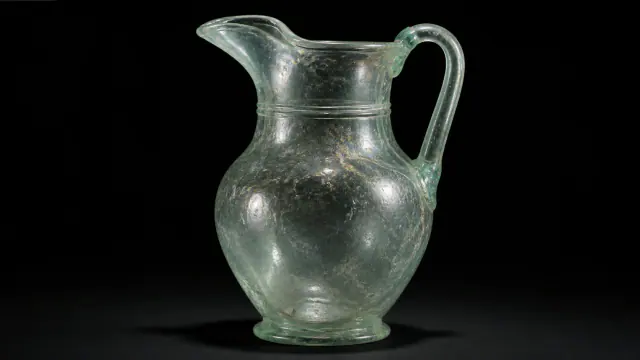
Roman glass oinochoe A jug for pouring, not necessarily an oil bottle
The shape of this glass jar facilitates pouring liquids, although we do not know what it contained.
ON THIS PAGE
History and context Evidence and facts Objects connected through time Further reading Location and territory Where it is held Sources and references Comments Museum documentation · free public access, no account required.
⛶ Enlarge image← Previous Image 1 of 2 · Main image Next →
Main image 2 DECLARED VISUAL RECONSTRUCTION · AI-GENERATED IMAGE · TRACEKEEPERS Generated reconstruction · Declared visual hypothesis
Declared visual reconstruction; not a photograph of the original nor documentary evidence.
View full image: DECLARED VISUAL RECONSTRUCTION · AI-GENERATED IMAGE · TRACEKEEPERS DECLARED VISUAL RECONSTRUCTION · AI-GENERATED IMAGE · TRACEKEEPERS Generated reconstruction · Declared visual hypothesis
Declared visual reconstruction; not a photograph of the original nor documentary evidence.
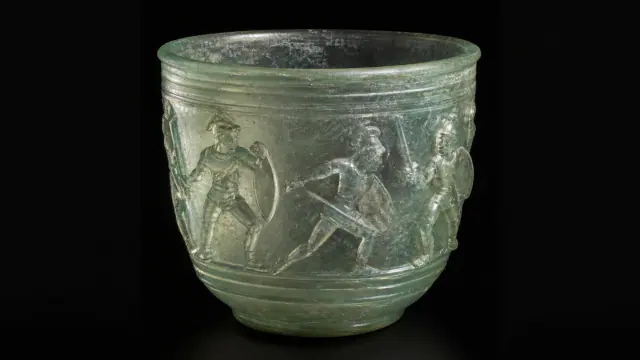
View full image: Original document · Glass oinochoe (jug) · 17.194.170 Original document · Glass oinochoe (jug) · 17.194.170 Documentary original · Exact correspondence
Glass oinochoe (jug) · 17.194.170 Web adaptation: size and format adjustment, without reconstructing parts or changing the photograph’s content.
Official record https://www.metmuseum.org/art/collection/search/249414; inventory number 17.194.170; API https://collectionapi.metmuseum.org/public/collection/v1/objects/249414 marked isPublicDomain=true. The same record is cited in the entry.
The Metropolitan Museum of Art · The Metropolitan Museum of Art · Inventory: 17.194.170 · CC0 1.0
History and context The oinochoe is a jar with mouth and handle designed for pouring. This glass example shows how a form known in pottery and metal was translated into a bright, technically demanding material.
Oil, wine, water or perfume may be suggested by context; without residues or a closed find, none should become a definite primary function.
Evidence and interpretation Form, chronology, glass and inventory are documented. Content and use scene are not.
Catalogue facts
Date Late 1st century BCE–early 1st century CE
Inventory The Met 17.194.170
Material Glass
Formal function Jar for pouring Glass6 Vessels70 Exchange and trade33
The order uses the midpoint of each approximate date range; ranges can overlap. Spacing does not represent elapsed time. Swipe, scroll or use the arrows. With the sequence focused, use ← / →, Home or End.
Earlier Later
3 / 5 In the centre: Roman glass oinochoe
Also connected, without a comparable date (1) These objects are not placed after the others: an unknown date does not mean a more recent object.
You can scroll the first group without JavaScript. The other topics are also available below.
Vessels Before Sumer · mid-6th–5th millennium BCE · SumerTwin-chambered vessel from Cova de l’Or · Early Neolithic · VI–V millennia BCE · PrehistoryBefore Egypt · ca. 4400–3800 BCE · Ancient EgyptBefore Nubia · V–IV millennium BCE · Nubia, Kerma and KushBefore Gojoseon · Middle Neolithic, c. 4000 BCE · Gojoseon and early KoreaBevel-rimmed bowl · ca. 3500–3000 BCE · SumerUruk Vase · ca. 3300–3000 BCE · SumerBefore Yayoi · Middle Jōmon, ca. 3000 BCE · Yayoi JapanVasiliki · ca. 2500–2200 BCE · Greek worldsBefore the Greeks · c. 2400–2200 BCE · Greek worldsBefore Ancient China · c. 2500–2000 BCE · Ancient ChinaLongshan · c. 2500–2000 BCE · Ancient ChinaKerma vessel · c. 1802–1640 BCE · Nubia, Kerma and KushGrave Circle A and Chrysolakkos · 18th–16th centuries BCE · Greek worldsBefore Vedic India · c. 1900–1300 BCE · Vedic and later Indian worldsJue · c. sixteenth century BCE · Ancient ChinaPithos · c. 1450–1375 BCE · Greek worldsTutankhamun's grave goods · death towards 1323 BCE · Ancient EgyptStag Vessel · 14th–13th centuries BCE · HittitesValchitran · second half of the 14th century–beginning of the 13th century BCE, according to NAIM; other publications use wider intervals from the Late Bronze. · ThraciansLiding · 12th–11th centuries BCE · Ancient ChinaBefore the Iberias · Final Bronze, c. 1000 BCE · IberiansGrey bowl from Hastinapura · c. 1100–800 BCE in the classical sequence of Hastinapura · Vedic and later Indian worldsBefore Etruscans and Rome · ca. 850–800 BCE · Etruscans and RomeThe urn under the helmet · 9th–8th centuries BCE · Etruscans and RomeTomb 1 at Kuntur Wasi · c. 800 BCE · Pre-Inca culturesRegolini-Galassi tomb · ca. 675–650 BCE · Etruscans and RomeThe great Greek krater of Vix · ≈530–500 BCE · Greek worldsScorțaru cauldron · 6th–5th centuries BCE · ThraciansVix Tomb · c. 500 BCE · Celtic worldsOrpheus among the Thracians · circa 440 BCE; attributed to the London Painter E 497. · ThraciansTwenty-six voiceless signs · 5th–4th centuries BCE · Scythians and SakaRogozen · mainly 5th–4th centuries BCE; The set has a history of accumulation, not a single manufacturing date. · ThraciansGrave goods of Baza and Toya · First half of the 4th century BCE · IberiansThe Attic krater that took on a new life in Cástulo · 4th century BCE · Greek worldsThe silver amphora of Chertomlyk · 4th century BCE · Greek worldsThe Kul-Oba vase · 4th century BCE · Greek worldsFaces of the Steppe · Second half of the 4th century BCE · Scythians and SakaPoroina Mare Rhyton · Second half of the 4th century BCE · ThraciansBorovo · 4th century BC C.; 350–300 BCE in the ISAW catalog. · ThraciansLeipzig Fish Plate · Last third 4th–early 3rd century BCE · Greek worldsGolyamata Kosmatka · End of the 4th century – beginning of the 3rd century BCE; ritual burial at the beginning of the III according to Iskra. · ThraciansPanagyurishte · late 4th century – early 3rd century BCE, towards 300 BCE · ThraciansDove of the Amarejo · 3rd century BCE · IberiansMairena Hoard · 3rd century BCE · IberiansVase from Chão de Lamas · Piece: III–II centuries BCE · concealment ≈110–76 BCE · IberiansVas dels Guerrers · 3rd–early 2nd century BCE · IberiansWarriors' Vase · 3rd–2nd centuries BCE · IberiansThe dismantled cauldron · 2nd–1st centuries BCE · Celtic worldsKalathos of Alcorisa · 2nd–1st centuries BCE · IberiansPatera from Perotito · Second half of the 2nd–beginnings of the 1st century BCE · IberiansUrewe vessel · regional range c. 800 BCE–650 CE · Bantu-speaking worldsTwo rows of coffins · Mainly Middle Yayoi, 2nd century BCE–1st century CE · Yayoi JapanCeramics that continued · Last third of the 2nd century BCE–1st century CE · IberiansRoman glass oinochoe · Late 1st century BCE–early 1st century CE · Etruscans and Rome — You are viewingGladiators Cup of Chavagnes · 25–75 CE · Etruscans and RomeEgyptian oil lamp with a fish, held in Laon · 3rd–4th centuries CE · Ancient EgyptLaon lamp with fish · 3rd–4th centuries CE · Etruscans and RomeWater in a shell · 1816–1826 · San historiesWithout a comparable date (not part of the chronological order):
Exchange and trade Weights · ca. 2600–1900 BCE · Indus civilisationBefore the Hittites · c. 19th century BCE · HittitesKerma vessel · c. 1802–1640 BCE · Nubia, Kerma and KushIvory in Nimrud · 9th–8th centuries BCE · PhoeniciansMotagua jade · c. 900–600 BCE · Maya worldsThe so-called ‘Priest of Cádiz’ · 7th century BCE · PhoeniciansThe so-called ‘Priest of Cádiz’ · 7th century BCE · IberiansThe Gallery of the Conch Shells · Main use c. 800–500 BCE · Pre-Inca culturesMazarrón 1 · Second half of the 7th century BCE · PhoeniciansMazarrón 2 · Second half of the 7th century BCE · PhoeniciansIvory with names · End of the 7th century–first half of the 6th century BCE · PhoeniciansThe inscription of Pistiros · 4th century BCE · ThraciansYan knife-money in the Gojoseon sphere · 4th–3rd centuries BCE · Ancient ChinaLead tablet · 4th–3rd centuries BCE · IberiansA coin with the memory of a blade · 323–222 BCE · Gojoseon and early KoreaCeramics that continued · Last third of the 2nd century BCE–1st century CE · IberiansRoman glass oinochoe · Late 1st century BCE–early 1st century CE · Etruscans and Rome — You are viewingMoulds for gold · 9th–11th centuries CE · Mande WorldsMissing grave goods · 13th–15th centuries according to the heritage overview · Bantu-speaking worldsCatalan Atlas · after 1375 and before November 1380 · Mande WorldsKilwa coin · 1482–1493 · Bantu-speaking worldsWithout a comparable date (not part of the chronological order):
A closer look About 1 min to read · 1 section. Further reading and sources · free access. Editorial review recorded: September 5, 2026 .
The glass retains a memory of metal The lower joint of the handle is diamond-shaped and reproduces a fastening plate typical of metal vessels. It also incorporates a thumb rest and a central rib. The Metropolitan interprets these details as imitation of metal models, transferred to a pale blue, partially opaque glass. It is not merely copying a silhouette: the artisan preserves recognisable elements of another material. Observing the handle allows study of how a technical innovation could be presented through familiar forms, without deducing from them what liquid this specific jar contained.
Location and territory Physical world map with routes of human evolution Present-day world coastline from Natural Earth in an equirectangular projection. The overlaid markers let you explore each milestone. Map base: Natural Earth 1:110m · public domain · present-day reference coastline REGIONAL AREA
Etruria and formative Italy; the later Roman expansion was much greater Etruria and formative Italy; the later Roman expansion was much greater. The footprint indicates the orientative centre of the area, not a boundary nor an exact point. Where it is held Item or group in the record · Documented collection
Inventory 17.194.170.
The holding institution is documented; public display may change. Check its official record before visiting.
See Roman glass oinochoe in the museum Find this record in its gallery and save your route, favourites and places to explore later.
Open this exhibit in the museum → Museum access requires a free account. You can read this page's documentation without registering.
Did you enjoy this exhibit? Your opinion helps us improve the museum. You can change it whenever you like.
Loading your rating…

 English
 Español
 Français
 Italiano
 Deutsch
 Русский
 Português
 Polski
 Română
 Svenska
 Norsk bokmål
 Suomi
 Türkçe
 العربية
 简体中文
 한국어
 हिन्दी
 Ελληνικά
 You are viewing