
 English
 Español
 Français
 Italiano
 Deutsch
 Русский
 Português
 Polski
 Română
 Svenska
 Norsk bokmål
 Suomi
 Türkçe
 العربية
 简体中文
 한국어
 हिन्दी
 Ελληνικά
06 · OBJECT · WORKSHOP AND NETWORK
Carnelian beads
A red stone travels far
Cutting, polishing and drilling carnelian required specialised artisans; some beads travelled very far.
Museum documentation · free public access, no account required.
Generated reconstruction · Declared visual hypothesis
Declared visual reconstruction; not a photograph of the original nor documentary evidence.
History and context
Carnelian beads and other worked stones show specialised craftsmanship in the Harappan world. Cutting, heating, polishing and drilling transformed a mineral into a recognisable and transportable good.
Their scale produces a physical surprise: an object that fits in the palm summarises supply chains and technical learning of enormous length.
Carnelian could be heated to intensify the red, shaped and drilled with specialised drills. Long beads accumulated many hours of invisible work.
Engraved specimens found in Mesopotamia show travel or imitation, but do not retain the name of their producer nor each intermediary.
Evidence and interpretation
Documented fact: Dholavira and other Harappan centres have produced evidence of workshops and objects of stone, shell and metal; beads circulated widely. Interpretation and caution: A bead found far away does not automatically identify its manufacturer nor prove a concrete direct trade route. Expanded documented fact: Dholavira and other centres preserve bead workshops; Indus tradition beads reached the Gulf and Mesopotamia. Expanded interpretation and caution: Style and raw material do not always fix a single workshop; some pieces circulated indirectly or were imitated.
Catalogue facts
- Narrative date
- ca. 2600–1900 BCE
- Location
- Gujarat and Indus valley
- Material
- Carnelian, agate, steatite and drills
- Context
- Specialised craftsmanship
- Curatorial reading
- The documented fact and its interpretation appear separately in the evidence block.
- Operations
- Cutting, heating, polishing and drilling
- Network
- Gujarat, Indus, Oman, Gulf and Mesopotamia
- Documentary coverage
- 4 museum, heritage, primary corpus or research sources for this stop.
A SHARED TOPIC, DIFFERENT MOMENTS
Objects connected through time
Follow a topic across the collections. A shared tag is a way to compare objects, not proof that one culture influenced another.
The order uses the midpoint of each approximate date range; ranges can overlap. Spacing does not represent elapsed time. Swipe, scroll or use the arrows. With the sequence focused, use ← / →, Home or End.
Ornamental stones6 dated objects
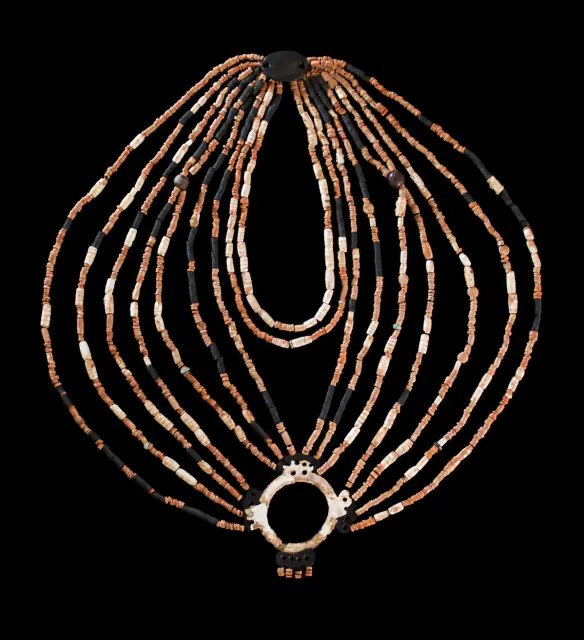
≈7250–7000 BCE
'Jamila's' necklace
Prehistory
Approximate dating according to the record.
Read the record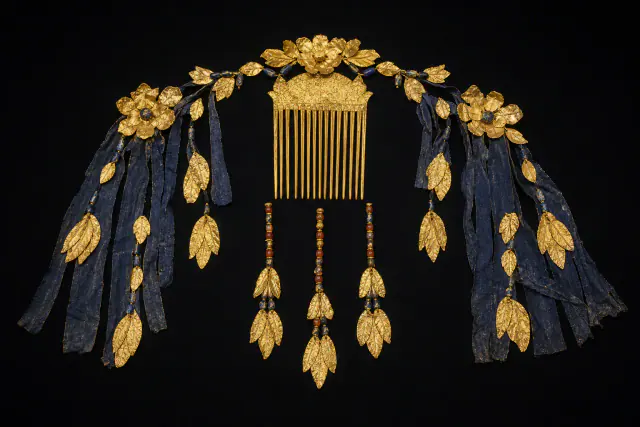
ca. 2600–2450 BCE
Overlapping datesPuabi headdress
Sumer
Approximate dating according to the record.
Read the record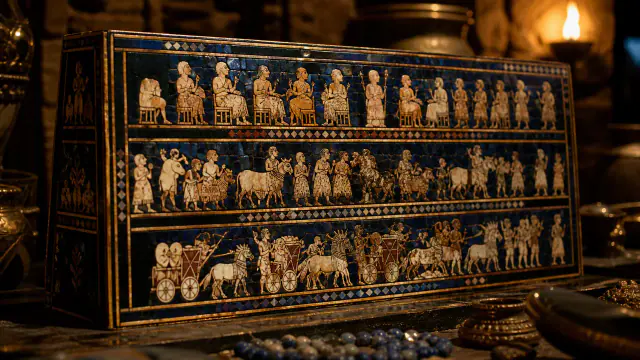
ca. 2600–2400 BCE
Overlapping datesStandard of Ur
Sumer
Unknown function; The scenes do not prove that it was a banner.
Read the record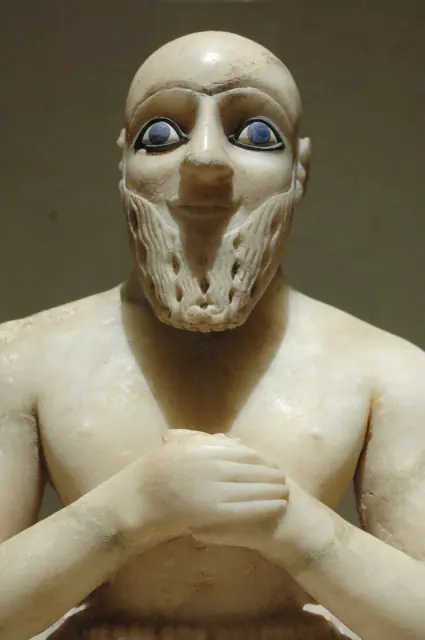
Towards 2400 BCE
Overlapping datesStatue of Ebih-Il
Sumer
Approximate dating according to the record.
Read the record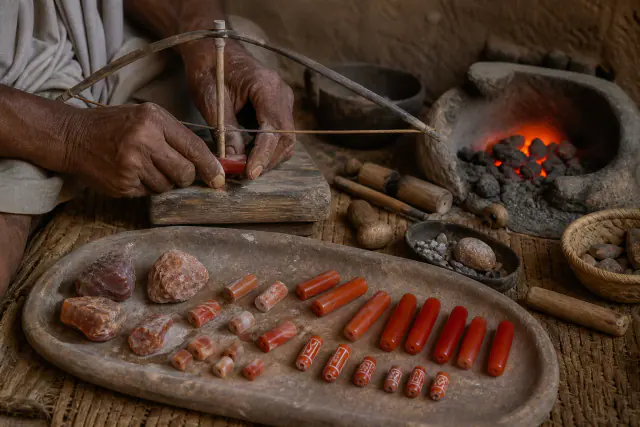 You are viewing
ca. 2600–1900 BCE
Carnelian beads
Indus civilisation
Archaeological framework of the bead assemblage and its production.
Current record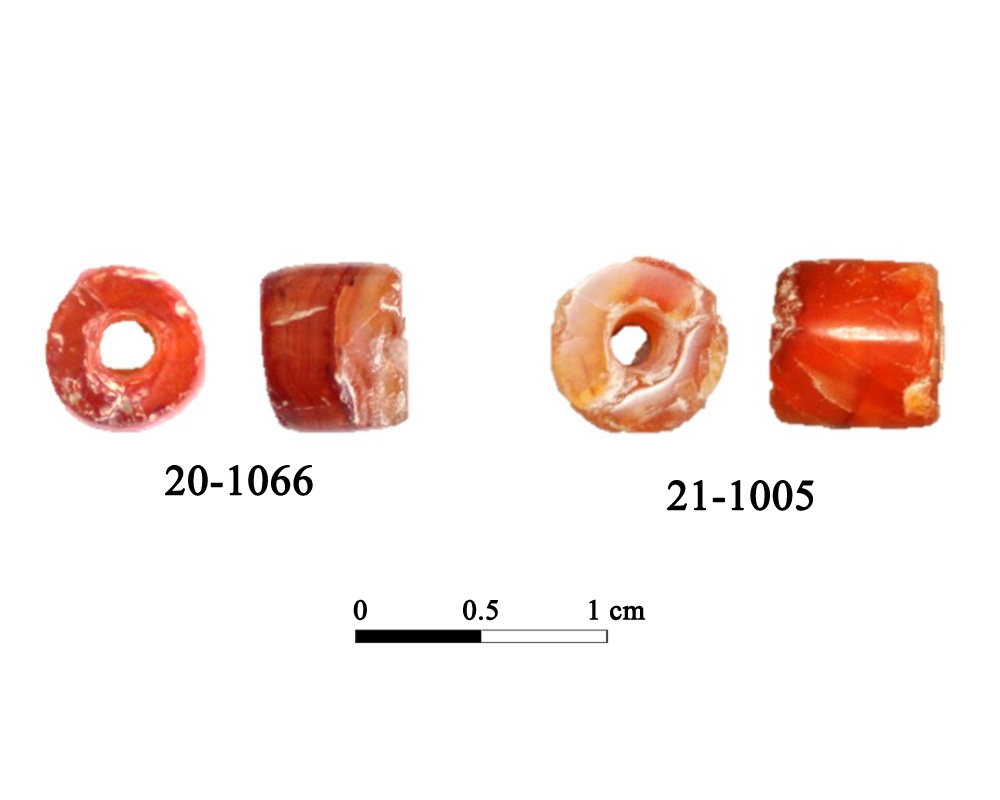
8th–7th centuries BCE · orientalizing
Beads from Cerro de los Vientos
Iberians
Chronology of the funerary context of Tomb 5, Orientalising horizon.
Read the record
Also connected, without a comparable date (1)
These objects are not placed after the others: an unknown date does not mean a more recent object.
- MeluhhaIndus civilisation · ca. 2600–1900 BCE
A closer look
About 1 min to read · 1 section. Further reading and sources · free access. Editorial review recorded: .
Accidents indicate where a bead was produced
At Chanhu-daro, decorated carnelian beads were found that had broken during drilling. Mackay used these failed pieces, together with the variety of designs, to argue that such beads were manufactured there. The residue has a distinct documentary value from a finished jewel: the latter may arrive through exchange; a piece broken during a stage of the process helps locate the activity. Observing the moment of breakage also allows reconstruction of the sequence of operations, including the relationship between decoration and drilling.
- Research · Harappa · Etched Carnelian Beads from Chanhu-daroAccess recorded: .
Location and territory
REGIONAL AREA
Gujarat and Indus valleyPunjab, Sindh, Balochistan and Gujarat within an urban network. The footprint marks the indicative center of the area, not a border or an exact point.Where it is held
The British Museum
Item or group in the record · Documented collection
The holding institution is documented; public display may change. Check its official record before visiting.
Sources and references
Did you enjoy this exhibit?
Your opinion helps us improve the museum. You can change it whenever you like.
Loading your rating…