
 English
 Español
 Français
 Italiano
 Deutsch
 Русский
 Português
 Polski
 Română
 Svenska
 Norsk bokmål
 Suomi
 Türkçe
 العربية
 简体中文
 한국어
 हिन्दी
 Ελληνικά
TREASURES · ORIENTALIZING PERIOD
Beads from Cerro de los Vientos
Two carnelian beads in tomb 5
Small ornaments that raise questions about exchanges.
Museum documentation · free public access, no account required.
Documentary original · Exact correspondence
Documentary photograph of the digital resource linked by Arquiberlab. File preserved without alterations; its licence limits use to non-commercial purposes and does not allow derivative works.
University Institute of Research in Iberian Archaeology · University of Jaén · Arquiberlab · Creative Commons - Attribution, Non-Commercial, No Derivatives (BY-NC-ND) 3.0
History and context
Beads 1015 and 1066 come from tomb 5 of Cerro de los Vientos. Analyses identified carnelian in both. They belong to the orientalizing horizon of the 8th–7th centuries BCE, prior to the development of full Iberian culture.
Evidence and interpretation
Mineral identification by Raman and X-ray fluorescence; the material alone does not determine a quarry or an exact trade route. The Arquiberlab text file identifies the beads as 1015 and 1066, while their photograph labels them 21-1005 and 20-1066; we retain this visible inventory discrepancy.
Catalogue facts
- Date
- 8th–7th centuries BCE · orientalizing
- Provenance
- Tomb 5 · Cerro de los Vientos, Puente del Obispo, Baeza (Jaén)
- Material
- Carnelian · inventories 1015 and 1066
- Classification
- Orientalizing antecedent, not full Iberian
A SHARED TOPIC, DIFFERENT MOMENTS
Objects connected through time
Follow a topic across the collections. A shared tag is a way to compare objects, not proof that one culture influenced another.
The order uses the midpoint of each approximate date range; ranges can overlap. Spacing does not represent elapsed time. Swipe, scroll or use the arrows. With the sequence focused, use ← / →, Home or End.
Ornamental stones6 dated objects
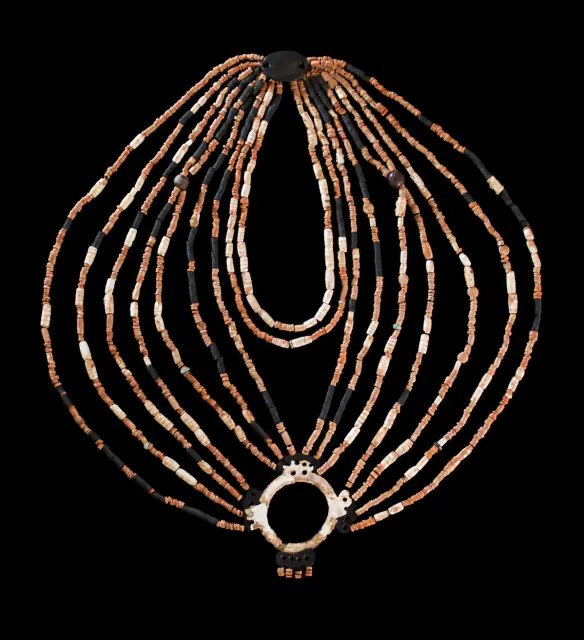
≈7250–7000 BCE
'Jamila's' necklace
Prehistory
Approximate dating according to the record.
Read the record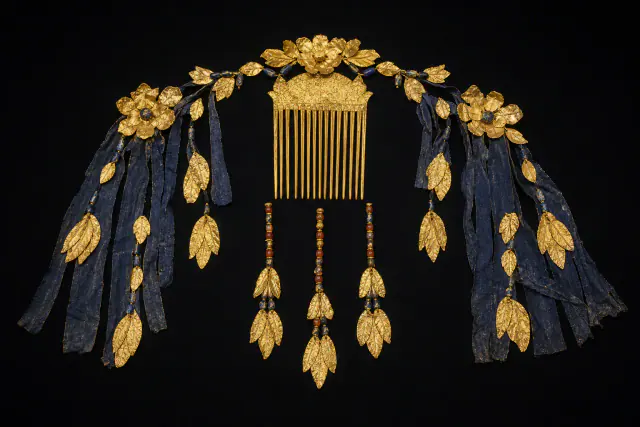
ca. 2600–2450 BCE
Puabi headdress
Sumer
Approximate dating according to the record.
Read the record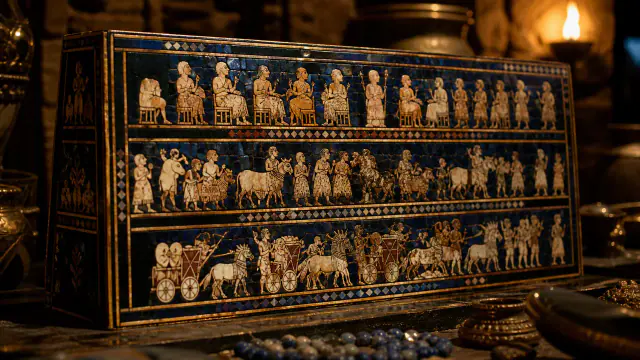
ca. 2600–2400 BCE
Standard of Ur
Sumer
Unknown function; The scenes do not prove that it was a banner.
Read the record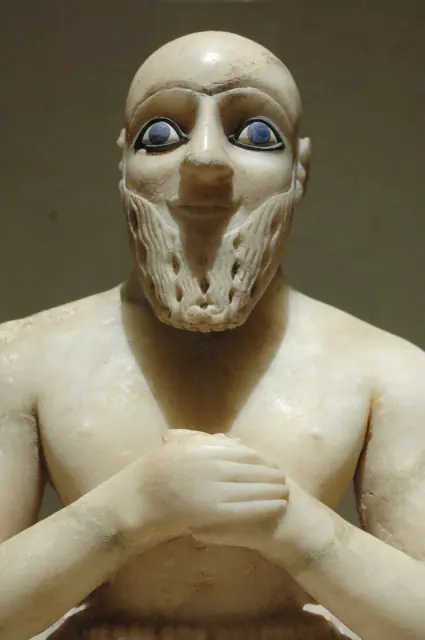
Towards 2400 BCE
Statue of Ebih-Il
Sumer
Approximate dating according to the record.
Read the record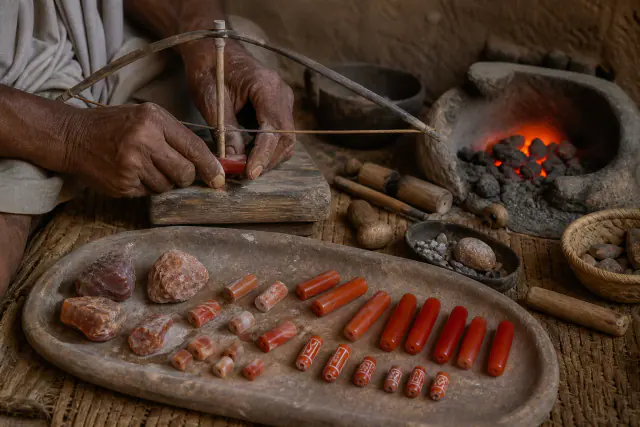
ca. 2600–1900 BCE
Carnelian beads
Indus civilisation
Archaeological framework of the bead assemblage and its production.
Read the record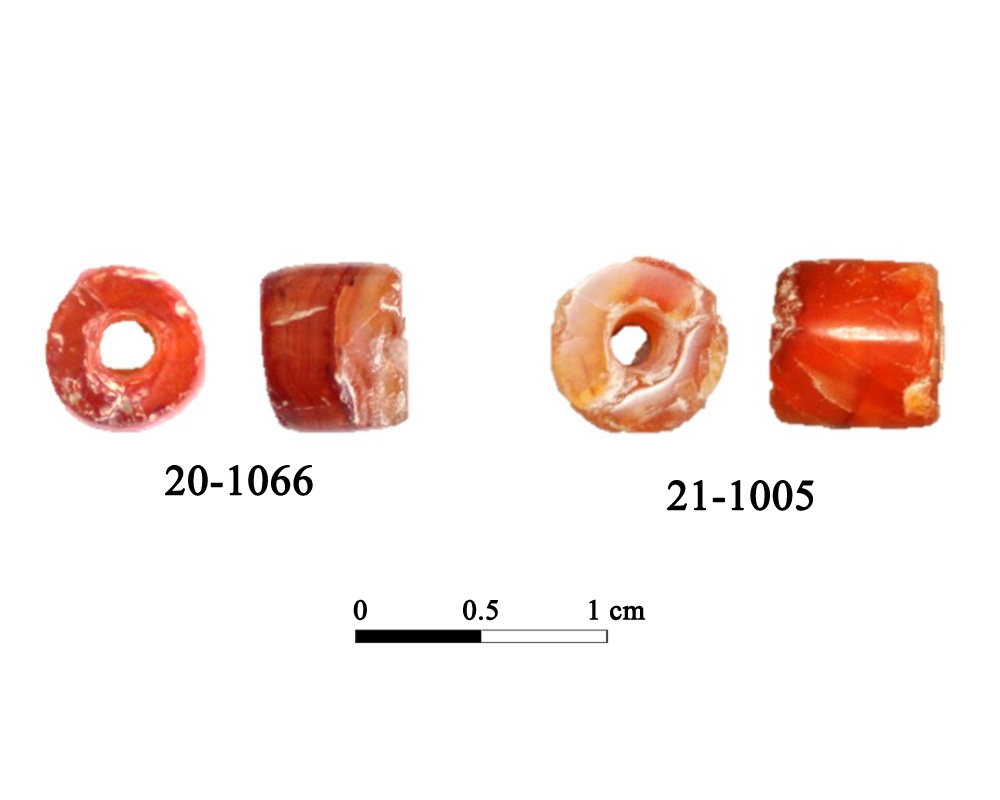 You are viewing
8th–7th centuries BCE · orientalizing
Beads from Cerro de los Vientos
Iberians
Chronology of the funerary context of Tomb 5, Orientalising horizon.
Current record
Also connected, without a comparable date (1)
These objects are not placed after the others: an unknown date does not mean a more recent object.
- MeluhhaIndus civilisation · ca. 2600–1900 BCE
A closer look
About 1 min to read · 2 sections. Further reading and sources · free access. Editorial review recorded: .
From colour to composition
The reddish colour alone was insufficient to identify the beads. Their analysis distinguished quartz and moganite, characteristic components of chalcedony, and ruled out detectable organic colourants. These are data on the matter; attributing a precise trade itinerary requires additionally provenance evidence and archaeological comparison.
What matter can say about exchange
X-ray fluorescence recorded a composition dominated by silica and a very low proportion of iron oxide. Arquiberlab relates the carnelian to supply areas outside the Iberian peninsula, among them India and Egyptian Sahara. It is a lead for investigating exchange networks of the orientalizing horizon, but these two beads alone do not identify a mine, a workshop nor the route they followed to the tomb.
Location and territory
REGIONAL AREA
Cerro de los Vientos · surroundings of Puente del ObispoRegional marker of the surroundings of Puente del Obispo, not the coordinates of tomb 5.Sources and references
Did you enjoy this exhibit?
Your opinion helps us improve the museum. You can change it whenever you like.
Loading your rating…