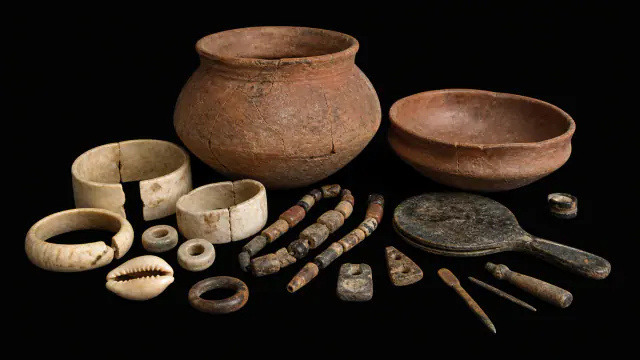
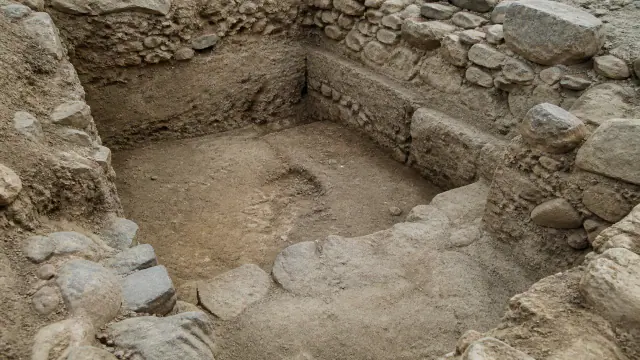
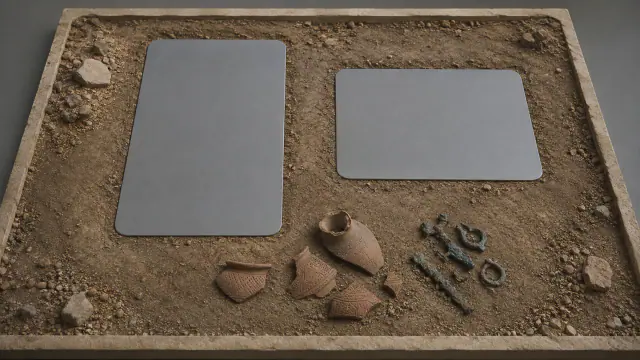
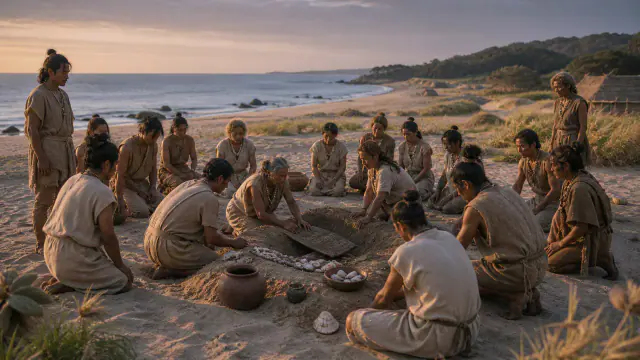
Declared visual reconstruction for museographic context; it is not a photograph of the original nor documentary evidence.
History and context
Nineteen campaigns recovered remains of about three hundred people at Doigahama. Osteological form, isotopes and DNA studies allow investigation of kinship and movements between the archipelago and the continent with increasing resolution.
Some Yayoi skeletons show weapon-inflicted injuries more frequently than the studied Jomon, consistent with more conflict-prone societies. This does not authorise dividing the population into fixed races: migrants and local communities mixed in regional and prolonged ways.
Nineteen campaigns recovered nearly three hundred individuals in coastal sand. Rather than a ‘type’ skeleton, the cemetery allows comparison of ages, diets, kinships and movements across generations.
Blade-produced traumas appear more frequently than in comparable Jōmon samples. DNA, morphology and isotopes answer different questions and must not be combined to fabricate fixed racial categories.
Evidence and interpretation
Documented fact: The National Museum of Nature and Science documents about 300 individuals, morphological differences, trauma and new DNA research. Interpretation and caution: individual origin, cultural identity and a direct link between a wound and a specific war require case-by-case analysis.
Expanded documentation: The National Museum of Nature and Science documents quantity, morphological differences, trauma and genetic analysis.
Expanded interpretation and caution: Biological resemblance does not equal cultural identity; a wound cannot be assigned to a specific war without context.
Catalogue facts
Narrative date
Mainly 4th century BCE–3rd century CE
Location
Doigahama, Shimonoseki, Yamaguchi
Material
Human remains, shells, pottery and sandy sediments
Context
Coastal cemetery and bioarchaeological laboratory
Curatorial reading
The documented fact and its interpretation appear separately in the evidence block.
Sample
The campaigns recovered remains of approximately 300 people.
Trauma
Several individuals present lethal or perimortem injuries caused by sharp instruments.
Methods
Morphology, isotopes and DNA offer distinct scales of mobility and kinship.
Documentary coverage
2 museum, heritage, primary corpus or research sources for this stop.
A SHARED TOPIC, DIFFERENT MOMENTS
Objects connected through time
Follow a topic across the collections. A shared tag is a way to compare objects, not proof that one culture influenced another.
The order uses the midpoint of each approximate date range; ranges can overlap. Spacing does not represent elapsed time. Swipe, scroll or use the arrows. With the sequence focused, use ← / →, Home or End.
THE CURRENT OBJECT
Its date is not sufficiently established to place it on the timeline. We keep it here, separate from the dated objects.
Shum LakaBantu-speaking worlds · c. 8,000 and 3,000 years before present
A closer look
About 1 min to read · 1 section. Further reading and sources · free access. Editorial review recorded: .
One genome does not represent an entire cemetery
A study published in 2024 sequenced the nuclear genome of one individual from Doigahama and compared it with ancient and present-day populations. It identified affinities related to Jōmon, East Asia and northeast Siberia; among external populations, the Korean comparison proved especially close. The authors employed admixture models to investigate migrations from the peninsula. The individual result does not convert ancestry into nationality, language or shared identity among all Yayoi inhabitants.

 English
 Español
 Français
 Italiano
 Deutsch
 Русский
 Português
 Polski
 Română
 Svenska
 Norsk bokmål
 Suomi
 Türkçe
 العربية
 简体中文
 한국어
 हिन्दी
 Ελληνικά
 You are viewing