 English
 Español
 Français
 Italiano
 Deutsch
 Русский
 Português
 Polski
 Română
 Svenska
 Norsk bokmål
 Suomi
 Türkçe
 العربية
 简体中文
 한국어
 हिन्दी
 Ελληνικά
01 · INITIAL ATLAS · ORIGIN AND EXPANSION
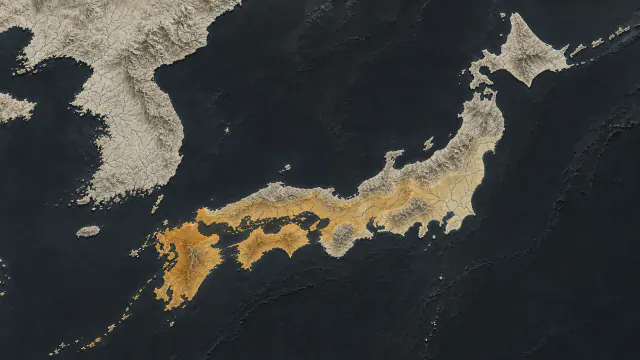
Yayoi Map
Rice, metal and settlements from Kyūshū
Read the complete record → TRACEKEEPERS
HISTORY · OPEN COLLECTION
Yayoi developments involved the interaction of incoming populations and agricultural technologies with Jōmon communities. Rice fields, villages and regional hierarchies took shape through these varied encounters.
27 complete records · free to read, no account needed
Read freely here. A free account saves your visits inside the museum.
Before you begin · Yayoi
The Yayoi horizon arose from encounters with the continent and transformations among communities that already inhabited the Japanese archipelago.
Since c. 14000 BCE
Ceramics, fishing and exploitation of diverse resources accompany communities with regional forms of mobility and settlement.
IV–III millennia BCE
Elaborately crafted vessels and relations between communities show the technical and social diversity of middle Jōmon.
Since the X–IX centuries BCE
The proposed chronology for northern Kyūshū precedes a gradual and uneven expansion towards other regions.
Since the end of the last glaciation, communities of the archipelago produced pottery and exploited fish, animals and plants. The long Jōmon history included distinct forms of settling and managing resources. In the Shinano basin, the vessels and occupation remains allow tracking how activities changed as the climate transformed and forests extended.
In the middle Jōmon, villages and exchange networks flourished. The famous llama-style vessels of Niigata, modelled about five thousand years ago, express that technical elaboration. Their use remains show that they also served for cooking. Elaborated pottery and durable settlements existed long before irrigated rice gained importance.
The contacts and population movements from the continent contributed to the expansion of rice cultivation in flooded fields. In northern Kyūshū, some chronologies place the beginning of Yayoi in the X–IX centuries BCE. Its diffusion towards other regions took centuries and produced local combinations of earlier practices, new techniques and social relations.
The museum allows relating rice paddies, tools, bronzes and settlements with the collective decisions that transformed everyday life.
Interpreting these traces. Jōmon and Yayoi are archaeological categories: their chronological limits vary by region and do not describe two uniform populations.
c. 300 BCE · working chronology · EAST ASIA
Access to the museum brings together the atlas and the background of Yayoi. Afterwards, seven areas order the historical context, culture, architecture, characters and society, treasures and grave goods, beliefs and curiosities, and two historical doors towards other museums. Each card preserves narrative layers, cautions and differentiated sources.
The room combines a specific visual catalog with an audited thematic dossier. Separates facts, interpretations and cautions; the 3D volumes continue to be replaceable markers until models with provenance and license are incorporated.
Yayoi culture appeared when new populations and agricultural technologies were integrated with Jōmon communities, creating landscapes of rice paddies, villages and regional hierarchies.
Do not present Jōmon and Yayoi as two closed races nor fix a single transition date for all Japan; the process was long and geographically uneven.
Read the background and its sources →EXPLORE THE COLLECTION
Follow the museum’s curated order or go straight to a section. Every record includes its full public documentation and sources.
01 · COLLECTION
Consult the maps and initial context sheets to situate this museum in time and territory; then choose the areas that interest you most.
01 · INITIAL ATLAS · ORIGIN AND EXPANSION
Rice, metal and settlements from Kyūshū
Read the complete record →02 · BEFORE THE PADDY FIELD AND METAL · JŌMON · 14000–900 BCE
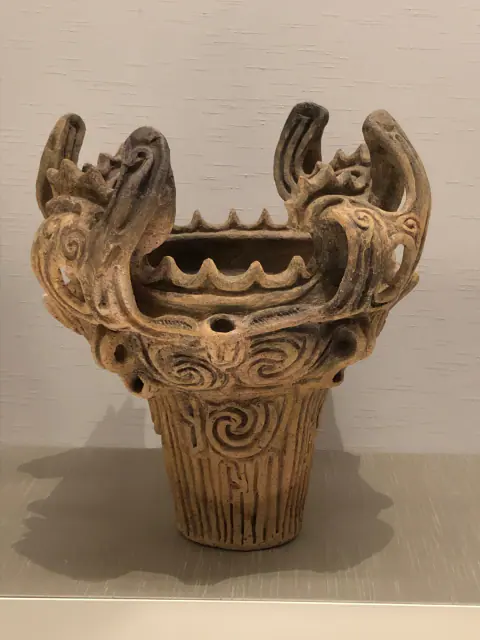
Jōmon communities made vessels with elaborated rims that are today compared to flames.
Read the complete record →02 · COLLECTION
The first stop reconstructs the area before Yayoi; afterwards, places and processes allow entering its history without reducing it to a start date nor to an inevitable destination.
01 · 01 · Fukuoka · planning a harvest
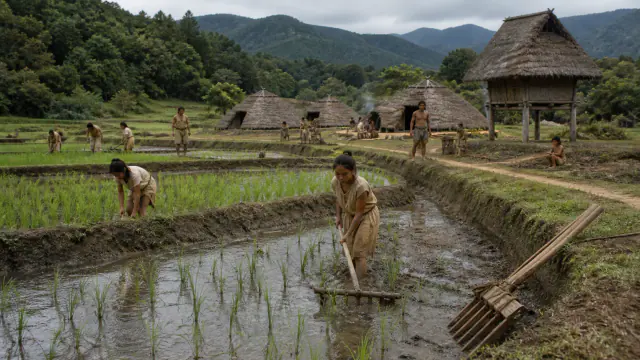
Growing rice in flooded fields required levelling the soil, conducting water and organising labour among several people.
Read the complete record →02 · 02 · Tokyo, 1884 · archaeology and classification
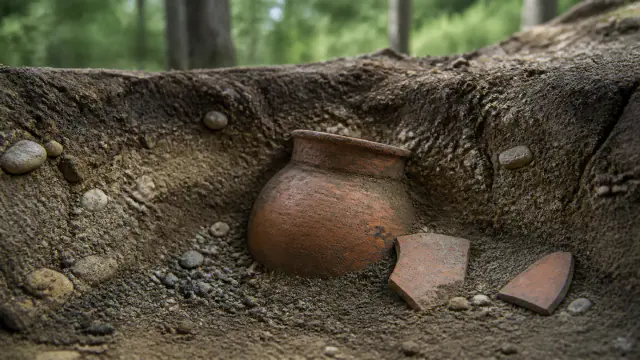
A jar found in a Tokyo neighbourhood appeared distinct and ended up giving its name to twelve centuries of history.
Read the complete record →03 · 06 · Shizuoka · a village preserved as a system
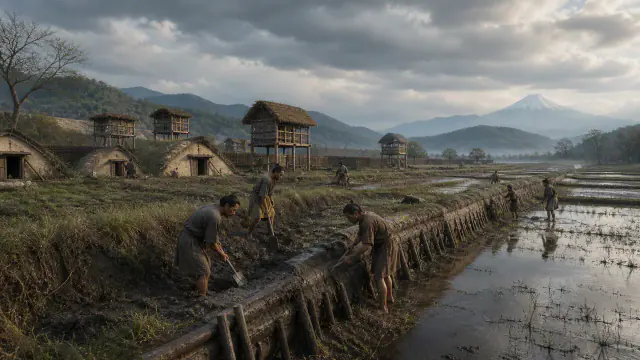
A flood preserved houses, rice fields and the wooden tools used to cultivate them.
Read the complete record →04 · 12 · Sakurai · when tombs changed scale
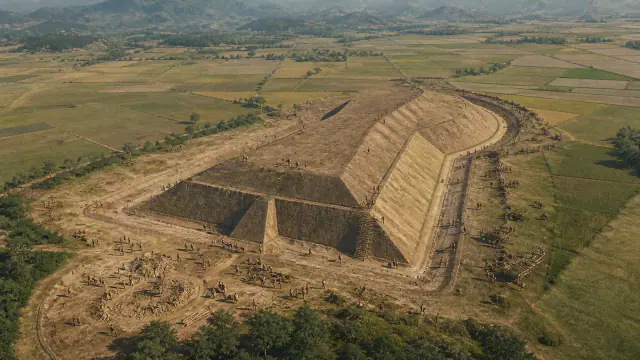
The construction of this great tomb shows a new capacity to organise labour; its relation to Himiko remains a hypothesis.
Read the complete record →03 · COLLECTION
These stops distinguish instruments, ritual actions, orality or writing and visual culture. Where there is no theatre, score or certain meaning, the museum preserves the limit.
01 · LIVING AND DOCUMENTED CULTURE · 01
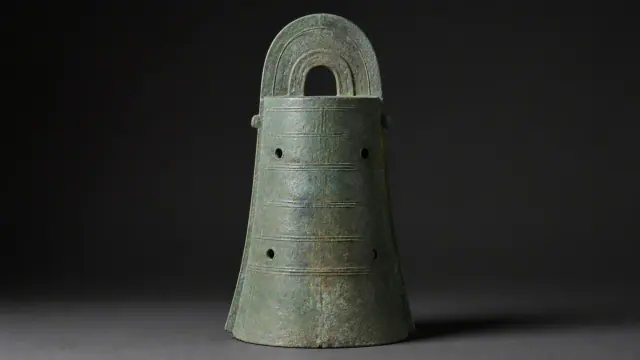
Over time, some bronze bells became larger and appear to have served more for display than for ringing.
Read the complete record →02 · LIVING AND DOCUMENTED CULTURE · 02
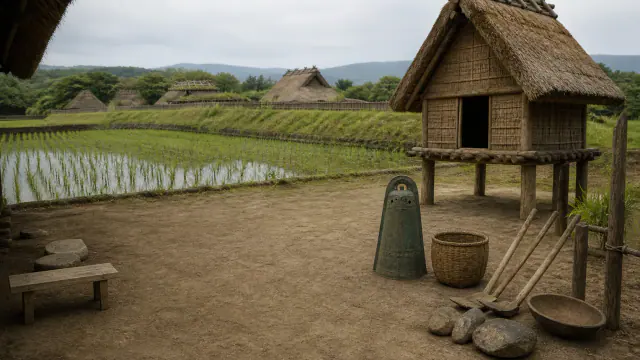
The bells, the images, and the remains of the settlements offer indications of ceremonies related to agriculture.
Read the complete record →03 · LIVING AND DOCUMENTED CULTURE · 03
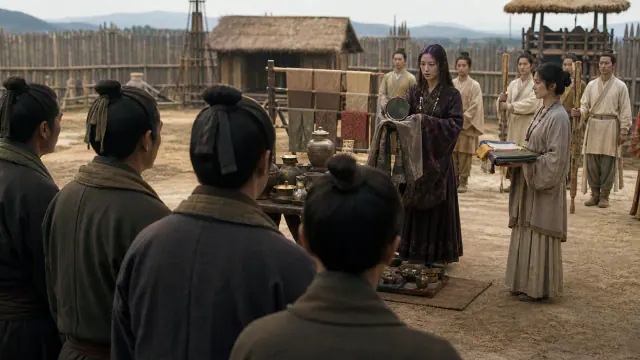
A Chinese chronicle describes Himiko and Yamatai from outside and at a late date.
Read the complete record →04 · LIVING AND DOCUMENTED CULTURE · 04
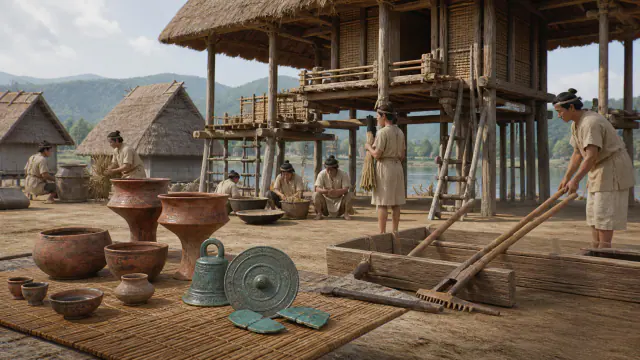
These objects help study differences in wealth and ritual practices that varied between regions.
Read the complete record →04 · COLLECTION
These architectures explain how materials, water, work and memory organized the territory without converting an elevation reconstruction into certainty.
01 · ARCHITECTURE AND LANDSCAPE · 01
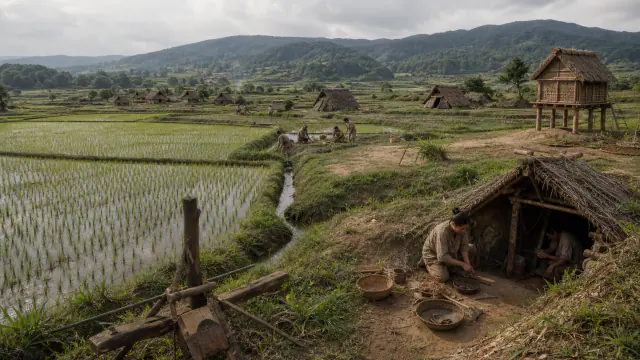
The flooded fields needed channels, tools and coordinated labour.
Read the complete record →02 · ARCHITECTURE AND LANDSCAPE · 02
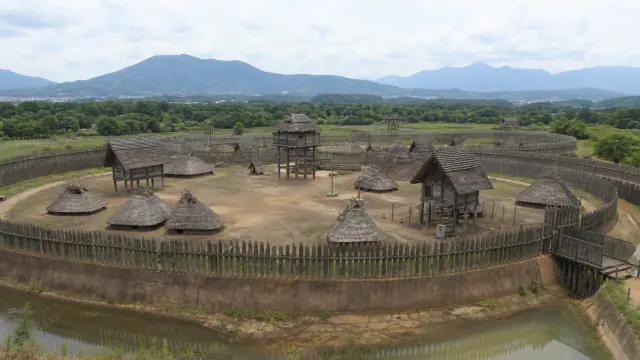
The defences and enclosures of the settlement allow one to study how it was protected and how its population was organised.
Read the complete record →03 · ARCHITECTURE AND LANDSCAPE · 03
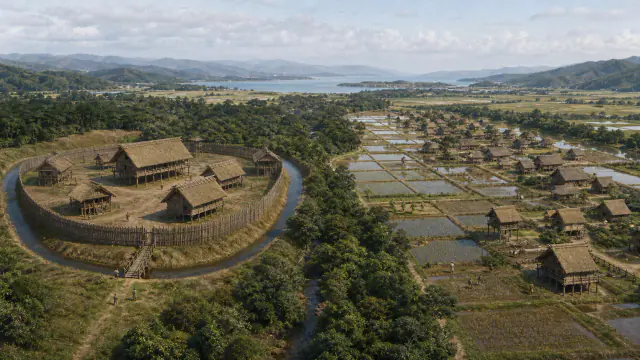
Their houses, workshops and granaries show that Yayoi life was not the same in all regions.
Read the complete record →05 · COLLECTION
Known people, reconstructed voices and collective footprints. From oldest to most recent according to life, reign or scene. The periods may overlap; The voices without a determinable date close the journey.
01 · 03 · Saga · living behind a frontier
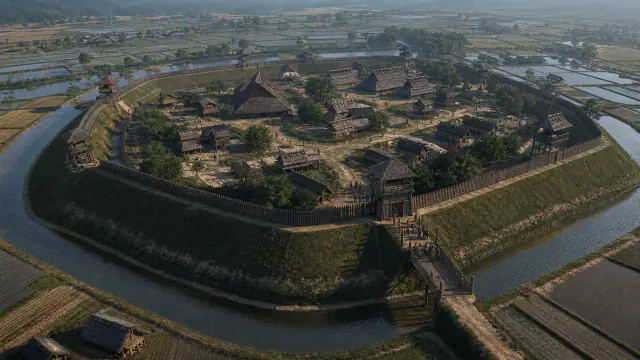
Deep ditches, palisades and towers show a community that expected threats and controlled access.
Read the complete record →02 · 08 · Itoshima · a possible woman of power
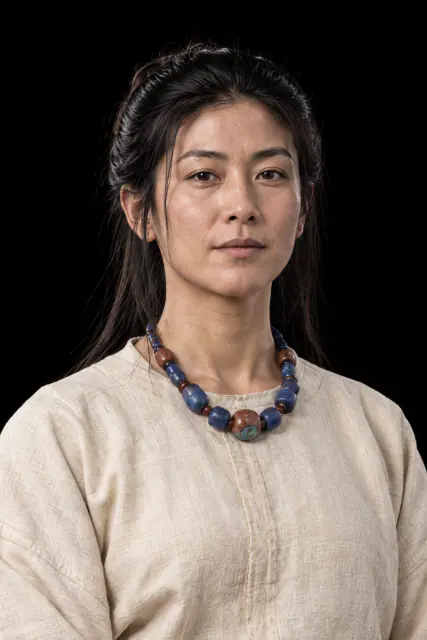
Five mirrors of 46.5 centimetres, the largest of their type in Japan, were broken before or during burial.
Read the complete record →03 · 11 · 238–239 CE · diplomacy across the sea
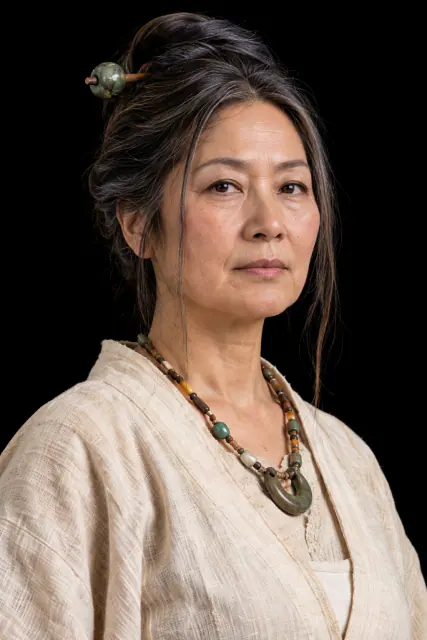
A Chinese chronicle describes a ruling woman who stabilised Wa and sent an embassy to the Wei emperor.
Read the complete record →06 · COLLECTION
Concrete pieces to understand materials, decisions and knowledge systems, with separate evidence and interpretation.
01 · 04 · Northern Kyushu · burial within pottery
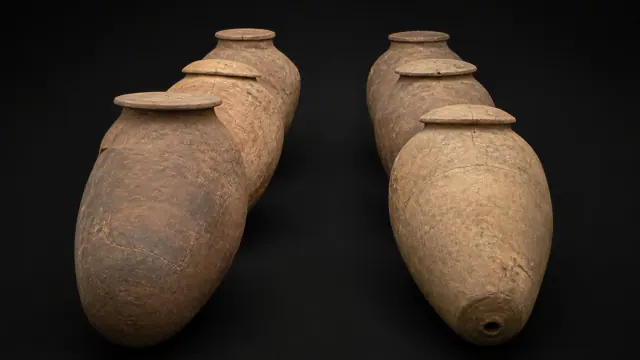
Thousands of large jars formed an ordered cemetery where children and adults received different treatments.
Read the complete record →02 · 05 · Storage · surplus is also power
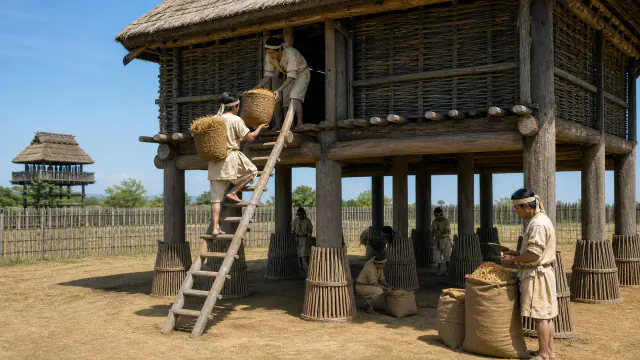
Raising the ground protected the harvest from moisture and animals, but doors controlled who could enter.
Read the complete record →03 · 07 · Shimane · bronze to be seen and then hidden
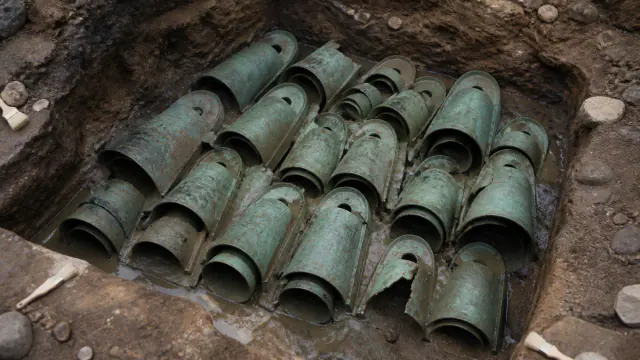
The largest known set of Yayoi bells was placed on its side on a slope and never recovered.
Read the complete record →04 · 09 · Yamaguchi · mobility, kinship and injuries
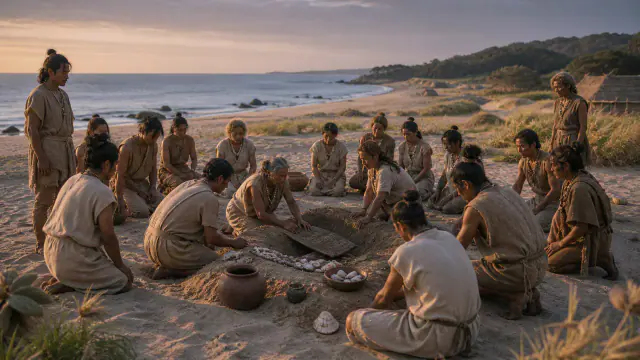
The remains of about three hundred people allow investigation of their diet, kinship and movements.
Read the complete record →05 · 10 · Nara · specialists in a large settlement
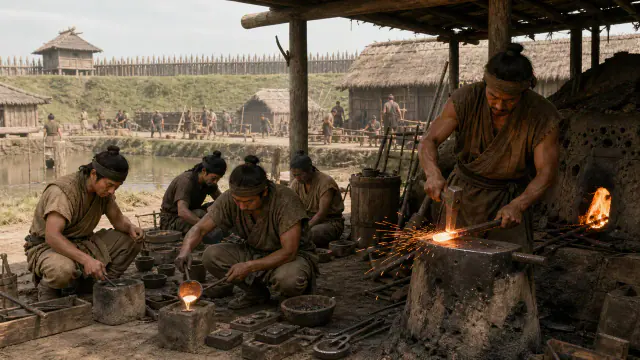
Moulds, crucibles and metal residues allow localisation of the workshops and knowledge of their work.
Read the complete record →06 · DOCUMENTED OUTFIT · CLOSED CONTEXT OR CONTROLLED COMPARISON
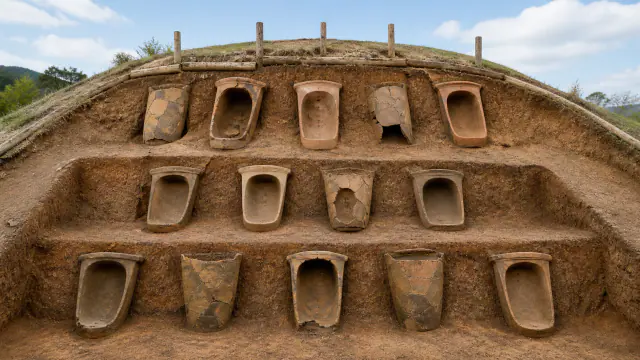
Several people were buried in large jars with swords, glass beads and other valuable objects.
Read the complete record →07 · COLLECTION
These cards separate what is documented from what is interpreted and recover practices, questions and details capable of changing our image of this culture.
01 · BELIEFS AND CURIOSITIES · 01
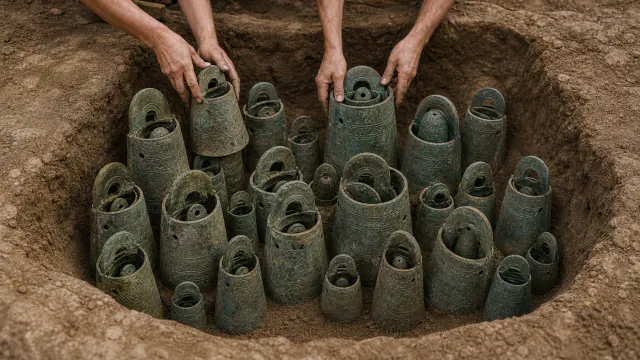
The buried bells and the accounts of Himiko offer indications of beliefs and ceremonies, but not a complete explanation.
Read the complete record →02 · BELIEFS AND CURIOSITIES · 02
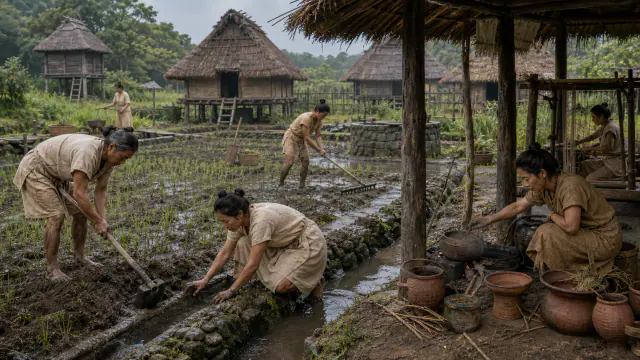
The wooden hoes, spades and rakes show how much agriculture depended on carpenters’ labour.
Read the complete record →03 · BELIEFS AND CURIOSITIES · 03
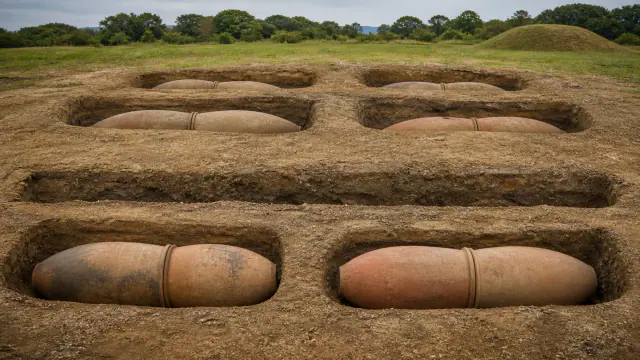
The large funerary vessels, mirror graves and coastal cemeteries show different ways of burying the dead.
Read the complete record →08 · COLLECTION
Each door explains why the link exists, when it occurred, and what limits prevent contact from being converted into shared identity.
01 · GATE 01 · ASIA · CONTACT
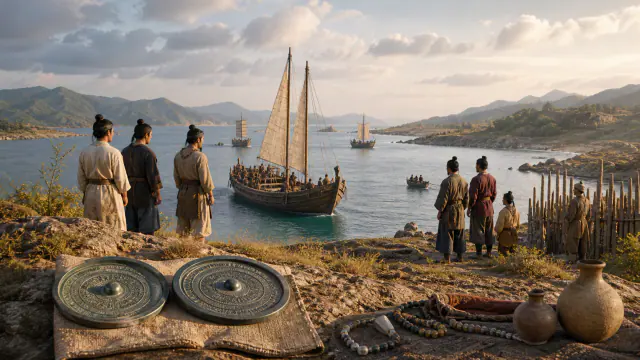
Continues in the Museum of Ancient China
Read the complete record →02 · GATE 02 · ASIA · EXCHANGE
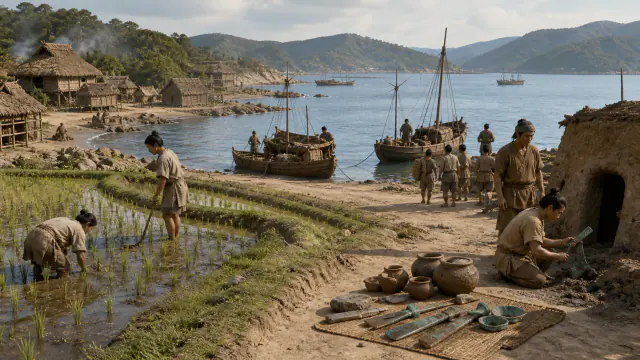
Continues at the Gojoseon Museum
Read the complete record →El arroz detrás del foso
Discover the connected fiction project. The available Prehistory reader is in Spanish; other volumes are not presented as finished products for sale.
Explore the books →Try the available Prehistory browser alpha. Campaigns for the other cultures are still in development.
Open the game (Spanish) →Use each record’s institution and heritage links to continue your research. Country-by-country historical travel guides are planned, not yet published.
Historical travel →Discover artistic designs inspired by the collections and check each product’s availability. Museum access remains free.
Explore the collection →