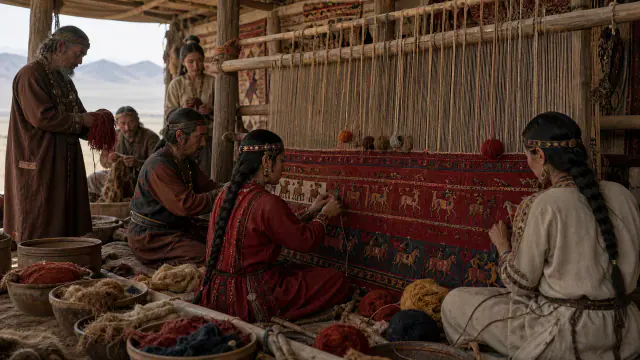
Declared visual reconstruction for museographic context; it is not a photograph of the original nor documentary evidence.
History and context
The large wool carpet shows bands of riders, deer and hybrid creatures with extraordinary technical density. The ice of kurgan 5 preserved fibres and colours that reveal highly specialised manufacture.
Its place of manufacture remains debated: motifs and technique connect the Altai with Iran and other regions. Finding it in a Pazyryk tomb demonstrates ownership and circulation, not that it was necessarily woven by the same community buried there.
The central field contains twenty-four cruciform figures formed by stylised shoots. Around it are bands of griffins, twenty-four deer and twenty-eight riders or dismounted men, a numerical structure as important as the colour.
Kurgan 5 measured about forty-seven metres in diameter and also protected a cart, felts and horses. The carpet was a Pazyryk possession in the funeral; its motifs and technique do not resolve whether it was woven locally or in an Iranian or Central Asian region.
Evidence and interpretation
Documented fact: The Hermitage preserves the carpet from kurgan 5, dated to the 5th–4th centuries BCE, made of knotted wool and preserved in ice. Interpretation and caution: workshop and region of origin continue to be debated; the find does not equal manufacturing provenance.
Expanded documented fact: Knotted wool carpet found in kurgan 5, with friezes of deer, griffins and riders, preserved by freezing.
Expanded interpretation and caution: 'The oldest in the world' means the oldest known preserved knotted-pile carpet, not the absolute invention of weaving; the workshop origin is debated.
Catalogue facts
Narrative date
5th–4th centuries BCE
Location
Kurgan 5 of Pazyryk, Altai Republic
Material
Dyed and knotted wool
Context
Organic grave goods from a frozen funerary chamber
Curatorial reading
The documented fact and its interpretation appear separately in the evidence block.
Figures
24 central motifs, 24 deer and 28 equestrian figures
Kurgan 5
Ca. 47 m diameter and 2.2 m preserved height
Colour
Reds, yellows and blues unevenly preserved
Documentary coverage
3 museum, heritage, primary corpus or research sources for this stop.
A SHARED TOPIC, DIFFERENT MOMENTS
Objects connected through time
Follow a topic across the collections. A shared tag is a way to compare objects, not proof that one culture influenced another.
The order uses the midpoint of each approximate date range; ranges can overlap. Spacing does not represent elapsed time. Swipe, scroll or use the arrows. With the sequence focused, use ← / →, Home or End.
About 1 min to read · 1 section. Further reading and sources · free access. Editorial review recorded: .
The red seen from inside a fibre
In 2021, a team examined sections of red fibres using X-ray fluorescence microscopy. The distribution of aluminium, associated with madder root dye, matched that of experimental samples of wool fermented before dyeing. That treatment facilitates pigment penetration to the fibre centre and improves its permanence. The outer layer of scales had largely disappeared in the ancient fibres, so observing the interior provided evidence that the surface no longer conserved. This is information about material preparation, not about the workshop location.

 English
 Español
 Français
 Italiano
 Deutsch
 Русский
 Português
 Polski
 Română
 Svenska
 Norsk bokmål
 Suomi
 Türkçe
 العربية
 简体中文
 한국어
 हिन्दी
 Ελληνικά