PUABI SETTINGS · INSTRUMENT · PG 800
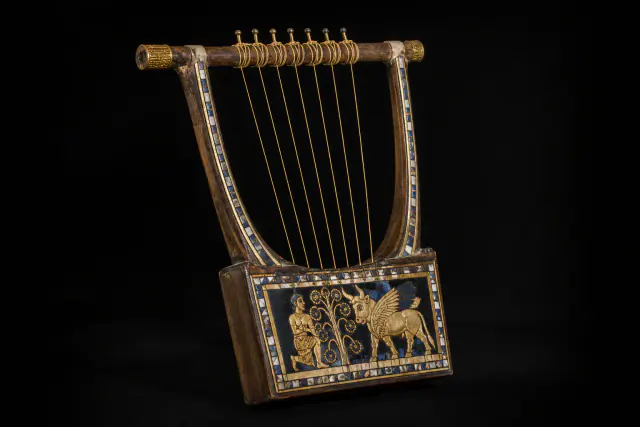
Queen's Lyre A lyre from PG 800 reconstructed around what survived
The bull's head and the inlays allowed the lyre to be reconstructed, but not its music.
ON THIS PAGE
History and context Evidence and facts Objects connected through time Further reading Where it is held Sources and references Comments Museum documentation · free public access, no account required.
⛶ Enlarge imageDECLARED VISUAL RECONSTRUCTION · EXISTING EDITORIAL RESOURCE · TRACEKEEPERS Generated reconstruction · Declared visual hypothesis
Declared visual reconstruction for museographic context; it is not a photograph of the original nor documentary evidence.
History and context The so-called Queen's Lyre comes from PG 800. The wood, arms, case and strings visible today are reconstructions; the bull's head and the shell, lapis lazuli and bitumen plates preserved essential parts of the instrument.
In the same tomb, a boat-shaped harp appeared, different from the lyre. Showing both forces conservation to be told: an archaeological instrument can be at the same time an ancient object, a negative left by lost materials, and a modern restoration decision.
Evidence and interpretation The PG 800 provenance and conserved elements are documented. We do not know its tuning, repertoire or the exact moment in which it was played; It should not be confused with the Great Lyre of PG 789.
Catalogue facts
Date ca. 2600–2500 BCE
Location PG 800 · Royal Cemetery of Ur
Preserved Bull head and antique inlays
Rebuilt Snare, arms, horns and strings Musical instruments11 Music16 Animal imagery49 Funerary contexts64
The order uses the midpoint of each approximate date range; ranges can overlap. Spacing does not represent elapsed time. Swipe, scroll or use the arrows. With the sequence focused, use ← / →, Home or End.
Earlier Later
2 / 6 In the centre: Queen's Lyre
Also connected, without a comparable date (5) These objects are not placed after the others: an unknown date does not mean a more recent object.
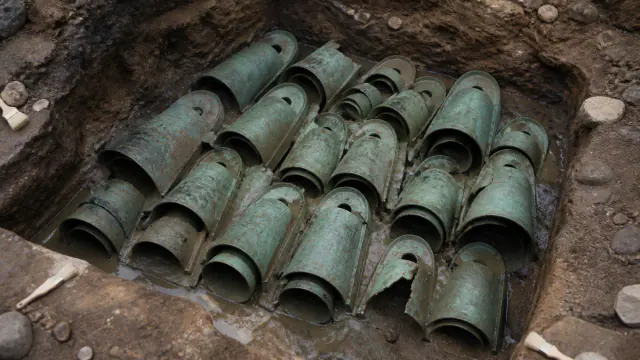
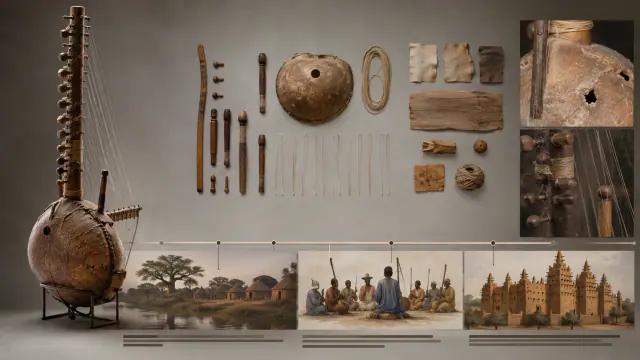
Daegok-ri grave goods Gojoseon and early Korea · from c. 5th century BCE Living m’bolon Mande Worlds · The present with historical memory Musical bows San histories · Twentieth-century ethnomusicological documentation Sosso-Bala Mande Worlds · Tradition linked through narrative to the 13th century; the present instrument and its custodianship have their own chronology Trumpet from Numantia Iberians · No individual dating published on this record You can scroll the first group without JavaScript. The other topics are also available below.
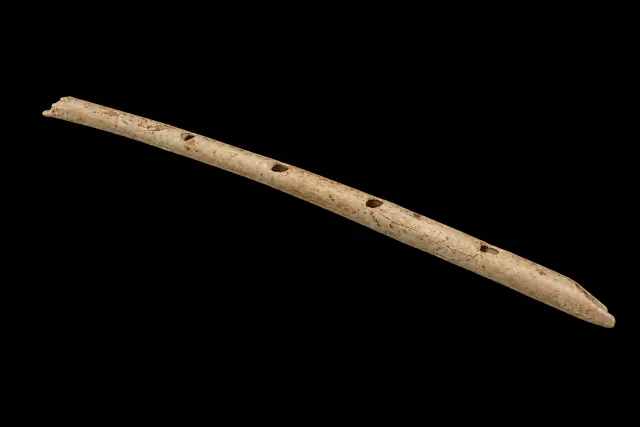
Music Hohle Fels flute · ≈35,000–40,000 years · PrehistoryQueen's Lyre · ca. 2600–2500 BCE · Sumer — You are viewingLove song to Shu-Sin · Paleo-Babylonian copy, around 1900–1600 BCE according to CDLI · SumerThe Gallery of the Conch Shells · Main use c. 800–500 BCE · Pre-Inca culturesOrpheus among the Thracians · circa 440 BCE; attributed to the London Painter E 497. · ThraciansEight voices in one hand · 3rd–2nd centuries BCE · Gojoseon and early KoreaThirty-nine buried bells · Buried towards the 1st century BCE–1st century CE · Yayoi Japan19th-century kora · 19th century · Mande WorldsTwo songs, missing names · 15 July 1952 · Batwa / Twa historiesBatwa on a colonial record · 1954 · Batwa / Twa historiesWithout a comparable date (not part of the chronological order):
Dance with weapons · Towards 400 BCE. Xenophon's story · ThraciansHealing dance · Recordings 1968–1972 · San historiesLiving m’bolon · The present with historical memory · Mande WorldsMusical bows · Twentieth-century ethnomusicological documentation · San historiesSosso-Bala · Tradition linked through narrative to the 13th century; the present instrument and its custodianship have their own chronology · Mande WorldsTrumpet from Numantia · No individual dating published on this record · IberiansAnimal imagery Lion-man · ≈40,000 years · Aurignacian · PrehistoryBefore the San · ≈25.500–23.500 BCE · San historiesBefore the name San · ≈25.500–23.500 BCE · San historiesAltamira · Assemblage ≈36,000–13,000 BP · bison ≈18,400–15,300 cal BP · PrehistoryLascaux · ≈23,500–21,000 cal BP · debated contextual estimate · PrehistoryZaraysk Bison · ≈23,000–21,000 years · PrehistoryRondelle de Mas-d'Azil · ≈18,000–16,000 years · PrehistoryLamp from La Mouthe · ≈20,500–13,000 years · Magdalenian framework · PrehistoryEngraved stone from Çakmaktepe · PPNA · site proposal: ≈9600–8800 BCE, provisional · PrehistoryCueva de las Manos · Sequence ≈9300–1300 BP · PrehistoryCylinder seal · c. 3500–3100 BCE · SumerQueen's Lyre · ca. 2600–2500 BCE · Sumer — You are viewingThe goat from PG 1237 · ca. 2600–2400 BCE · SumerIndus seals · ca. 2600–1900 BCE · Indus civilisationQueen of the Night · 19th–18th centuries BCE · SumerBull-leaping · c. 1600–1450 BCE · Greek worldsStag Vessel · 14th–13th centuries BCE · HittitesBefore the Scythians and Sakas · Final Bronze–Initial Iron, ca. 1200–600 BCE · Scythians and SakaIvory in Nimrud · 9th–8th centuries BCE · PhoeniciansLamassu of Khorsabad · Reign of Sargon II · 721–705 BCE · SumerThe Tello Obelisk · c. 800–500 BCE · Pre-Inca culturesAshurbanipal Hunt · 645–635 BCE · SumerBanquet under leopards · Around 480–470 BCE · Etruscans and RomeThe oldest knotted carpet · 5th–4th centuries BCE · Scythians and SakaThe silver amphora of Chertomlyk · 4th century BCE · Greek worldsThoth in the form of a baboon · 664–30 BCE · Ancient EgyptPoroina Mare Rhyton · Second half of the 4th century BCE · ThraciansBorovo · 4th century BC C.; 350–300 BCE in the ISAW catalog. · ThraciansLeipzig Fish Plate · Last third 4th–early 3rd century BCE · Greek worldsDove of the Amarejo · 3rd century BCE · IberiansChão de Lamas pectoral · 3rd–2nd centuries BCE · concealed in the early 1st century BCE · IberiansFibula from Lancia · ≈300–100 BCE · IberiansHorse fibula · 2nd century BCE · disputed chronology · IberiansThe dismantled cauldron · 2nd–1st centuries BCE · Celtic worldsKalathos of Alcorisa · 2nd–1st centuries BCE · IberiansEgyptian oil lamp with a fish, held in Laon · 3rd–4th centuries CE · Ancient EgyptLaon lamp with fish · 3rd–4th centuries CE · Etruscans and RomeGold rhinoceros · ca. 1220–1290; found in 1933 · Bantu-speaking worldsZimbabwe birds · main period of Great Zimbabwe, c. 12th–15th centuries · Bantu-speaking worldsWithout a comparable date (not part of the chronological order):
Funerary contexts Brno II Articulated Figure · ≈28,000 years cal BP · by funerary association · Prehistory'Jamila's' necklace · ≈7250–7000 BCE · PrehistoryThe Gold of Varna · Towards 4600–4200 BCE · ThraciansEl Miradero spatula-idols · ≈4000–3800 cal BCE · PrehistoryGuadancil idol-plaque · 3750–2500 cal BCE · IberiansStaff of Anta 4 · Late 4th–first half of the 3rd millennium BCE. · PrehistoryAbydos Boats · ca. 3000 BCE · Ancient EgyptQueen's Lyre · ca. 2600–2500 BCE · Sumer — You are viewingPuabi headdress · ca. 2600–2450 BCE · SumerStandard of Ur · ca. 2600–2400 BCE · SumerCemetery R-37 · ca. 2550–2030 BCE · Indus civilisationKerma vessel · c. 1802–1640 BCE · Nubia, Kerma and KushGrave Circle A and Chrysolakkos · 18th–16th centuries BCE · Greek worldsBurial at K IV · circa 1750–1550 BCE · Nubia, Kerma and KushBefore Vedic India · c. 1900–1300 BCE · Vedic and later Indian worldsOsmankayası and Ilıca · ca. 1700/1650–1200 BCE · HittitesTutankhamun's grave goods · death towards 1323 BCE · Ancient EgyptFu Hao’s burial goods · ca. 1200 BCE · Ancient ChinaThe voice of Ahiram · c. 11th–10th century BCE · PhoeniciansBefore Etruscans and Rome · ca. 850–800 BCE · Etruscans and RomeThe urn under the helmet · 9th–8th centuries BCE · Etruscans and RomeTomb 1 at Kuntur Wasi · c. 800 BCE · Pre-Inca culturesBeads from Cerro de los Vientos · 8th–7th centuries BCE · orientalizing · IberiansCeramic stand 1010 · 8th–7th centuries BCE · orientalizing · IberiansRegolini-Galassi tomb · ca. 675–650 BCE · Etruscans and RomeShabti of Psamtek · 570–526 BCE · Ancient EgyptTwo voices in an urn · 530–520 BCE · Etruscans and RomeThe great Greek krater of Vix · ≈530–500 BCE · Greek worldsSteppe kurgans · 7th–4th centuries BCE · Scythians and SakaVix Tomb · c. 500 BCE · Celtic worldsLa Venta grave goods · ca. 600–400 BCE · Maya worldsSarcophagus of Eshmunazar · first quarter of the 5th century BCE · PhoeniciansBanquet under leopards · Around 480–470 BCE · Etruscans and RomeTwenty-six voiceless signs · 5th–4th centuries BCE · Scythians and SakaThe oldest knotted carpet · 5th–4th centuries BCE · Scythians and SakaThe statue was the urn · First half of the 4th century BCE · IberiansGrave goods of Baza and Toya · First half of the 4th century BCE · IberiansThe Attic krater that took on a new life in Cástulo · 4th century BCE · Greek worldsThe silver amphora of Chertomlyk · 4th century BCE · Greek worldsThe Kul-Oba vase · 4th century BCE · Greek worldsSusa grave goods · c. 350 BCE · Achaemenid PersiaFaces of the Steppe · Second half of the 4th century BCE · Scythians and SakaLady of Ibiza · 4th–3rd centuries BCE · Phoenicians453 astragali from Alarcos · 4th–3rd centuries BCE · necropolis chronology · IberiansLady of Ibiza · 4th–3rd centuries BCE · IberiansFalcata from Almedinilla · 4th–3rd centuries BCE · IberiansGolyamata Kosmatka · End of the 4th century – beginning of the 3rd century BCE; ritual burial at the beginning of the III according to Iskra. · ThraciansThe blade became straight · 5th–1st centuries BCE · Gojoseon and early KoreaGeometry in very fine lines · 3rd–2nd centuries BCE · Gojoseon and early KoreaNorthern mound · 2nd–1st centuries BCE · Yayoi JapanTwo rows of coffins · Mainly Middle Yayoi, 2nd century BCE–1st century CE · Yayoi JapanKabusanza, ca. 400 · ca. 400 CE · Batwa / Twa historiesPakal’s grave goods · sealed on 28 August 683 CE · Maya worldsMissing grave goods · 13th–15th centuries according to the heritage overview · Bantu-speaking worldsWithout a comparable date (not part of the chronological order):
A closer look About 1 min to read · 1 section. Further reading and sources · free access. Editorial review recorded: September 5, 2026 .
The sound box was also a narrative surface The front plates bring together different creatures and encounters: a lion-headed eagle among gazelles, bulls next to plants, a bullman among leopards and a lion attacking a bovid. The figurative program turns the instrument into a composite image, as well as a sound producer. To recover the instrument’s position, Woolley poured plaster into the gap left by the decayed wood. The excavation thus preserved spatial relationships between incrustations that, separated from the ground, would have been much more difficult to recompose.
Where it is held Item or group in the record · Documented collection
Queen's Lyre; The institutional record indicates that it is not currently exposed.
The holding institution is documented; public display may change. Check its official record before visiting.
See Queen's Lyre in the museum Find this record in its gallery and save your route, favourites and places to explore later.
Open this exhibit in the museum → Museum access requires a free account. You can read this page's documentation without registering.
Did you enjoy this exhibit? Your opinion helps us improve the museum. You can change it whenever you like.
Loading your rating…

 English
 Español
 Français
 Italiano
 Deutsch
 Русский
 Português
 Polski
 Română
 Svenska
 Norsk bokmål
 Suomi
 Türkçe
 العربية
 简体中文
 한국어
 हिन्दी
 Ελληνικά
 You are viewing