
 English
 Español
 Français
 Italiano
 Deutsch
 Русский
 Português
 Polski
 Română
 Svenska
 Norsk bokmål
 Suomi
 Türkçe
 العربية
 简体中文
 한국어
 हिन्दी
 Ελληνικά
06 · Sound · Long-distance Exchange
The Gallery of the Conch Shells
Pacific Trumpets within the Mountain
Large marine shells were used as trumpets within the Andean sanctuary.
Museum documentation · free public access, no account required.
Generated reconstruction · Declared visual hypothesis
Declared visual reconstruction for museographic context; it is not a photograph of the original nor documentary evidence.
History and context
Pututus made from large Strombus shells were found in a temple gallery. Carved and polished, they could produce powerful tones whose direction and reverberation changed within corridors, plazas and open spaces.
The shell came from warm waters far from Chavín, so each instrument materialised a network before sounding. Acoustic studies measure their frequencies and differences; the melody, number of players and meaning of each call have been lost.
The large Strombus shells from the Gallery of the Snails came from tropical waters and were cut, polished and perforated as trumpets. Before sounding, they already materialised a long-distance network.
Studies measure the frequency and directivity of each instrument inside and outside galleries. They do not preserve repertoire, player position or a single function: summoning, guiding or startling remain plausible scenarios.
Evidence and interpretation
Documented fact: the National Chavín Museum preserves pututus from the Gallery of the Snails and Stanford has acoustically studied these instruments. Interpretation and caution: their use for guiding, startling, summoning or making the temple speak is plausible, but we do not know repertoires or exact ritual positions.
Catalogue facts
- Narrative date
- Main use c. 800–500 BCE
- Location
- Gallery of the Snails, Chavín de Huántar; tropical water shells
- Material
- Carved and polished Strombus galeatus shell
- Context
- Music, architectural acoustics and coast-highlands networks
- Curatorial reading
- The documented fact and its interpretation appear separately in the evidence block.
- Date
- Main use c. 800–500 BCE
- Location
- Gallery of the Snails, Chavín de Huántar; tropical water shells
- Support
- Carved and polished Strombus galeatus shell
- Documentary coverage
- 4 museum, heritage, primary corpus or research sources for this stop.
A SHARED TOPIC, DIFFERENT MOMENTS
Objects connected through time
Follow a topic across the collections. A shared tag is a way to compare objects, not proof that one culture influenced another.
The order uses the midpoint of each approximate date range; ranges can overlap. Spacing does not represent elapsed time. Swipe, scroll or use the arrows. With the sequence focused, use ← / →, Home or End.
Shell and mother-of-pearl8 dated objects
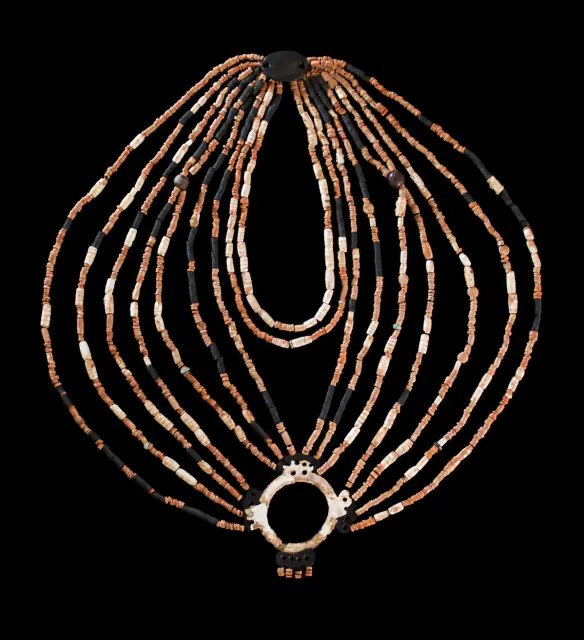
≈7250–7000 BCE
'Jamila's' necklace
Prehistory
Approximate dating according to the record.
Read the record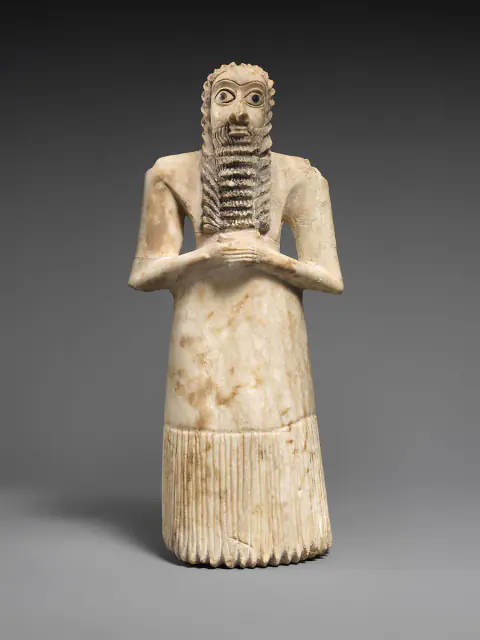
Towards 2900–2600 BCE
Worshiper of Tell Asmar
Sumer
Approximate dating according to the record.
Read the record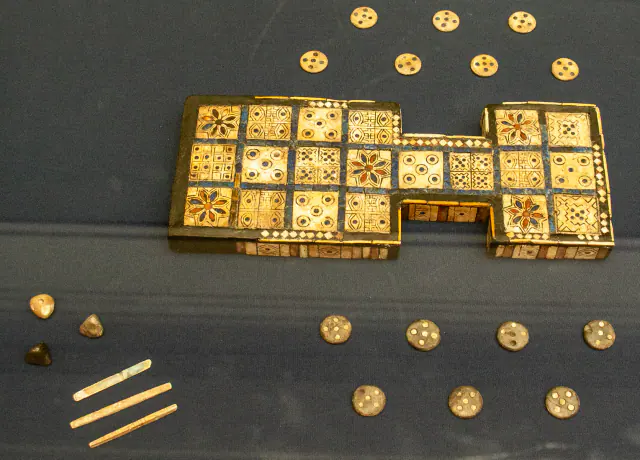
2600–2400 BCE
Royal Game of Ur
Sumer
Approximate dating according to the record.
Read the record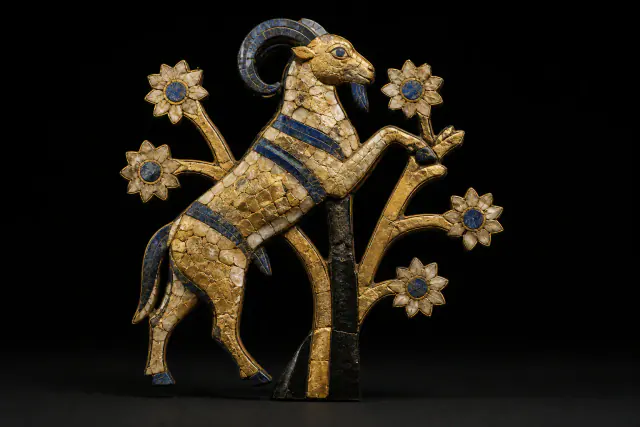
ca. 2600–2400 BCE
The goat from PG 1237
Sumer
The function as support is not resolved.
Read the record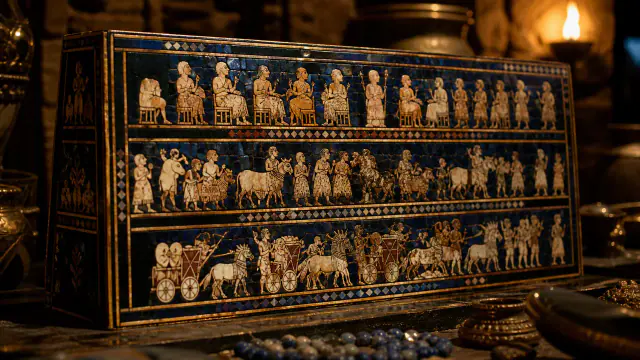
ca. 2600–2400 BCE
Standard of Ur
Sumer
Unknown function; The scenes do not prove that it was a banner.
Read the record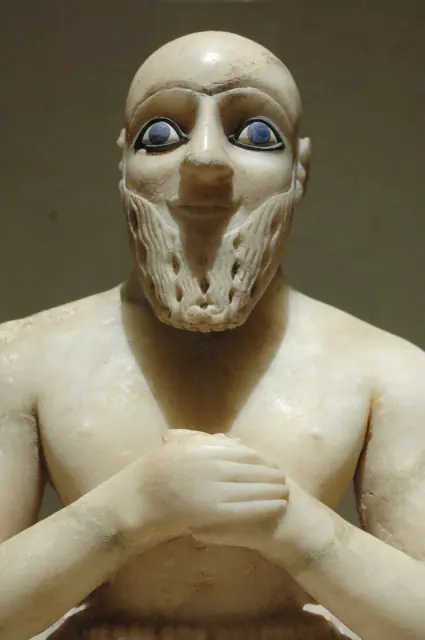
Towards 2400 BCE
Statue of Ebih-Il
Sumer
Approximate dating according to the record.
Read the record You are viewing
Main use c. 800–500 BCE
The Gallery of the Conch Shells
Pre-Inca cultures
Main period of use of the shell ensemble.
Current record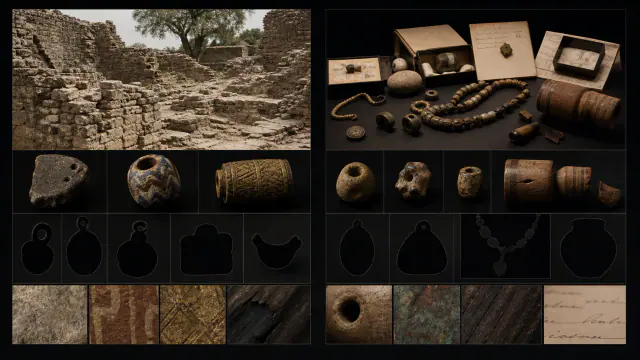
13th–15th centuries according to the heritage overview
Missing grave goods
Bantu-speaking worlds
Date range of the burial assemblage; incomplete individual inventories.
Read the record
Also connected, without a comparable date (2)
These objects are not placed after the others: an unknown date does not mean a more recent object.
- MeluhhaIndus civilisation · ca. 2600–1900 BCE
- Three hundred lives in the sandYayoi Japan · Mainly 4th century BCE–3rd century CE
A closer look
About 1 min to read · 1 section. Further reading and sources · free access. Editorial review recorded: .
A modification still without a secure explanation
The Chavín pututus preserve manufacturing modifications. Besides cutting one end to form the mouthpiece, their makers practised a V-notch on the outer edge. The exact function of this modification remains unresolved. The set found in 2001 comprised twenty decorated specimens, allowing technical solutions to be compared between pieces. This comparison is important: an isolated shell shows one form, while a contextualised collection allows recognition of repeated decisions, manufacturing differences and testable questions through experimentation, without attributing identical tuning to all instruments.
Location and territory
LOCATED SITE
Chavín de Huántar · PeruMarker of the ceremonial centre.Where it is held
National Chavín Museum
Item or group in the record · Documented collection
The institutional record lists the Chavín pututus collection.
The holding institution is documented; public display may change. Check its official record before visiting.
Sources and references
- National Chavín Museum · Pututus Collection
- Stanford Humanities Center · Acoustic study of Chavín conches
- Stanford University · Chavín archaeoacoustics research
- Ministry of Culture of Peru · Guide to museums of Peru
- Archaeology, Archaeological Institute of America · Listening to the Gods of Ancient Peru
Did you enjoy this exhibit?
Your opinion helps us improve the museum. You can change it whenever you like.
Loading your rating…