 English
 Español
 Français
 Italiano
 Deutsch
 Русский
 Português
 Polski
 Română
 Svenska
 Norsk bokmål
 Suomi
 Türkçe
 العربية
 简体中文
 한국어
 हिन्दी
 Ελληνικά
01 · INITIAL ATLAS · DIVISIONS AND REGIONS
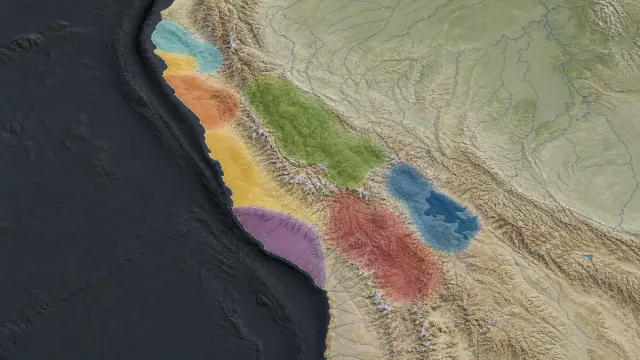
Map of Pre-Inca Cultures
Discover seven different Andean cultures that existed before Inca rule.
Read the complete record → TRACEKEEPERS
HISTORY · OPEN COLLECTION
Explore several Andean histories rather than one civilisation: Caral and Kotosh, Chavín, Nazca and Moche, Tiwanaku and Wari, and Chimú. Their timelines overlap and their landscapes and political forms differ.
29 complete records · free to read, no account needed
Read freely here. A free account saves your visits inside the museum.
Before you begin · Pre-Inca cultures
The Andean world gathered many histories of coast and highlands, connected by exchanges and distinct solutions for living in each landscape.
III millennium BCE
Great platforms and plazas testify to social organisation and public architecture in the Late Archaic.
Preceramic Period
The ceremonial architecture and crossed-hand reliefs express another early experience of the highlands.
Later millennia
Chavín and other societies develop networks and powers distinct in regions and periods that also overlap.
Long before the Incas, Andean communities coordinated food, materials and labour between different environments. During the Late Archaic, public constructions of great scale were erected. Caral-Supe, on the central coast of present-day Peru, shows that a society could organise monumental centres before incorporating pottery into daily life. The plazas and platforms retain traces of repeated encounters and collective labour.
In the highlands, Kotosh offers another early trajectory. Its ceremonial enclosures of the Preceramic period included crossed-hand reliefs. They were not mere trials for a future Inca temple: they responded to communities and practices of their own time. Caral and Kotosh allow the journey to begin with different experiences of construction and ritual, without imagining that the entire territory already obeyed a single authority.
Later, Chavín articulated an important religious and artistic language. In other periods and regions, Nazca, Moche, Tiwanaku, Wari and Chimú developed centres, crafts and powers of their own. Some were contemporaries; others were separated by centuries. 'Pre-Inca Cultures' brings together these histories for comparison, but it was not the name of a civilisation nor does it describe an inevitable march towards the Inca Empire.
The rooms compare these trajectories by means of architecture, ceramics, textiles and images, respecting their differences of place and time.
Interpreting these traces. The sequence of the route does not represent a chain of descent Caral–Chavín–Moche–Wari–Chimú–Incas.
Caral ≈3000 BCE—Chimú until ≈1470 CE · AMÉRICA
Access to the museum brings together the atlas and the antecedents of Pre-Inca Cultures. Afterwards, seven areas order the historical context, culture, architecture, persons and society, treasures and belongings, beliefs and curiosities, and a historical gateway towards other museums. Each file preserves narrative layers, cautions and differentiated sources.
The room combines a specific visual catalog with an audited thematic dossier. Separates facts, interpretations and cautions; the 3D volumes continue to be replaceable markers until models with provenance and license are incorporated.
The first wing moves from Caral and Kotosh to Chavín; the following wings open parallel chronologies for Nazca and Moche, Tiwanaku and Wari, and finally Chimú.
Kotosh and Caral must not be described as early Chavín, and none of the seven traditions should be presented as an inevitable step towards the Incas.
Read the background and its sources →EXPLORE THE COLLECTION
Follow the museum’s curated order or go straight to a section. Every record includes its full public documentation and sources.
01 · COLLECTION
Consult the maps and initial context sheets to situate this museum in time and territory; then choose the areas that interest you most.
01 · INITIAL ATLAS · DIVISIONS AND REGIONS
Discover seven different Andean cultures that existed before Inca rule.
Read the complete record →02 · BEFORE THE SEVEN TRADITIONS · LATE ARCHAIC · 3000–1500 BCE
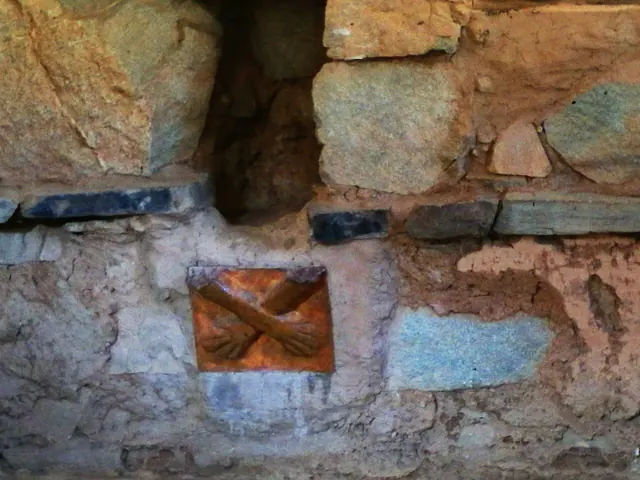
Caral and Kotosh show that public buildings were constructed in the Andes long before Chavín.
Read the complete record →02 · COLLECTION
The first stop reconstructs the area before Pre-Inca Cultures; afterwards, places and processes allow entry into its history without reducing it to a start date nor to an inevitable destination.
01 · 01 · Áncash · Convergence Centre
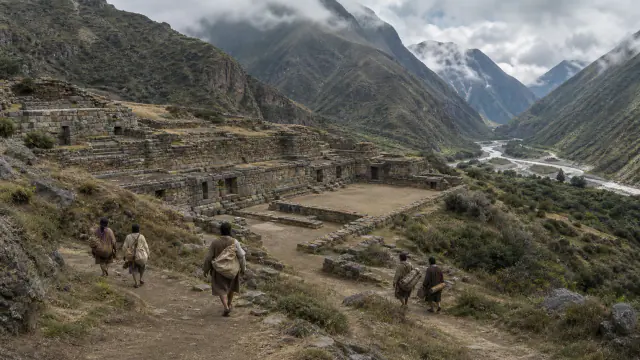
At 3,200 metres, a sanctuary gathered materials, languages and images from distant regions.
Read the complete record →02 · 02 · Old Temple · Architectural choreography
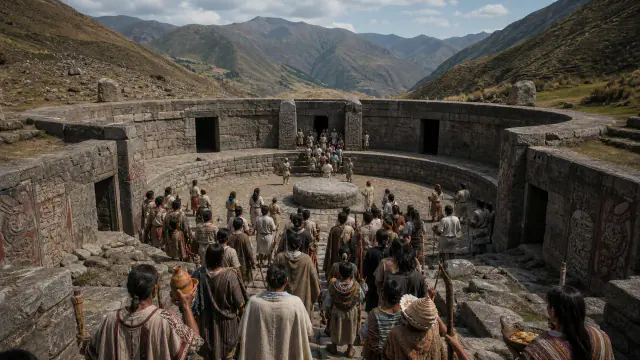
The route descended to an open circle and then led towards increasingly narrow corridors.
Read the complete record →03 · 05 · Hydraulic engineering · Mountain risk
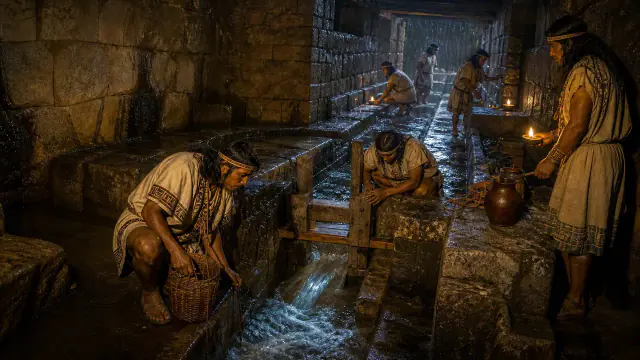
Controlling the current protected the building and could transform its sound.
Read the complete record →04 · 12 · Legacy · Network, not tree
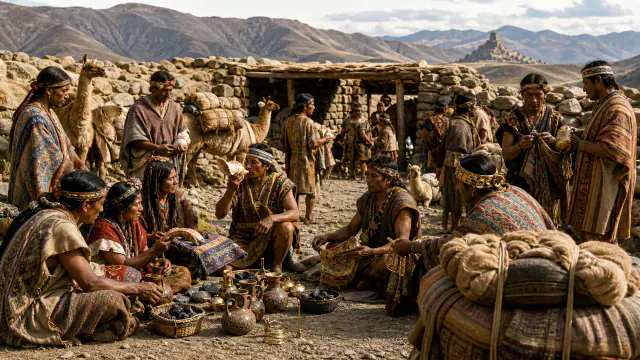
Different Andean communities shared artistic motifs without necessarily forming the same state.
Read the complete record →05 · CARAL–SUPE · FIRST URBANISM · ca. 3000–1800 BCE
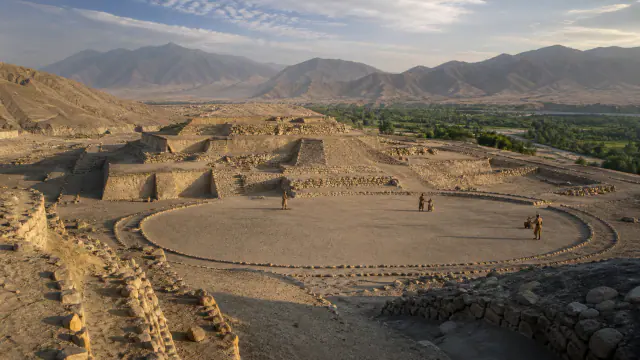
A sunken plaza brought the community together centuries before Chavín and nearly four millennia before the Tawantinsuyu.
Read the complete record →06 · TIWANAKU (TIAHUANACO) · ALTIPLANO · ca. 400–1000 CE
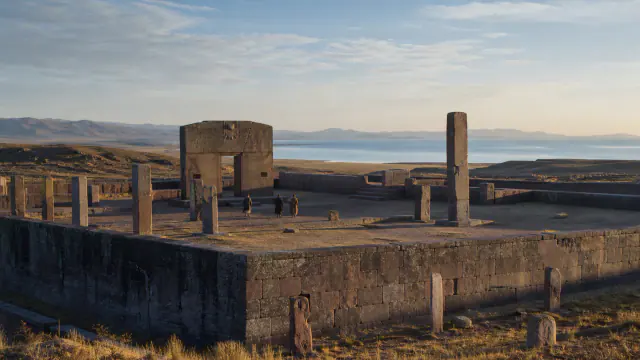
Tiwanaku combined large stone constructions with agriculture adapted to the height of Lake Titicaca.
Read the complete record →07 · WARI · MIDDLE HORIZON · ca. 550/600–1000 CE
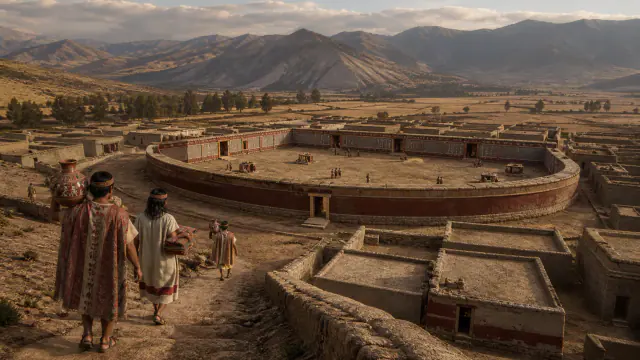
D-shaped enclosures are repeated in various centres related to Wari.
Read the complete record →08 · CHIMÚ / CHIMOR · NORTH COAST · ca. 900–1470 CE
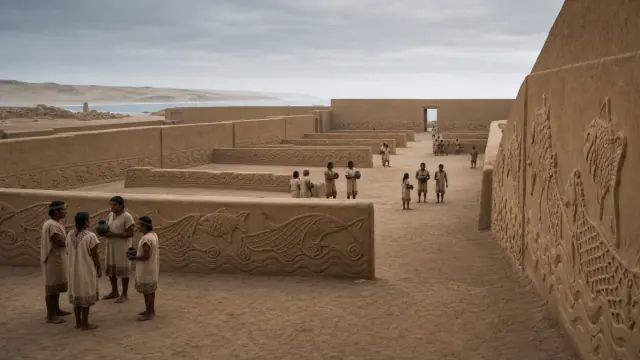
Fish, waves and nets covered mud walls in one of the world’s largest adobe cities.
Read the complete record →03 · COLLECTION
These stops distinguish instruments, ritual actions, orality or writing and visual culture. Where there is no theatre, score or certain meaning, the museum preserves the limit.
01 · LIVING AND DOCUMENTED CULTURE · 01
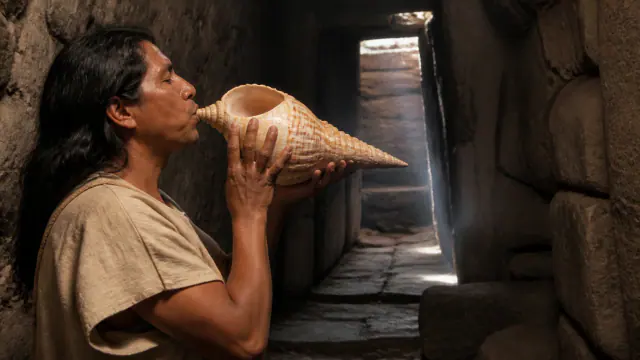
At Chavín, conch-shell trumpets were found; other Andean cultures had their own instruments.
Read the complete record →02 · LIVING AND DOCUMENTED CULTURE · 02
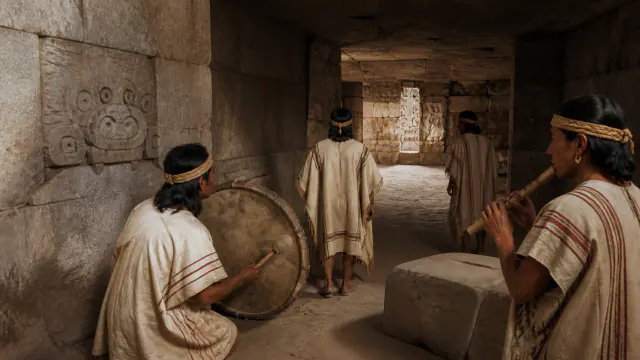
The galleries and plazas of Chavín changed what participants could see and hear during ceremonies.
Read the complete record →03 · LIVING AND DOCUMENTED CULTURE · 03
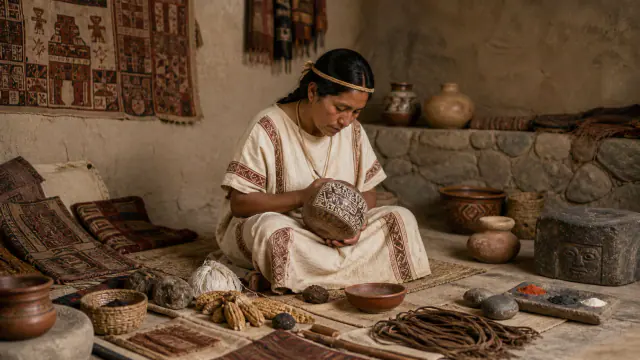
Textiles, ceramics and geoglyphs communicated ideas, but we do not know of a common deciphered phonetic writing.
Read the complete record →04 · LIVING AND DOCUMENTED CULTURE · 04
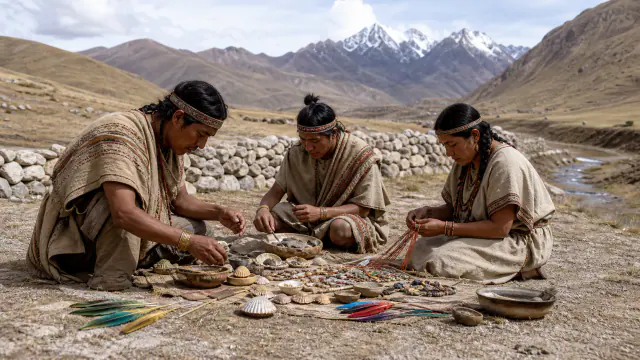
Feathers, shells, metals and fibres travelled between the coast, the highlands and the jungle to become objects.
Read the complete record →04 · COLLECTION
These architectures explain how materials, water, work and memory organized the territory without converting an elevation reconstruction into certainty.
01 · ARCHITECTURE AND LANDSCAPE · 01
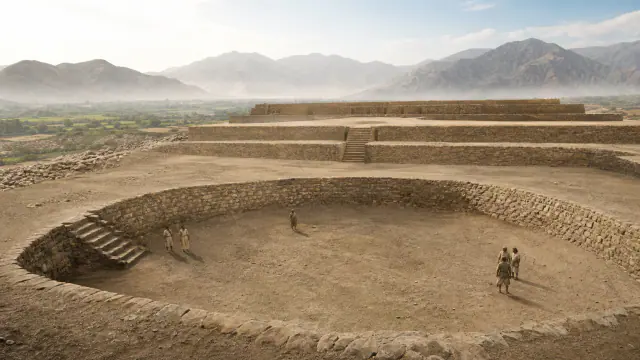
Caral formed part of a network of settlements with plazas and large platforms in the Supe Valley.
Read the complete record →02 · ARCHITECTURE AND LANDSCAPE · 02
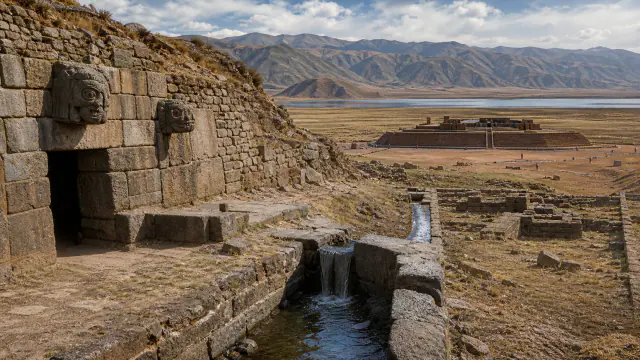
Chavín and Tiwanaku built large stone buildings in different places and periods.
Read the complete record →03 · ARCHITECTURE AND LANDSCAPE · 03
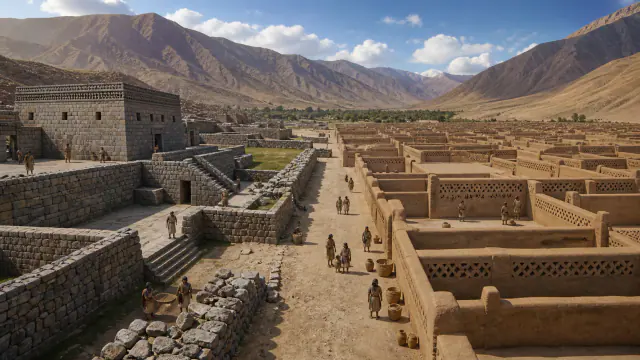
Wari and Chan Chan organised their storehouses, enclosures and ceremonial spaces in different ways.
Read the complete record →05 · COLLECTION
Known people, reconstructed voices and collective footprints. From oldest to most recent according to life, reign or scene. The periods may overlap; The voices without a determinable date close the journey.
01 · 04 · Galleries · Light, sound and authority
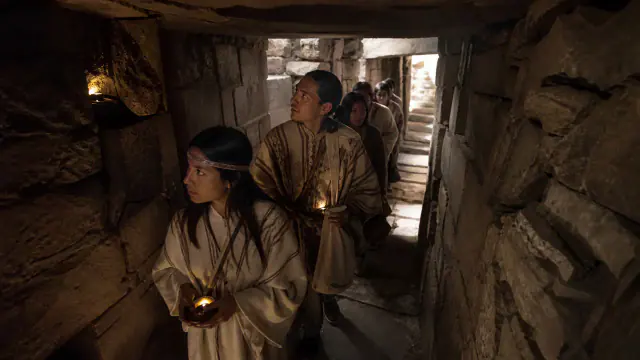
The interior passages of Chavín altered light, sound and orientation.
Read the complete record →02 · MOCHE (MOCHICA) · HISTORICAL PERSON · ca. 260–300 CE
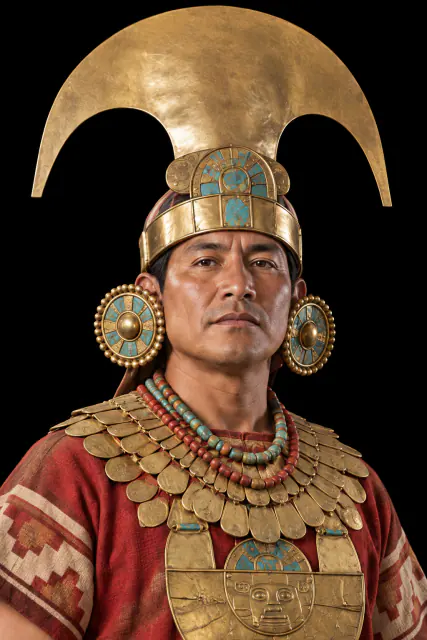
The jewellery and emblems from the tomb show the importance of the Lord of Sipán, although we do not know his name.
Read the complete record →06 · COLLECTION
Concrete pieces to understand materials, decisions and knowledge systems, with separate evidence and interpretation.
01 · 03 · Lanzón Gallery · Monolith
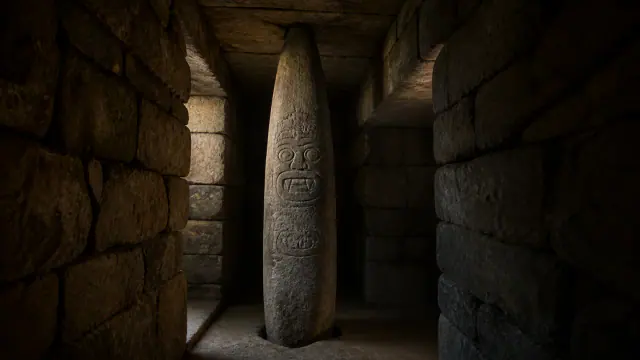
The Lanzón is a granite sculpture over four metres tall, installed inside a gallery at Chavín.
Read the complete record →02 · 06 · Sound · Long-distance Exchange
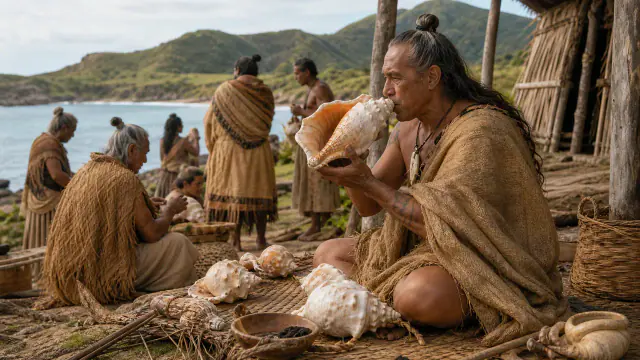
Large marine shells were used as trumpets within the Andean sanctuary.
Read the complete record →03 · 07 · Rival Contour · Expert Perception
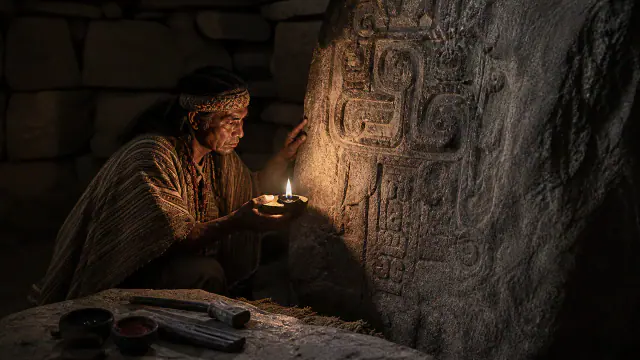
Some lines on the Raimondi Stele form more than one figure depending on how the image is viewed.
Read the complete record →04 · 08 · Iconography · Fertile and Predatory World
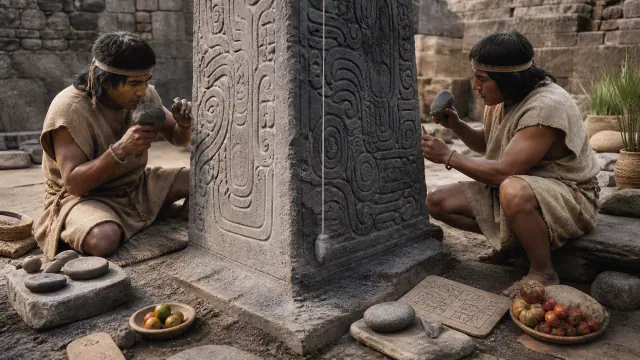
A single stone brings together bodies that appear human, crocodilian, feline, avian and cultivated.
Read the complete record →05 · 09 · Clava heads · Debated transformation
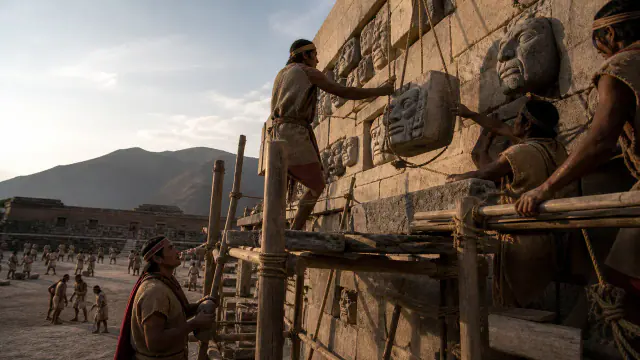
The heads set into the walls mix human features with fangs, snakes and other details.
Read the complete record →06 · 10 · Cajamarca · Regional network, not colony
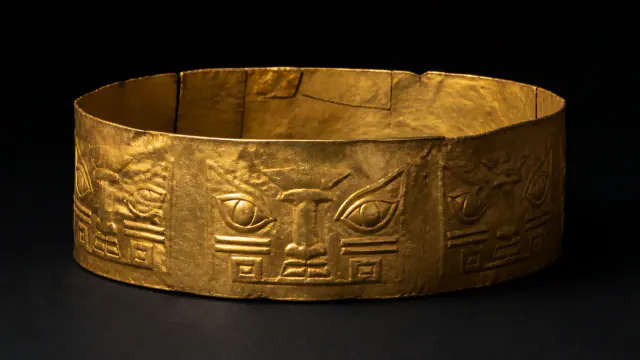
The jewellery from Kuntur Wasi shares motifs with other regions, without proving dependence on Chavín.
Read the complete record →07 · 11 · South coast · Portable medium
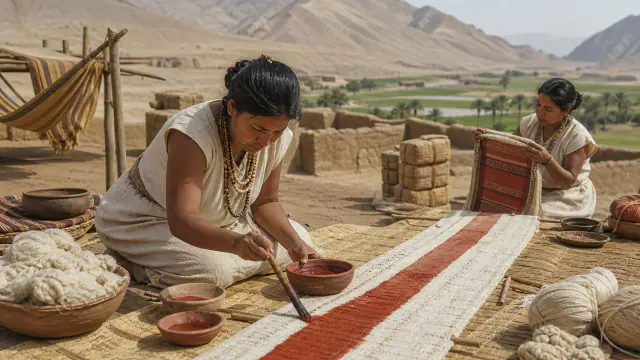
This textile from the coast carries a painted figure similar to Chavín representations.
Read the complete record →08 · DOCUMENTED OUTFIT · CLOSED CONTEXT OR CONTROLLED COMPARISON
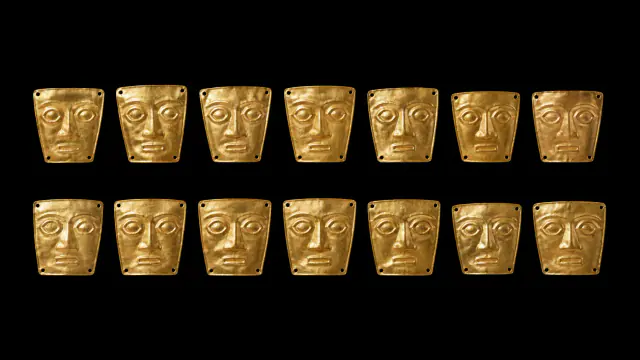
The tombs at Kuntur Wasi preserved a gold crown, other ornaments, beads and ceramics.
Read the complete record →07 · COLLECTION
These cards separate what is documented from what is interpreted and recover practices, questions and details capable of changing our image of this culture.
01 · NAZCA (NASCA) · SOUTHERN COAST · c. 100 BCE–700/800 CE
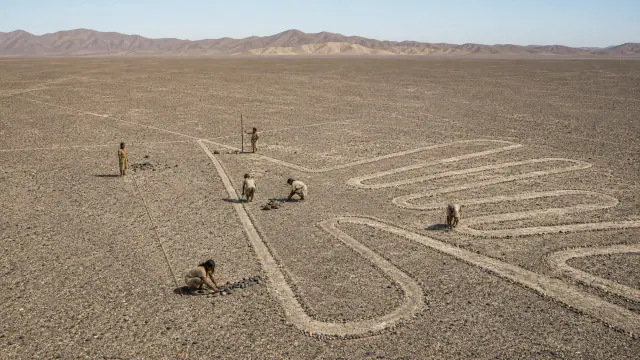
The geoglyphs were made by removing dark stones to leave the light desert soil visible.
Read the complete record →08 · COLLECTION
Each door explains why the link exists, when it occurred, and what limits prevent contact from being converted into shared identity.
01 · GATE 01 · AMERICA · CAUTIOUS COMPARISON
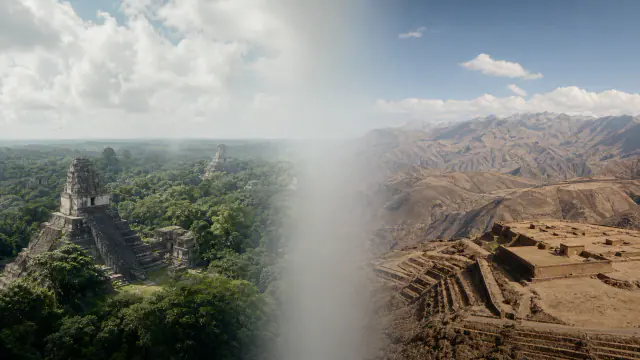
Continues in the Maya museum
Read the complete record →La piedra que reunía montañas
Discover the connected fiction project. The available Prehistory reader is in Spanish; other volumes are not presented as finished products for sale.
Explore the books →Try the available Prehistory browser alpha. Campaigns for the other cultures are still in development.
Open the game (Spanish) →Use each record’s institution and heritage links to continue your research. Country-by-country historical travel guides are planned, not yet published.
Historical travel →Discover artistic designs inspired by the collections and check each product’s availability. Museum access remains free.
Explore the collection →