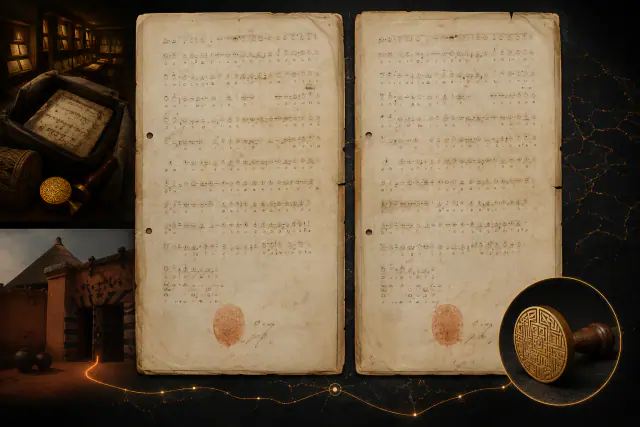
Declared visual reconstruction for museographic context; it is not a photograph of the original nor documentary evidence.
History and context
The Venus pages of the Dresden Codex organise five synodic periods of 584 days, a total of 2,920 days close to eight solar years. The planet's appearances and disappearances are linked to omens and ritual actions, not to astronomy separate from society.
Internal corrections allowed the table to be used over long intervals. The preserved manuscript is Postclassic and likely copied older knowledge; it does not represent all Maya scribes nor demonstrate modern observation with optical instruments.
Five Venus periods of 584 days sum to 2,920 days, nearly eight solar years, and the pages incorporate adjustments to prolong the table's use. The cycle organises omen and ritual action alongside calculation.
The preserved manuscript is Postclassic and likely gathers older knowledge; it is not a modern observatory notebook. Telescopes, current decimals, and the idea of prediction separate from religion must be avoided.
Evidence and interpretation
Documented fact: The SLUB Dresden identifies in the codex calendrical, eclipse, and Venus tables based on a 584-day period and extended cycles. Interpretation and caution: The dates of copying and knowledge layers are debated; "exact prediction" must be understood within Maya calendrical and ritual conventions.
3 museum, heritage, primary corpus or research sources for this stop.
A SHARED TOPIC, DIFFERENT MOMENTS
Objects connected through time
Follow a topic across the collections. A shared tag is a way to compare objects, not proof that one culture influenced another.
The order uses the midpoint of each approximate date range; ranges can overlap. Spacing does not represent elapsed time. Swipe, scroll or use the arrows. With the sequence focused, use ← / →, Home or End.
About 1 min to read · 1 section. Further reading and sources · free access. Editorial review recorded: .
Material history affects reading
The Dresden Codex was divided into two strips and placed between glass in 1835 to protect and display it. During the destruction of the Japanese Palace in 1945, water penetrated the storage where it was kept; when the glass was separated to dry it, parts of the lime preparation adhered. Three leaves were mistakenly replaced rotated. The SLUB documents these interventions because the order and conservation of the pages matter when studying its tables. The manuscript we consult combines the work of Maya scribes with a later history of mounting, damage and conservation.
Northern Yucatán, probable provenance; today Dresden, GermanyGulf Olmec coast and Maya lands brought together in a museum; contact does not equal lineal descent. The footprint marks the orienting centre of the scope, not a boundary nor an exact point.

 English
 Español
 Français
 Italiano
 Deutsch
 Русский
 Português
 Polski
 Română
 Svenska
 Norsk bokmål
 Suomi
 Türkçe
 العربية
 简体中文
 한국어
 हिन्दी
 Ελληνικά
 You are viewing