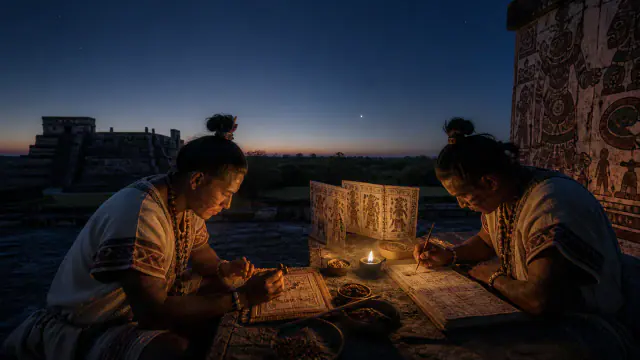
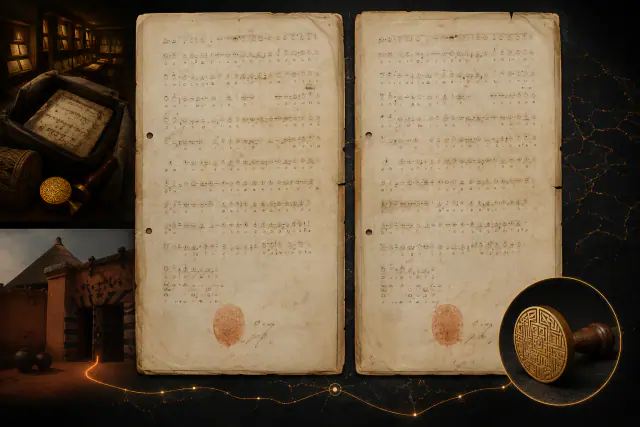
Declared visual reconstruction; not a photograph of the original nor documentary evidence.
History and context
The notebooks used phonetic signs, translations and annotations to record languages that the collectors were learning.
Comparing original, transcription and edition allows us to see decisions, gaps and power. Digitising does not make a colonial archive neutral.
The notebooks place |Xam text, glosses, translations and notes in layers that do not always coincide. The facsimile allows examination of deletions, doubts and editorial decisions.
Digitisation improves access and traceability, but does not recover tone, full situation or consent according to current criteria. Document and experience are not equivalent.
Evidence and interpretation
The documentary layers are comparable at UCT. Intention and full experience of the speakers cannot be recovered solely from the paper.
Catalogue facts
Narrative date
19th century–current digital edition
Location
Bleek-Lloyd Archive · UCT
Material
Paper, ink and digital facsimile
Context
History of the archive
Curatorial reading
The documented fact and its interpretation appear separately in the evidence block.
Support
Handwritten notebooks and digital facsimiles
Layers
Transcription, gloss, translation and edition
Documentary coverage
2 museum, heritage, primary corpus or research sources for this stop.
A SHARED TOPIC, DIFFERENT MOMENTS
Objects connected through time
Follow a topic across the collections. A shared tag is a way to compare objects, not proof that one culture influenced another.
The order uses the midpoint of each approximate date range; ranges can overlap. Spacing does not represent elapsed time. Swipe, scroll or use the arrows. With the sequence focused, use ← / →, Home or End.
THE CURRENT OBJECT
Its date is not sufficiently established to place it on the timeline. We keep it here, separate from the dated objects.
About 1 min to read · 1 section. Further reading and sources · free access. Editorial review recorded: .
A letter passes through several hands
The C15.02 letter in the archive preserves a message that Diaǃkwain dictated to Lucy Lloyd in August 1875 for her sister ǃkweiten ta ǁken. He wanted to know whether she and her family had returned safely and why he was not receiving news. The intended route passed via Doctor Meyer in Calvinia and another intermediary in Middlepost. This piece shows what writing could serve besides recording narratives: attempting to maintain distant bonds. Its transmission required a narrator, scribe, translation and people capable of delivering the message.
Institutional archive of notebooks, drawings, correspondence and other holdings; the record refers to the archive and not to a single archaeological piece.
The holding institution is documented; public display may change. Check its official record before visiting.

 English
 Español
 Français
 Italiano
 Deutsch
 Русский
 Português
 Polski
 Română
 Svenska
 Norsk bokmål
 Suomi
 Türkçe
 العربية
 简体中文
 한국어
 हिन्दी
 Ελληνικά
 You are viewing