
 English
 Español
 Français
 Italiano
 Deutsch
 Русский
 Português
 Polski
 Română
 Svenska
 Norsk bokmål
 Suomi
 Türkçe
 العربية
 简体中文
 한국어
 हिन्दी
 Ελληνικά
20 · Treasure · legal heritage
Eleven articles
African ruling on Kahuzi-Biega
The African Commission ordered redress for violations of Batwa communities' rights; verifying compliance is a separate task.
Museum documentation · free public access, no account required.
Generated reconstruction · Declared visual hypothesis
IA-RECREATED DOCUMENT · ordered remedies, compliance not proven
History and context
The African Commission declared that the DRC violated eleven articles of the African Charter concerning Batwa communities of Kahuzi-Biega.
It ordered restitution, customary title, reparation, benefits, apology, employment and participation. Each measure must be marked as ordered or verified.
Evidence and interpretation
Communication 588/15, primary decision of the ACHPR.
Catalogue facts
- Narrative date
- Adopted April–May 2022; public portal 2025
- Location
- Kahuzi-Biega, South Kivu, DRC; African Commission
- Material
- Digital legal document
- Context
- Do not confuse adoption, publication and implementation.
- Curatorial reading
- The documented fact and its interpretation appear separately in the evidence block.
- Dossier axis
- treasures
- Research record
- BATWA · treasure-kahuzi-biega-decision
- Documentary coverage
- 1 museum source, heritage, primary corpus or research for this stop.
A SHARED TOPIC, DIFFERENT MOMENTS
Objects connected through time
Follow a topic across the collections. A shared tag is a way to compare objects, not proof that one culture influenced another.
The order uses the midpoint of each approximate date range; ranges can overlap. Spacing does not represent elapsed time. Swipe, scroll or use the arrows. With the sequence focused, use ← / →, Home or End.
Archives and documents8 dated objects
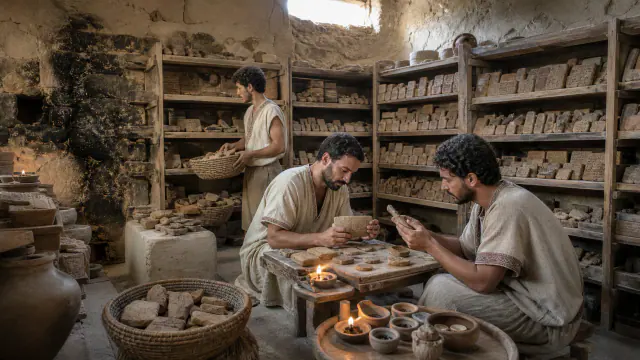
Above all 17th–13th centuries BCE
Boğazköy Archive
Hittites
Main date range for the archive, not a single date for all the tablets.
Read the record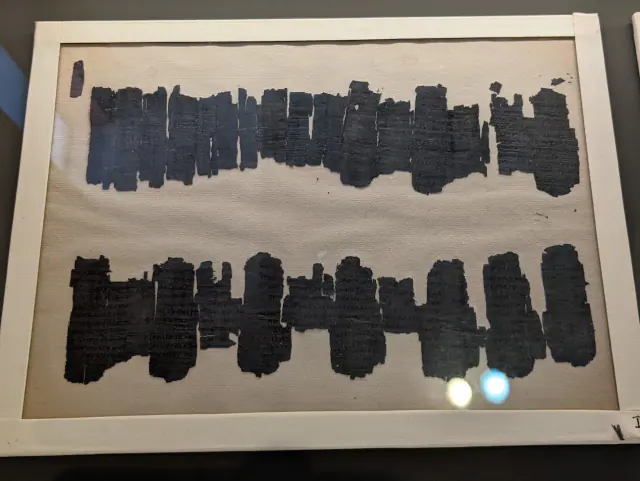
copy conserved towards 340–320 BCE; comments on a previous text.
Derveni Papyrus
Thracians
Date of preserved copy; The commented text is previous.
Read the record
Preserved manuscript: Postclassic, probably 13th–14th centuries; earlier knowledge
Venus in the codex
Maya worlds
Probable date of the preserved manuscript, not of the origin of its knowledge.
Read the record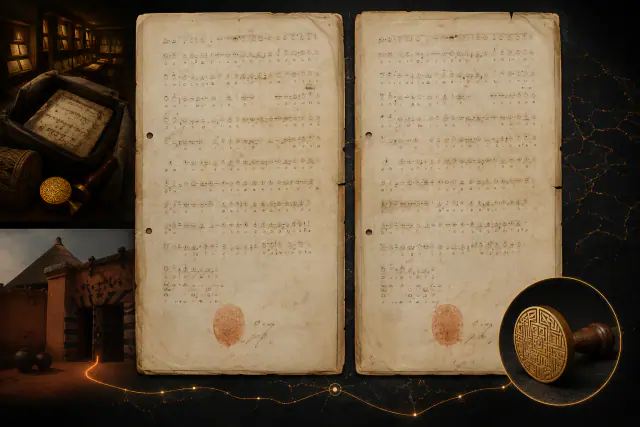
28 April 1922
Bamum document
Bantu-speaking worlds
Year of the document dated 28 April.
Read the record
15 July 1952
Two songs, missing names
Batwa / Twa histories
Date of the concrete recording, not antiquity of the songs.
Read the record
1954
Batwa on a colonial record
Batwa / Twa histories
Date of the disc and its record, not of the origin of the musical tradition.
Read the record
2012–2013
A map with the right to be closed
Batwa / Twa histories
Date of the process and participatory cartographic document, not of the territory's occupation.
Read the record You are viewing
Adopted April–May 2022; public portal 2025
Eleven articles
Batwa / Twa histories
Year of adoption of the decision; the portal's publication in 2025 is subsequent.
Current record
Also connected, without a comparable date (10)
These objects are not placed after the others: an unknown date does not mean a more recent object.
- 49 Classical VoicesIberians · Authors and traditions between the 6th century BCE and 4th century CE
- Before Bantu WorldsBantu-speaking worlds · Modern linguistic reconstruction on historical and living languages
- Dance with weaponsThracians · Towards 400 BCE. Xenophon's story
- Kumbi SalehMande Worlds · medieval occupation; prominent phases between the 11th and 13th centuries
- Shum LakaBantu-speaking worlds · c. 8,000 and 3,000 years before present
- The Banquet of Seuthes IIThracians · Towards 400 BCE. Anabasis episode
- The cost of transcriptionSan histories · 19th century–current digital edition
- Translating faithBantu-speaking worlds · 16th–18th centuries
- Voices from outsideGaramantes · Fifth century BCE–Late Antiquity
- ZalmoxisThracians · testimony of Herodotus, 5th century BCE; no biographical date of the divinity.
A closer look
About 1 min to read · 1 section. Further reading and sources · free access. Editorial review recorded: .
Why culture cannot be reduced to ceremonies
In paragraphs 180–184, the African Commission develops a broad notion of culture: it includes language, housing, forms of subsistence, economic practices, shared values and modes of resolving conflicts, in addition to rituals. This reasoning is decisive for understanding a claim linked to the forest. Territorial loss can alter a way of living and transmitting knowledge even if no monumental building exists to protect. The decision thus connects cultural protection with collective identity and the material conditions of its continuity; it does not treat heritage merely as a collection of objects or spectacles.
Sources and references
Did you enjoy this exhibit?
Your opinion helps us improve the museum. You can change it whenever you like.
Loading your rating…