
 English
 Español
 Français
 Italiano
 Deutsch
 Русский
 Português
 Polski
 Română
 Svenska
 Norsk bokmål
 Suomi
 Türkçe
 العربية
 简体中文
 한국어
 हिन्दी
 Ελληνικά
14 · SENSITIVE EVIDENCE · ANCIENT DNA
Shum Laka
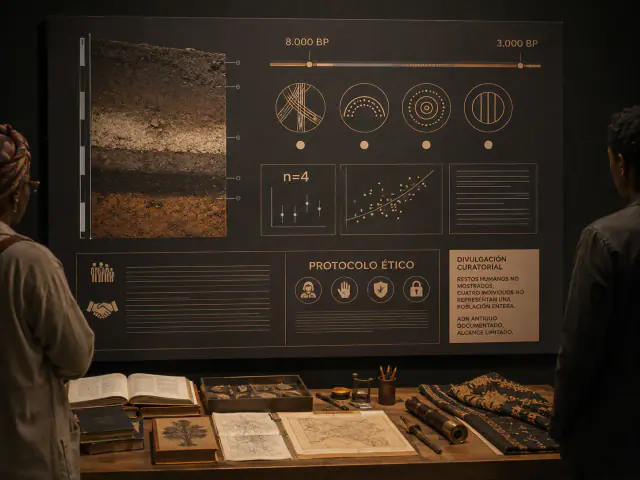
The four children buried at Shum Laka
Their remains allow us to investigate the ancient population of the region without attributing to them a language we do not know.
Museum documentation · free public access, no account required.
Editorial visualisation · Contextual correspondence
Declared editorial visualisation, based on the cartography and sources of the fact sheet; it is not an exact historical frontier.
History and context
Four children were buried at Shum Laka in two periods, around eight thousand and three thousand years ago.
Their genomes are related to those of west-central African hunter-gatherers and require site, language and ancestry to be considered separately.
Evidence and interpretation
Authenticated DNA and dates for four individuals. The sample is too small to represent the entire regional population.
Catalogue facts
- Narrative date
- c. 8,000 and 3,000 years before present
- Location
- Shum Laka, Cameroon Grassfields
- Material
- Burial context, human remains and genomic data
- Context
- The distinction between geographical proximity and ancestry
- Curatorial reading
- The documented fact and its interpretation appear separately in the evidence block.
- Dossier axis
- treasures
- Research record
- BANTU · bantu-treasure-shum-laka
- Documentary coverage
- 2 museum, heritage, primary corpus or research sources for this stop.
A SHARED TOPIC, DIFFERENT MOMENTS
Objects connected through time
Follow a topic across the collections. A shared tag is a way to compare objects, not proof that one culture influenced another.
The order uses the midpoint of each approximate date range; ranges can overlap. Spacing does not represent elapsed time. Swipe, scroll or use the arrows. With the sequence focused, use ← / →, Home or End.
THE CURRENT OBJECT
Its date is not sufficiently established to place it on the timeline. We keep it here, separate from the dated objects.
 You are viewing
c. 8,000 and 3,000 years before present
Shum Laka
Bantu-speaking worlds
Two separate groups of samples; the gap between them is not converted into a single date range.
Current recordHuman remains and bioarchaeology3 dated objects
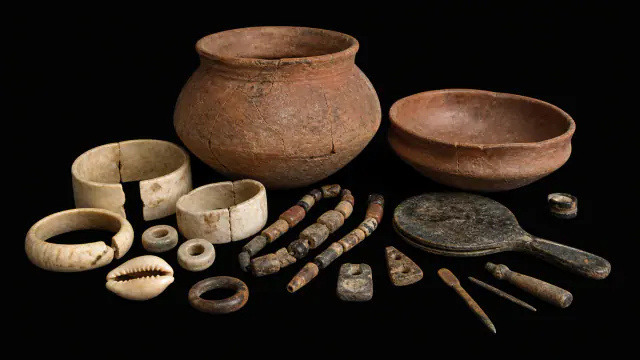
ca. 2550–2030 BCE
Cemetery R-37
Indus civilisation
Interval of the cemetery and its funerary group.
Read the record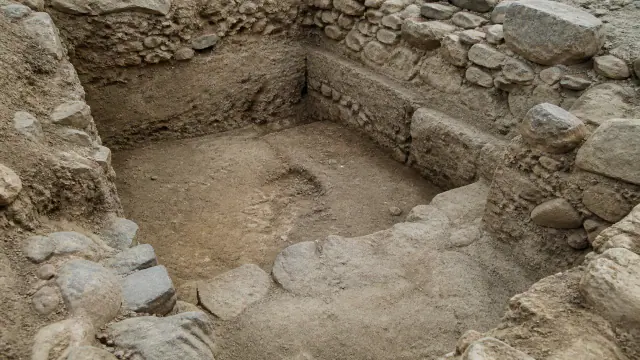
ca. 1700/1650–1200 BCE
Osmankayası and Ilıca
Hittites
The envelope of the explicit numerical alternatives is used as an orientative ordering framework: start towards 1700 or 1650 BCE and end towards 1200 BCE; framework of funerary assemblages, not a single manufacturing date.
Read the record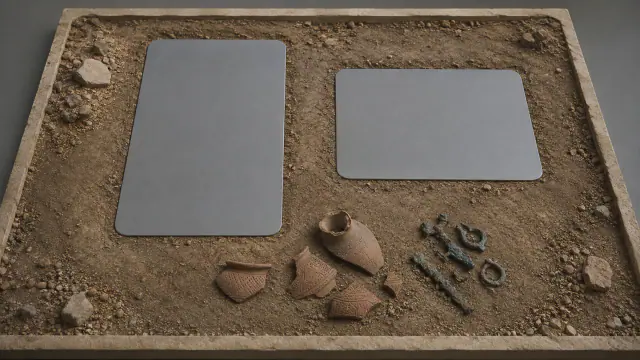
ca. 400 CE
Kabusanza, ca. 400
Batwa / Twa histories
Approximate date of the Kabusanza context; no automatic ethnic attribution.
Read the record
Also connected, without a comparable date (2)
These objects are not placed after the others: an unknown date does not mean a more recent object.
- CemeteryIndus civilisation · ca. 2600–1900 BCE
- Three hundred lives in the sandYayoi Japan · Mainly 4th century BCE–3rd century CE
A closer look
About 1 min to read · 1 section. Further reading and sources · free access. Editorial review recorded: .
A cemetery of family relationships
The kinship analysis of the 2020 study found fourth-degree affinity between the two oldest individuals and second-degree between the two most recent. For the latter, the data allow possibilities such as half-siblings or an uncle/aunt with nephew/niece relationship, without selecting a single one. Researchers compared shared chromosomal segments to support the archaeological hypothesis of a cemetery of extended families. This scale of relationship between people complements the continental map: the burials also document local links, not only broad ancestry categories.
Sources and references
Did you enjoy this exhibit?
Your opinion helps us improve the museum. You can change it whenever you like.
Loading your rating…