
 English
 Español
 Français
 Italiano
 Deutsch
 Русский
 Português
 Polski
 Română
 Svenska
 Norsk bokmål
 Suomi
 Türkçe
 العربية
 简体中文
 한국어
 हिन्दी
 Ελληνικά
12 · EXTERNAL SOURCES · ARCHIVE BIAS
Voices from outside
The Garamantes according to Greek and Roman authors
Their accounts offer an external perspective that we can cross-reference with the excavated fields, houses and tombs.
Museum documentation · free public access, no account required.
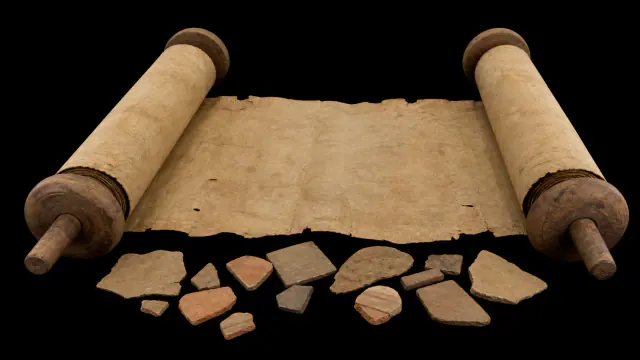
Generated reconstruction · Declared visual hypothesis
Declared visual reconstruction; not a photograph of the original nor documentary evidence.
History and context
Herodotus, Roman authors and geographers mention the Garamantes in episodes of distance, conflict and travel.
Their texts must be set against fields, houses, pottery and tombs. The written archive selects the extraordinary for the Mediterranean observer.
Herodotus wrote in the fifth century BCE and Roman authors added later news from Mediterranean interests. Their transmitted copies are sources for the relationship, not neutral observation of the social whole.
Confronting episodes of war, hunting or trade with fields, houses and tombs corrects the bias towards the extraordinary. Not all Fezzan communities appear in the texts.
Evidence and interpretation
Passages and dates of the authors are verifiable. Ethnographic generalisations, routes and figures require archaeological contrast.
Catalogue facts
- Narrative date
- Fifth century BCE–Late Antiquity
- Location
- Mediterranean · external gaze on Fezzan
- Material
- Text transmitted in later copies
- Context
- Source criticism
- Curatorial reading
- The documented fact and its interpretation appear separately in the evidence block.
- Early testimony
- Herodotus, Histories IV
- Control
- Mandatory contrast with regional archaeology
- Documentary coverage
- 3 museum, heritage, primary corpus or research sources for this stop.
A SHARED TOPIC, DIFFERENT MOMENTS
Objects connected through time
Follow a topic across the collections. A shared tag is a way to compare objects, not proof that one culture influenced another.
The order uses the midpoint of each approximate date range; ranges can overlap. Spacing does not represent elapsed time. Swipe, scroll or use the arrows. With the sequence focused, use ← / →, Home or End.
THE CURRENT OBJECT
Its date is not sufficiently established to place it on the timeline. We keep it here, separate from the dated objects.
 You are viewing
Fifth century BCE–Late Antiquity
Voices from outside
Garamantes
Testimonies and copies from various periods, not a single document.
Current recordArchives and documents8 dated objects
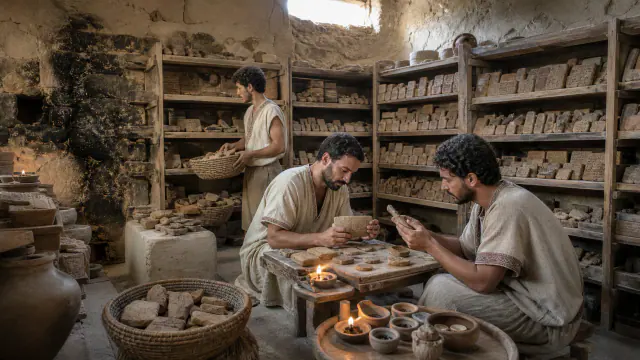
Above all 17th–13th centuries BCE
Boğazköy Archive
Hittites
Main date range for the archive, not a single date for all the tablets.
Read the record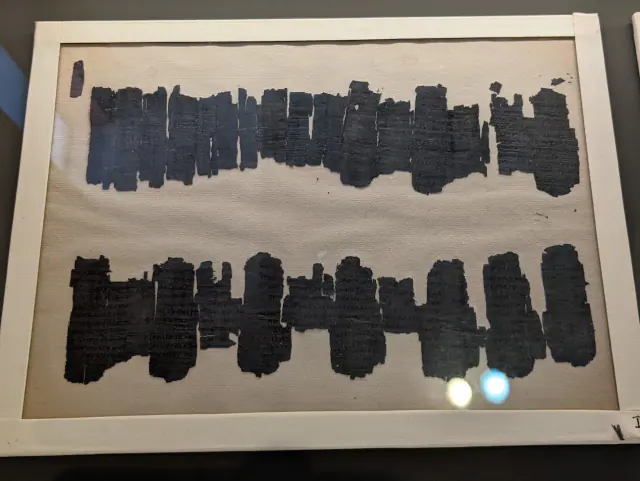
copy conserved towards 340–320 BCE; comments on a previous text.
Derveni Papyrus
Thracians
Date of preserved copy; The commented text is previous.
Read the record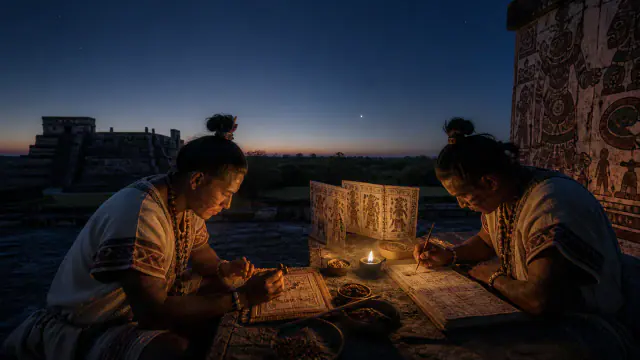
Preserved manuscript: Postclassic, probably 13th–14th centuries; earlier knowledge
Venus in the codex
Maya worlds
Probable date of the preserved manuscript, not of the origin of its knowledge.
Read the record
28 April 1922
Bamum document
Bantu-speaking worlds
Year of the document dated 28 April.
Read the record
15 July 1952
Two songs, missing names
Batwa / Twa histories
Date of the concrete recording, not antiquity of the songs.
Read the record
1954
Batwa on a colonial record
Batwa / Twa histories
Date of the disc and its record, not of the origin of the musical tradition.
Read the record
2012–2013
A map with the right to be closed
Batwa / Twa histories
Date of the process and participatory cartographic document, not of the territory's occupation.
Read the record
Adopted April–May 2022; public portal 2025
Eleven articles
Batwa / Twa histories
Year of adoption of the decision; the portal's publication in 2025 is subsequent.
Read the record
Also connected, without a comparable date (9)
These objects are not placed after the others: an unknown date does not mean a more recent object.
- 49 Classical VoicesIberians · Authors and traditions between the 6th century BCE and 4th century CE
- Before Bantu WorldsBantu-speaking worlds · Modern linguistic reconstruction on historical and living languages
- Dance with weaponsThracians · Towards 400 BCE. Xenophon's story
- Kumbi SalehMande Worlds · medieval occupation; prominent phases between the 11th and 13th centuries
- Shum LakaBantu-speaking worlds · c. 8,000 and 3,000 years before present
- The Banquet of Seuthes IIThracians · Towards 400 BCE. Anabasis episode
- The cost of transcriptionSan histories · 19th century–current digital edition
- Translating faithBantu-speaking worlds · 16th–18th centuries
- ZalmoxisThracians · testimony of Herodotus, 5th century BCE; no biographical date of the divinity.
A closer look
About 1 min to read · 1 section. Further reading and sources · free access. Editorial review recorded: .
Two accounts that do not fit together
In Book IV, Herodotus offers different reports on the Garamantes: one passage presents them as isolated and unarmed; another describes a numerous population, agriculture alongside salt deposits and four-horse chariots. The discrepancy allows studying how he gathered information about the African interior. His account also calculates stages between places by means of travel stages, a geography of routes rather than coordinates. Reading both passages together helps recognise selection and literary composition, and leaves concrete questions that the excavation of fields and settlements can contrast.
Sources and references
Did you enjoy this exhibit?
Your opinion helps us improve the museum. You can change it whenever you like.
Loading your rating…