
 English
 Español
 Français
 Italiano
 Deutsch
 Русский
 Português
 Polski
 Română
 Svenska
 Norsk bokmål
 Suomi
 Türkçe
 العربية
 简体中文
 한국어
 हिन्दी
 Ελληνικά
30 · CURIOSITY · LANGUAGE AND OCEAN
Indian Ocean Kiswahili
Kiswahili and contacts across the Indian Ocean
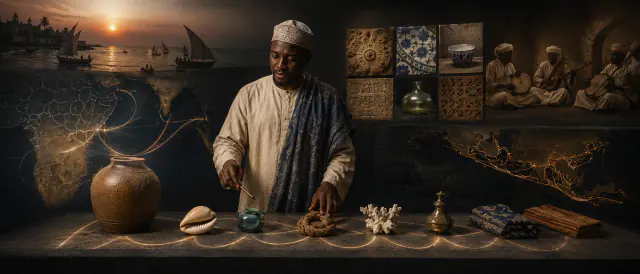
Kiswahili is a Bantu language that has incorporated Arabic, Persian and other words through its contacts.
Museum documentation · free public access, no account required.
Editorial visualisation · Contextual correspondence
Declared editorial visualisation, based on the cartography and sources of the fact sheet; it is not an exact historical frontier.
History and context
Kiswahili retains a Bantu structure and has incorporated words from Arabic, Persian and other Indian Ocean languages.
Archaeology and ancient DNA document relationships and admixture at medieval sites; a loanword does not measure a percentage of culture or ancestry.
Evidence and interpretation
Linguistics, sites and ancient samples converge at a regional scale; each etymology requires validation.
Catalogue facts
- Narrative date
- from the first millennium CE; major development in medieval and modern times
- Location
- The East African coast and islands of the western Indian Ocean
- Material
- Language, manuscripts, coins, pottery and ancient DNA
- Context
- African roots and oceanic connections
- Curatorial reading
- The documented fact and its interpretation appear separately in the evidence block.
- Dossier axis
- beliefs
- Research record
- BANTU · bantu-belief-swahili
- Documentary coverage
- 2 museum, heritage, primary corpus or research sources for this stop.
A SHARED TOPIC, DIFFERENT MOMENTS
Objects connected through time
Follow a topic across the collections. A shared tag is a way to compare objects, not proof that one culture influenced another.
The order uses the midpoint of each approximate date range; ranges can overlap. Spacing does not represent elapsed time. Swipe, scroll or use the arrows. With the sequence focused, use ← / →, Home or End.
THE CURRENT OBJECT
Its date is not sufficiently established to place it on the timeline. We keep it here, separate from the dated objects.
 You are viewing
from the first millennium CE; major development in medieval and modern times
Indian Ocean Kiswahili
Bantu-speaking worlds
A long-standing linguistic tradition with an open end date.
Current recordLanguages1 dated object
Also connected, without a comparable date (5)
These objects are not placed after the others: an unknown date does not mean a more recent object.
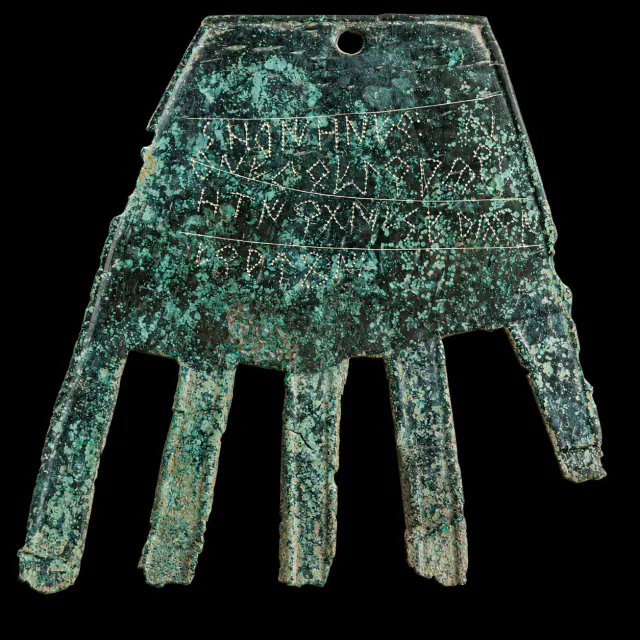
- 49 Classical VoicesIberians · Authors and traditions between the 6th century BCE and 4th century CE
- Ba-ntuBantu-speaking worlds · A long linguistic history; an academic term since the 19th century
- Before Bantu WorldsBantu-speaking worlds · Modern linguistic reconstruction on historical and living languages
- Clicks and contactBantu-speaking worlds · precolonial contacts with varying chronologies and subsequent continuity
- Voices from outsideGaramantes · Fifth century BCE–Late Antiquity
A closer look
About 1 min to read · 1 section. Further reading and sources · free access. Editorial review recorded: .
A predominantly local material culture
The study published in Nature in 2023 reminds us that imported objects usually represent less than five percent of the archaeological assemblages of numerous coastal sites. Crops, domestic animals, craft styles and pottery show continuities with earlier settlements. This datum shifts the balance of a display: focusing solely on foreign porcelains or ornaments would overrepresent a part of the record. Indian Ocean connections were important, but coexisted with a material life sustained mainly by African practices. The external connection is best interpreted when the proportion of the everyday is preserved.
Sources and references
Did you enjoy this exhibit?
Your opinion helps us improve the museum. You can change it whenever you like.
Loading your rating…