
 English
 Español
 Français
 Italiano
 Deutsch
 Русский
 Português
 Polski
 Română
 Svenska
 Norsk bokmål
 Suomi
 Türkçe
 العربية
 简体中文
 한국어
 हिन्दी
 Ελληνικά
26 · CURIOSITY · MORPHOLOGY
Ba-ntu
What the term Bantu means
The term relates to grammatical forms in several languages; it does not designate a race.
Museum documentation · free public access, no account required.
Editorial visualisation · Contextual correspondence
Declared editorial visualisation, based on the cartography and sources of the fact sheet; it is not an exact historical frontier.
History and context
Roots and class prefixes help explain the term’s history across several related languages.
The forms are not identical in every language, and their scientific use was racialised in colonial contexts.
Evidence and interpretation
Documented morphology and conceptual history. Each example should be reviewed by speakers.
Catalogue facts
- Narrative date
- A long linguistic history; an academic term since the 19th century
- Location
- Various Bantu-speaking communities
- Material
- Words, prefixes, grammars and voices
- Context
- Language versus racial classification
- Curatorial reading
- The documented fact and its interpretation appear separately in the evidence block.
- Dossier axis
- beliefs
- Research record
- BANTU · bantu-belief-ba-ntu
- Documentary coverage
- 2 museum, heritage, primary corpus or research sources for this stop.
A SHARED TOPIC, DIFFERENT MOMENTS
Objects connected through time
Follow a topic across the collections. A shared tag is a way to compare objects, not proof that one culture influenced another.
The order uses the midpoint of each approximate date range; ranges can overlap. Spacing does not represent elapsed time. Swipe, scroll or use the arrows. With the sequence focused, use ← / →, Home or End.
THE CURRENT OBJECT
Its date is not sufficiently established to place it on the timeline. We keep it here, separate from the dated objects.
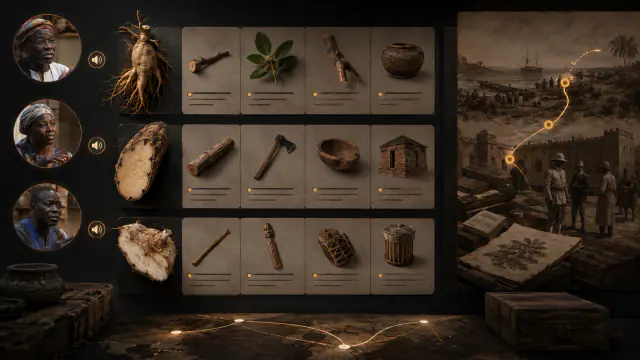 You are viewing
A long linguistic history; an academic term since the 19th century
Ba-ntu
Bantu-speaking worlds
The 19th century dates the academic term, not the age of the languages.
Current recordLanguages1 dated object

Also connected, without a comparable date (5)
These objects are not placed after the others: an unknown date does not mean a more recent object.
- 49 Classical VoicesIberians · Authors and traditions between the 6th century BCE and 4th century CE
- Before Bantu WorldsBantu-speaking worlds · Modern linguistic reconstruction on historical and living languages
- Clicks and contactBantu-speaking worlds · precolonial contacts with varying chronologies and subsequent continuity
- Indian Ocean KiswahiliBantu-speaking worlds · from the first millennium CE; major development in medieval and modern times
- Voices from outsideGaramantes · Fifth century BCE–Late Antiquity
A closer look
About 1 min to read · 1 section. Further reading and sources · free access. Editorial review recorded: .
A language can also be acquired through learning
The Kiswahili profile from the University of Kansas distinguishes those who acquire it as a first language from a majority who use it as a second or third language. Education, trade, religious uses and language policies have contributed to this diffusion. The case allows us to clarify what it means to classify a language as Bantu: its grammatical genealogy does not oblige all its users to share ancestry or local identity. One and the same person can incorporate it into a multilingual repertoire, and the growth of that repertoire changes the map of speakers without turning it into a racial map.
Location and territory
REGIONAL AREA
Various Bantu-speaking communitiesCurrent maximum linguistic envelope and historical corridors; it was not a single political territory nor was it occupied simultaneously. The footprint indicates the indicative centre of the sphere, not a border or an exact point.Sources and references
Did you enjoy this exhibit?
Your opinion helps us improve the museum. You can change it whenever you like.
Loading your rating…