28 · CURIOSITY · RELIGION AND POWER
Translating faith The different forms of Christianity in Kongo
Afonso I, crucifix artists and Kimpa Vita reveal different ways of adopting and interpreting Christianity.
ON THIS PAGE
History and context Evidence and facts Objects connected through time Further reading Where it is held Sources and references Comments Museum documentation · free public access, no account required.
⛶ Enlarge image← Previous Image 1 of 2 · Main image Next →
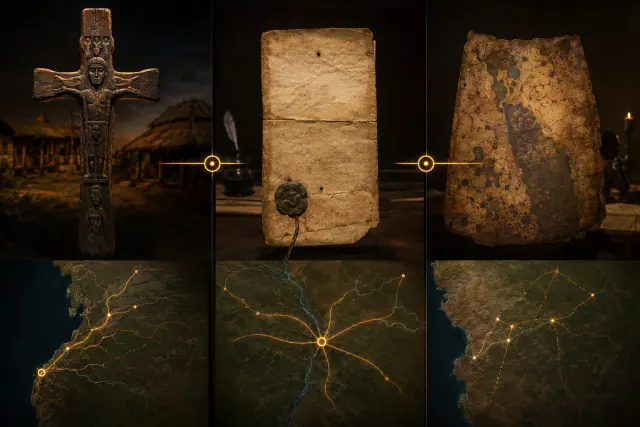
Main image 2 EDITORIAL VISUALISATION DECLARED · AI-GENERATED IMAGE · TRACEKEEPERS Editorial visualisation · Contextual correspondence
Declared editorial visualisation, based on the cartography and sources of the fact sheet; it is not an exact historical frontier.
View full image: EDITORIAL VISUALISATION DECLARED · AI-GENERATED IMAGE · TRACEKEEPERS EDITORIAL VISUALISATION DECLARED · AI-GENERATED IMAGE · TRACEKEEPERS Editorial visualisation · Contextual correspondence
Declared editorial visualisation, based on the cartography and sources of the fact sheet; it is not an exact historical frontier.
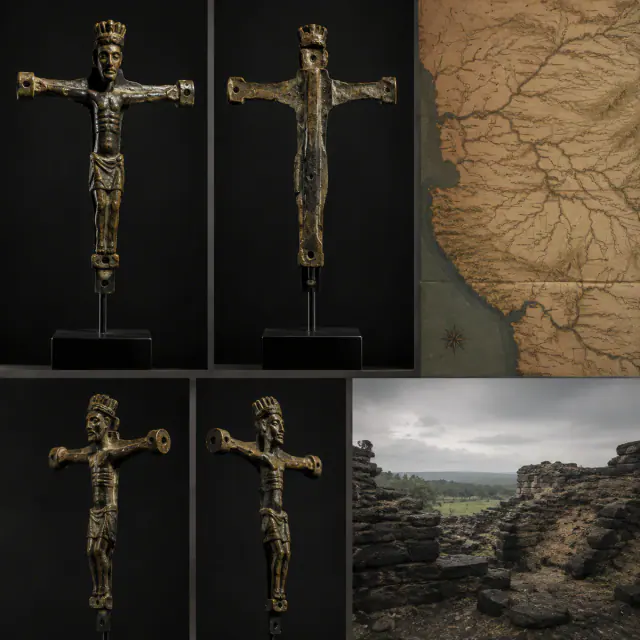
View full image: Original documentary · Photograph of the original Original documentary · Photograph of the original Documentary original · Exact correspondence
Documentary photograph from the Metropolitan Museum of Art collection. Adapted for the web: size and format adjusted, without reconstructing parts or changing the photograph’s content.
Inventory number 1999.295.7 and Met record 318323 identify the object described; this photograph shows its surviving condition, not an AI restoration.
The Metropolitan Museum of Art · The Metropolitan Museum of Art, New York · Inventory: 1999.295.7 · CC0 1.0 · Open Access
History and context Afonso used writing and Christianity to govern; artists transformed crucifixes; Kimpa Vita redrew a sacred geography.
These creative appropriations coexisted with coercion, missionary institutions and political conflicts.
Evidence and interpretation Documented letters, objects and archives. The term syncretism should not suggest a harmonious blend.
Catalogue facts
Narrative date 16th–18th centuries
Location Kingdom of Kongo
Material Brass, letters, names, rituals and Capuchin accounts
Context Religious translation, sovereignty and conflict
Curatorial reading The documented fact and its interpretation appear separately in the evidence block.
Dossier axis beliefs
Research record BANTU · bantu-belief-kongo-christianities
Documentary coverage 4 museum, heritage, primary corpus or research sources for this stop. Copper and its alloys11 Archives and documents18 Writing44 Worship and offerings29
The order uses the midpoint of each approximate date range; ranges can overlap. Spacing does not represent elapsed time. Swipe, scroll or use the arrows. With the sequence focused, use ← / →, Home or End.
Earlier Later
1 / 8 In the centre: The Gold of Varna
Also connected, without a comparable date (2) These objects are not placed after the others: an unknown date does not mean a more recent object.
You can scroll the first group without JavaScript. The other topics are also available below.
Archives and documents Current object, without a comparable date: Translating faith .
Boğazköy Archive · Above all 17th–13th centuries BCE · HittitesDerveni Papyrus · copy conserved towards 340–320 BCE; comments on a previous text. · ThraciansVenus in the codex · Preserved manuscript: Postclassic, probably 13th–14th centuries; earlier knowledge · Maya worldsBamum document · 28 April 1922 · Bantu-speaking worldsTwo songs, missing names · 15 July 1952 · Batwa / Twa historiesBatwa on a colonial record · 1954 · Batwa / Twa historiesA map with the right to be closed · 2012–2013 · Batwa / Twa historiesEleven articles · Adopted April–May 2022; public portal 2025 · Batwa / Twa historiesWithout a comparable date (not part of the chronological order):
49 Classical Voices · Authors and traditions between the 6th century BCE and 4th century CE · IberiansBefore Bantu Worlds · Modern linguistic reconstruction on historical and living languages · Bantu-speaking worldsDance with weapons · Towards 400 BCE. Xenophon's story · ThraciansKumbi Saleh · medieval occupation; prominent phases between the 11th and 13th centuries · Mande WorldsShum Laka · c. 8,000 and 3,000 years before present · Bantu-speaking worldsThe Banquet of Seuthes II · Towards 400 BCE. Anabasis episode · ThraciansThe cost of transcription · 19th century–current digital edition · San historiesVoices from outside · Fifth century BCE–Late Antiquity · GaramantesZalmoxis · testimony of Herodotus, 5th century BCE; no biographical date of the divinity. · ThraciansWriting Current object, without a comparable date: Translating faith .
Naqada labels · ca. 3300–3100 BCE · Ancient EgyptIvory tablets · c. 3100–2900 BCE · Ancient EgyptJemdet Nasr · c. 3100–2900 BCE · SumerAccount of malt and barley · c. 3100–2900 BCE · SumerBefore the Hittites · c. 19th century BCE · HittitesPlimpton 322 · Paleo-Babylonian period · around 1800 BCE · SumerSumerian King List · Towards 1800 BCE · SumerStele of Hammurabi · Towards 1750 BCE · SumerLove song to Shu-Sin · Paleo-Babylonian copy, around 1900–1600 BCE according to CDLI · SumerSi.427 tablet · Towards 1900–1600 BCE · paleobabylonian; uncertain chronological attribution in CDLI · SumerPhaistos Disc · ≈1700–1650 BCE · Greek worldsSumerian Flood of Nippur · Towards 1650 BCE · SumerLinear A · c. 1700–1500 BCE · Greek worldsBoğazköy Archive · Above all 17th–13th centuries BCE · HittitesLinear B · c. 1375 BCE · Greek worldsAlaksandu of Wilusa · c. 1300 BCE · HittitesTreaty with Egypt · c. 1259 BCE, year 21 of Ramesses II · HittitesThe voice of Ahiram · c. 11th–10th century BCE · PhoeniciansFlood Tablet · 7th century BCE · SumerBabylonian map of the world · Towards 700–500 BCE · SumerUni was also Astarte · Towards 510 BCE · Etruscans and RomeRations for women and children · Towards 509–493 BCE · Achaemenid PersiaEzerovo Ring · 5th century BCE · chronology discussed in the bibliography · ThraciansThe archer in gold · Type introduced from the late 6th century; specimen from the 4th century BCE. · Achaemenid PersiaThe inscription of Pistiros · 4th century BCE · ThraciansDerveni Papyrus · copy conserved towards 340–320 BCE; comments on a previous text. · ThraciansLead tablet · 4th–3rd centuries BCE · IberiansHand of Irulegui · First third of the 1st century BCE · IberiansDenarius of Carisius · ≈25–23 BCE · IberiansBetatun altar · 1st century BCE–1st century CE · IberiansThe date of 292 · 292 CE · Maya worldsVenus in the codex · Preserved manuscript: Postclassic, probably 13th–14th centuries; earlier knowledge · Maya worldsCatalan Atlas · after 1375 and before November 1380 · Mande WorldsBamum document · 28 April 1922 · Bantu-speaking worldsEleven articles · Adopted April–May 2022; public portal 2025 · Batwa / Twa historiesWithout a comparable date (not part of the chronological order):
Worship and offerings Current object, without a comparable date: Translating faith .
Uruk Vase · ca. 3300–3000 BCE · SumerWorshiper of Tell Asmar · Towards 2900–2600 BCE · SumerStatue of Ebih-Il · Towards 2400 BCE · SumerBefore Phoenicia · 20th–18th centuries BCE · PhoeniciansJue · c. sixteenth century BCE · Ancient ChinaRubber before the stadium · c. 1600–1200 BCE for the oldest specimens · Maya worldsWooden faces · c. 1600–1000 BCE, in several phases · Maya worldsLiding · 12th–11th centuries BCE · Ancient ChinaAstarte from El Carambolo · 8th century BCE · PhoeniciansAstarte from El Carambolo · 8th century BCE · IberiansThe invisible mosaic · c. 900–600 BCE · Maya worldsOffering 4 · c. 800–600 BCE · Maya worldsUni was also Astarte · Towards 510 BCE · Etruscans and RomeThe god on the roof · Towards 510–500 BCE · Etruscans and RomeThoth in the form of a baboon · 664–30 BCE · Ancient EgyptPoroina Mare Rhyton · Second half of the 4th century BCE · ThraciansEight voices in one hand · 3rd–2nd centuries BCE · Gojoseon and early KoreaThirty-nine buried bells · Buried towards the 1st century BCE–1st century CE · Yayoi JapanBetatun altar · 1st century BCE–1st century CE · IberiansKongo crucifix · 16th–17th centuries · Bantu-speaking worldsWithout a comparable date (not part of the chronological order):
A closer look About 1 min to read · 1 section. Further reading and sources · free access. Editorial review recorded: September 5, 2026 .
Discussing the afterlife through translation In the Met’s commentary, Cécile Fromont recalls missionary debates on how to translate heaven and hell. Kongolese interlocutors did not passively accept these concepts and questioned the Christian description of the afterlife. The historian also interprets the small figures on the crucifix as possible beings that traverse the separation between the living and the dead. This is an identified reading, not the demonstrated meaning of each figure. The translation conflict allows us to understand a Christianity elaborated through local questions: adopting an image did not imply accepting without discussion all the explanations that came with it.
Where it is held Item or group in the record · Documented collection
The holding institution is documented; public display may change. Check its official record before visiting.
See Translating faith in the museum Find this record in its gallery and save your route, favourites and places to explore later.
Open this exhibit in the museum → Museum access requires a free account. You can read this page's documentation without registering.
Did you enjoy this exhibit? Your opinion helps us improve the museum. You can change it whenever you like.
Loading your rating…

 English
 Español
 Français
 Italiano
 Deutsch
 Русский
 Português
 Polski
 Română
 Svenska
 Norsk bokmål
 Suomi
 Türkçe
 العربية
 简体中文
 한국어
 हिन्दी
 Ελληνικά
 You are viewing