
 English
 Español
 Français
 Italiano
 Deutsch
 Русский
 Português
 Polski
 Română
 Svenska
 Norsk bokmål
 Suomi
 Türkçe
 العربية
 简体中文
 한국어
 हिन्दी
 Ελληνικά
CONNECTION, NOT AN IBERIAN PIECE · CONNECTION · LATE IMPERIAL HISPANIA
Simancas-type belt buckle
Late Roman history along a livestock route
This late Roman belt buckle was found in the Sierra de Sobia, possibly lost beside a livestock route.
Museum documentation · free public access, no account required.
Generated reconstruction · Declared visual hypothesis
Declared visual reconstruction, created for museographic contextualisation; not a photograph of the original nor does it constitute documentary evidence.
History and context
The brooch appeared without associated structures in the Sierra de Sobia, perhaps lost in a livestock pass. Its openwork ornamentation and construction belong to the world of late Roman belts, where imperial models and regional variants mingled.
It is not Iberian and is separated by centuries from the main collection. It functions as proof against easy continuity: the same landscape accumulated objects from distinct communities, and an isolated find needs context before becoming history.
Evidence and interpretation
Documented fact: late Roman typology, decoration, proposed chronology and find in the Sierra de Sobia are published. Interpretation and caution: owner, strictly military function and circumstance of loss cannot be demonstrated; it is not an Iberian piece.
Catalogue facts
- Narrative date
- Second half of the IV century–V century CE
- Location
- Sobrevilla, Sierra de Sobia, Teverga (Asturias)
- Material
- Copper alloy · openwork ornamentation
- Context
- Isolated late Roman brooch · later connection
- Classification
- Comparative connection · must not be presented as an Iberian piece
- Visual reference
- Archaeological publication of the Sobia specimen · Sautuola XXIX
A SHARED TOPIC, DIFFERENT MOMENTS
Objects connected through time
Follow a topic across the collections. A shared tag is a way to compare objects, not proof that one culture influenced another.
The order uses the midpoint of each approximate date range; ranges can overlap. Spacing does not represent elapsed time. Swipe, scroll or use the arrows. With the sequence focused, use ← / →, Home or End.
Copper and its alloys8 dated objects
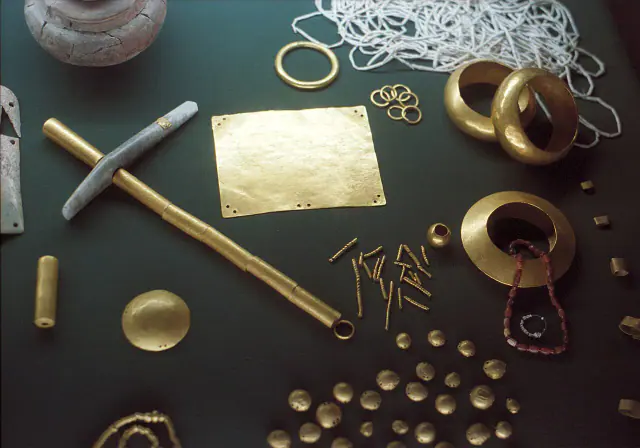
Towards 4600–4200 BCE
The Gold of Varna
Thracians
Date of the Varna funerary assemblage, not of an individual piece.
Read the record
III millennium BCE · usually towards 2650 BCE; approximate
Nippur Cubit
Sumer
Explicit indicative date in the 3rd millennium BCE
Read the record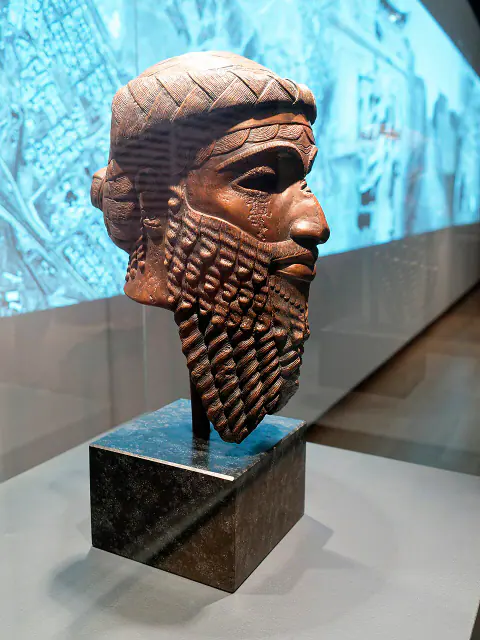
Akkadian period · 23rd century BCE
Akkadian sovereign head
Sumer
Approximate dating according to the record.
Read the record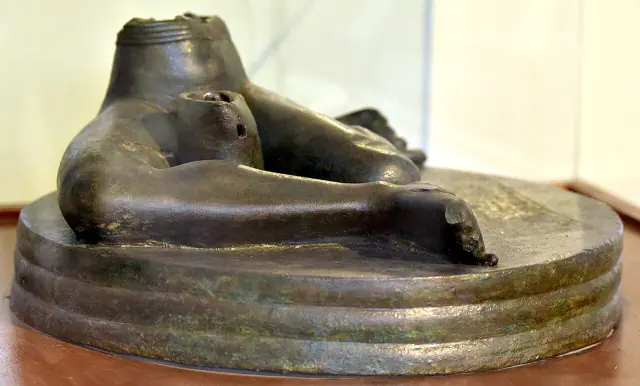
Akkadian period · 23rd century BCE
Bassetki Statue
Sumer
Approximate dating according to the record.
Read the record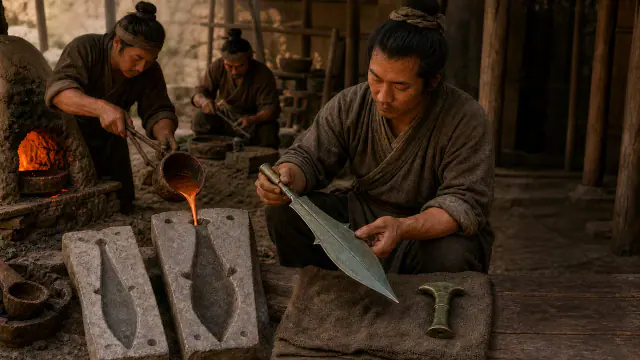
Towards 1000–400 BCE
The lute-shaped dagger
Gojoseon and early Korea
Typological framework of daggers; not a single manufacturing date.
Read the record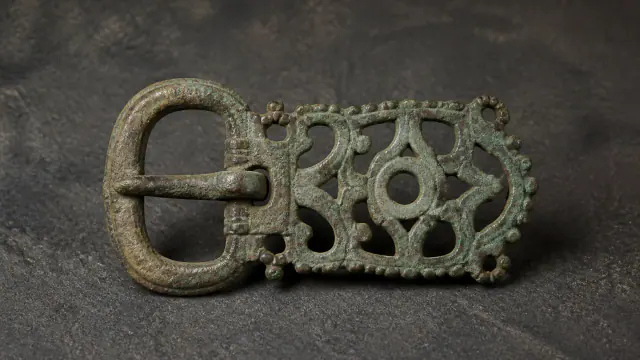 You are viewing
Second half of the IV century–V century CE
Simancas-type belt buckle
Iberians
The full 4th–5th centuries CE provide broad limits for chronological ordering; the record specifies the second half of the 4th century and the 5th.
Current record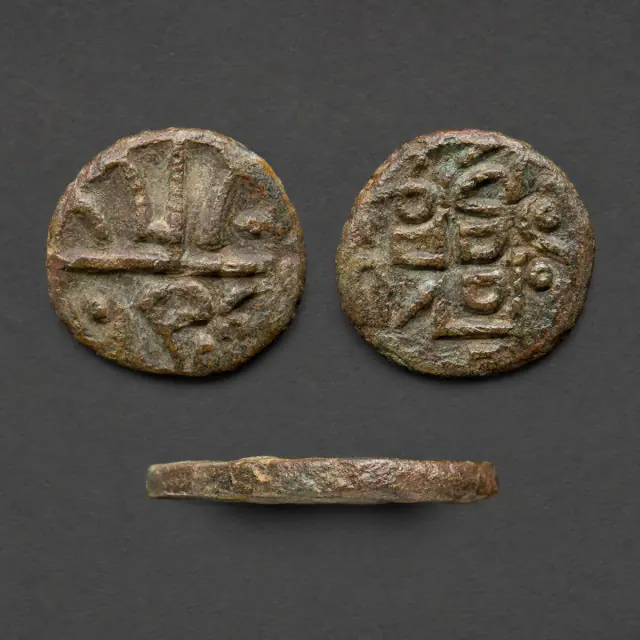
1482–1493
Kilwa coin
Bantu-speaking worlds
Read the record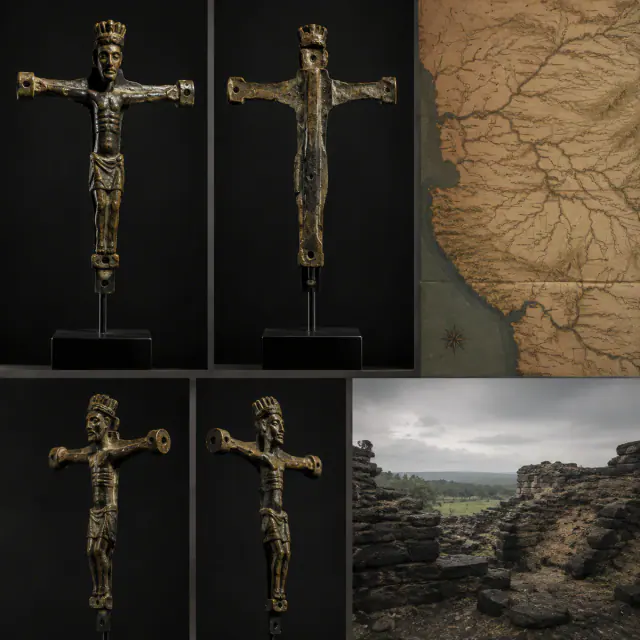
16th–17th centuries
Kongo crucifix
Bantu-speaking worlds
Read the record
Also connected, without a comparable date (3)
These objects are not placed after the others: an unknown date does not mean a more recent object.
- Copper and stoneAncient Egypt · ca. 3100–2700 BCE
- Early metallurgyAncient China · c. 1900–1500 BCE
- Translating faithBantu-speaking worlds · 16th–18th centuries
A closer look
About 1 min to read · 1 section. Further reading and sources · free access. Editorial review recorded: .
A terminal that departs from usual models
The singularity of Sobia is appreciated in the triangular terminal, which protrudes above the plane of the plate. Aurrecoechea-Fernández and Fanjul did not find this prominence in the other Hispanic brooches they compared. They also highlight the cold-struck added punched circles and a buckle resembling a small curved-outline shield, decorated with bundles of incisions. Other Simancas-type specimens present undulating stems, but not this exact combination. The authors propose a particular commission as explanation of its peculiarities; no contract nor identification of the commissioner is preserved.
Sources and references
Did you enjoy this exhibit?
Your opinion helps us improve the museum. You can change it whenever you like.
Loading your rating…