
 English
 Español
 Français
 Italiano
 Deutsch
 Русский
 Português
 Polski
 Română
 Svenska
 Norsk bokmål
 Suomi
 Türkçe
 العربية
 简体中文
 한국어
 हिन्दी
 Ελληνικά
04 · From Liaoning to the peninsula · a shared form
The lute-shaped dagger
The Liaoning-type bronze dagger
Blade and hilt were cast separately, creating a weapon recognisable on both sides of modern borders.
Museum documentation · free public access, no account required.
Generated reconstruction · Declared visual hypothesis
Declared visual reconstruction for museographic context; it is not a photograph of the original nor documentary evidence.
History and context
The blade widens in curves that recall a lute and has lateral protrusions; the detachable hilt could be replaced or combined with other materials. The type circulated between Liaoning, southern Manchuria and the Korean peninsula.
In Korea it is often associated with Gojoseon, but an object does not equal a passport. Its distribution reveals networks, workshops and emulation of authority; the exact limits of a kingdom must be investigated with more evidence than a bronze silhouette.
Blade and hilt were made separately; a piece of wood or another material could complete the weapon. This modularity explains why many excavations recover only the blade and why reconstructing a complete dagger requires caution.
The distribution from Liaoning to Korea shows persistent connections, but ceramic assemblages change from one region to another. Korean archaeology itself has debated whether there was a single "dagger people" and does not offer a simple answer.
Evidence and interpretation
Documented fact: the National Museum of Korea dates the Liaoning-type dagger culture between approximately 1000 and 400 BCE and explains blade and hilt as separate. Interpretation and caution: calling all these pieces Gojoseon daggers does not prove political control or common identity. Expanded documentation: Museums and typological studies document curved blade, lateral protrusions, separate assembly and wide distribution. Expanded interpretation and caution: "Bipa" or "lute" is a modern description of the silhouette; it does not prove a relation to musicians or the exact territory of Gojoseon.
Catalogue facts
- Narrative date
- Towards 1000–400 BCE
- Location
- Liaoning, southern Manchuria and Korean peninsula
- Material
- Copper alloy; hilt of bronze, wood or other materials
- Context
- Weapon, insignia and exchange good of the Bronze Age
- Curatorial reading
- The documented fact and its interpretation appear separately in the evidence block.
- Mounting
- Blade and hilt were separate pieces joined by a tang.
- Distribution
- The type appears in Liaoning, southern Manchuria and several regions of the peninsula.
- Interpretation
- Its concentration may signal prestige networks without equating to a state border.
- Documentary coverage
- 3 museum, heritage, primary corpus or research sources for this stop.
- In this grouping
- Bronze dagger: weapon and emblem of rank could coexist; no specific combat is asserted.
A SHARED TOPIC, DIFFERENT MOMENTS
Objects connected through time
Follow a topic across the collections. A shared tag is a way to compare objects, not proof that one culture influenced another.
The order uses the midpoint of each approximate date range; ranges can overlap. Spacing does not represent elapsed time. Swipe, scroll or use the arrows. With the sequence focused, use ← / →, Home or End.
Copper and its alloys8 dated objects
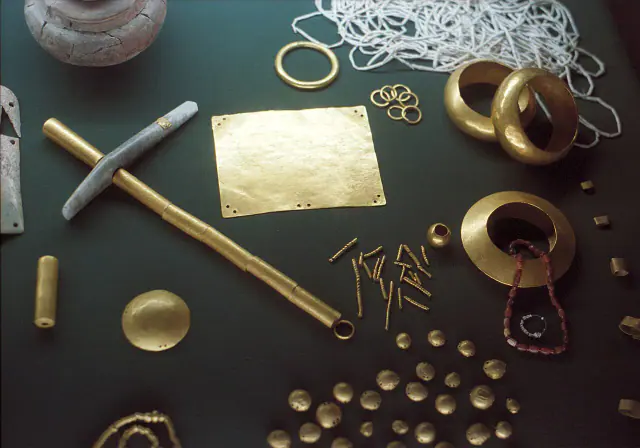
Towards 4600–4200 BCE
The Gold of Varna
Thracians
Date of the Varna funerary assemblage, not of an individual piece.
Read the record
III millennium BCE · usually towards 2650 BCE; approximate
Nippur Cubit
Sumer
Explicit indicative date in the 3rd millennium BCE
Read the record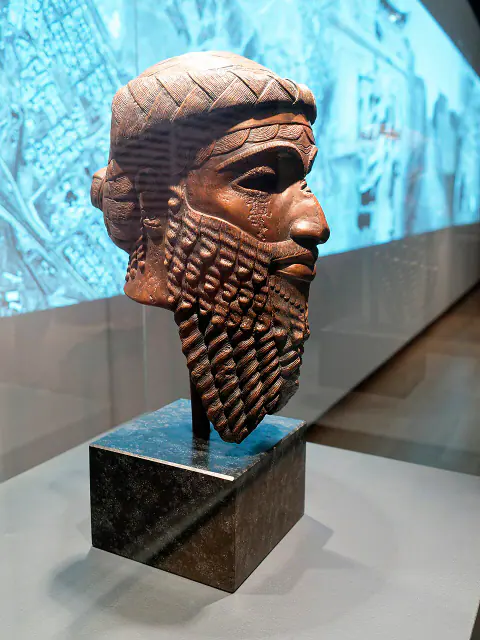
Akkadian period · 23rd century BCE
Akkadian sovereign head
Sumer
Approximate dating according to the record.
Read the record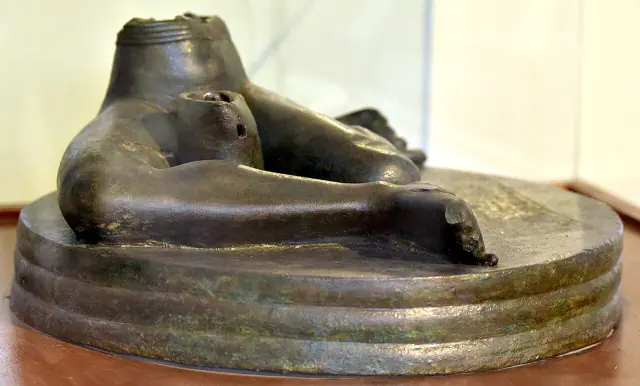
Akkadian period · 23rd century BCE
Bassetki Statue
Sumer
Approximate dating according to the record.
Read the record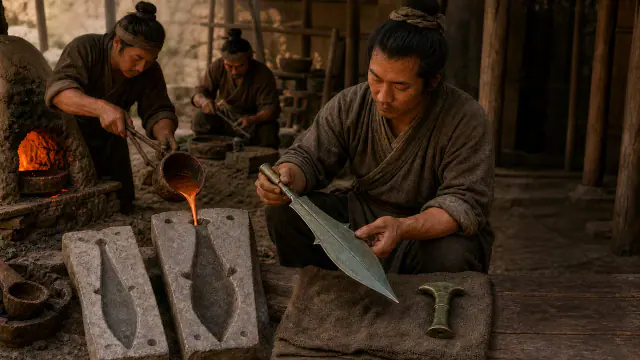 You are viewing
Towards 1000–400 BCE
The lute-shaped dagger
Gojoseon and early Korea
Typological framework of daggers; not a single manufacturing date.
Current record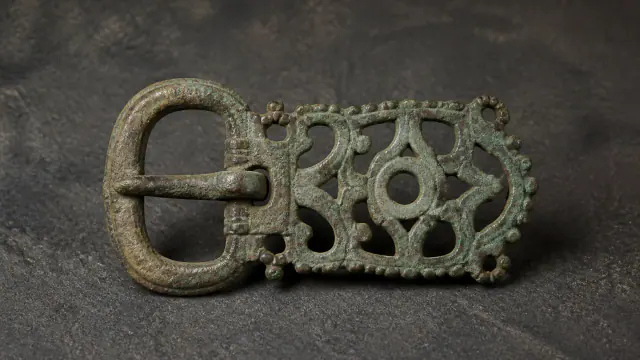
Second half of the IV century–V century CE
Simancas-type belt buckle
Iberians
The full 4th–5th centuries CE provide broad limits for chronological ordering; the record specifies the second half of the 4th century and the 5th.
Read the record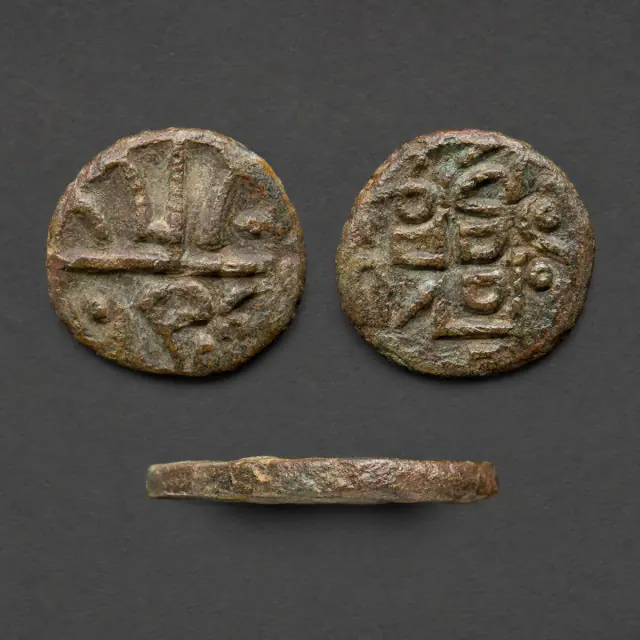
1482–1493
Kilwa coin
Bantu-speaking worlds
Read the record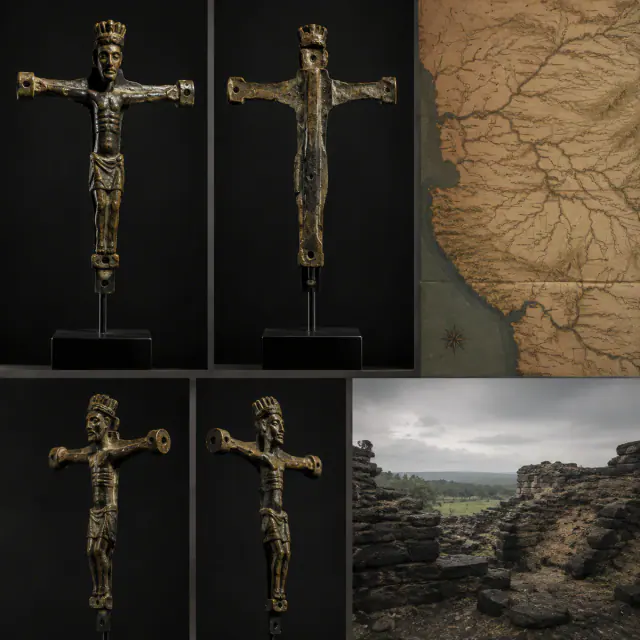
16th–17th centuries
Kongo crucifix
Bantu-speaking worlds
Read the record
Also connected, without a comparable date (3)
These objects are not placed after the others: an unknown date does not mean a more recent object.
- Copper and stoneAncient Egypt · ca. 3100–2700 BCE
- Early metallurgyAncient China · c. 1900–1500 BCE
- Translating faithBantu-speaking worlds · 16th–18th centuries
A closer look
About 1 min to read · 1 section. Further reading and sources · free access. Editorial review recorded: .
Separating casting from sharpening
The comparative study of daggers published by the national museum warns that some characteristics change during the weapon's life. Sharpening and use can modify the edges that later serve to classify it. For this reason it also compares parts related to the original casting, such as the tang that was inserted into the hilt. This distinction allows asking how the piece left the mould and how it was transformed by its owners. A visible difference between two daggers does not have to indicate different peoples: it may reflect production, repair or duration of use.
Location and territory
DEBATED LOCATION
Liaoning, southern Manchuria and Korean peninsulaLiaoning and northern Korea; the precise extent remains debated. The mark indicates the orienting centre of the scope, not a boundary or an exact point.Where it is held
National Museum of Korea
Item or group in the record · Documented collection
The holding institution is documented; public display may change. Check its official record before visiting.
Sources and references
Did you enjoy this exhibit?
Your opinion helps us improve the museum. You can change it whenever you like.
Loading your rating…