
 English
 Español
 Français
 Italiano
 Deutsch
 Русский
 Português
 Polski
 Română
 Svenska
 Norsk bokmål
 Suomi
 Türkçe
 العربية
 简体中文
 한국어
 हिन्दी
 Ελληνικά
03 · OBJECT · ERLITOU
Early metallurgy
Before the great ritual, tools, weapons and bells
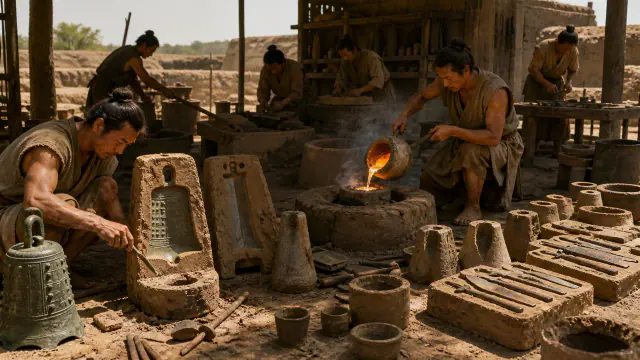
The earliest known metals at the site employed copper and several alloys, still on a smaller scale than the later great bronzes.
Museum documentation · free public access, no account required.
Generated reconstruction · Declared visual hypothesis
Declared visual reconstruction for museographic context; it is not a photograph of the original nor documentary evidence.
History and context
At Erlitou, small bells, weapons and tools of copper and various alloys appeared. Their modest scale does not diminish importance: they reveal experimentation with tin, lead and, in some cases, arsenic.
The gallery does not project backwards the enormous ding of Anyang. Metallurgy was changing in composition, capacity, form and organisation over centuries.
Erlitou produced small weapons, tools and bells, as well as early ritual vessels, in copper and various alloys. The variety shows an expanding industry, not merely a hoard of treasures.
Composition, casting and finish depended on specialists and transported minerals. The quantity recovered is a fraction affected by recycling and excavation.
Evidence and interpretation
Documented fact: Published analyses of Erlitou metal objects include pieces of copper, bronze, ternary copper-lead-tin alloy and one specimen with copper and arsenic. Interpretation and caution: The small analysed sample and the quantity of metal recovered do not allow calculation of total production or who controlled each workshop. Expanded documented fact: Published analyses of Erlitou objects include six pieces described as bronze, four copper-lead-tin alloys, two of copper and one of copper-arsenic. Expanded interpretation and caution: Total volume or state monopoly must not be calculated from conserved objects, and the provenance of metals remains under investigation.
Catalogue facts
- Narrative date
- c. 1900–1500 BCE
- Location
- Erlitou, Henan, China
- Material
- Copper and copper alloys with tin, lead or arsenic
- Context
- Early metallurgy
- Curatorial reading
- The documented fact and its interpretation appear separately in the evidence block.
- Products
- Bells, weapons, tools and early vessels
- Alloys
- Unalloyed copper and alloys with tin, lead or arsenic, according to the analysed pieces
- Documentary coverage
- 2 museum, heritage, primary corpus or research sources for this stop.
A SHARED TOPIC, DIFFERENT MOMENTS
Objects connected through time
Follow a topic across the collections. A shared tag is a way to compare objects, not proof that one culture influenced another.
The order uses the midpoint of each approximate date range; ranges can overlap. Spacing does not represent elapsed time. Swipe, scroll or use the arrows. With the sequence focused, use ← / →, Home or End.
THE CURRENT OBJECT
Its date is not sufficiently established to place it on the timeline. We keep it here, separate from the dated objects.
 You are viewing
c. 1900–1500 BCE
Early metallurgy
Ancient China
History of a technique and several alloys, not an individually dated piece.
Current recordCopper and its alloys8 dated objects
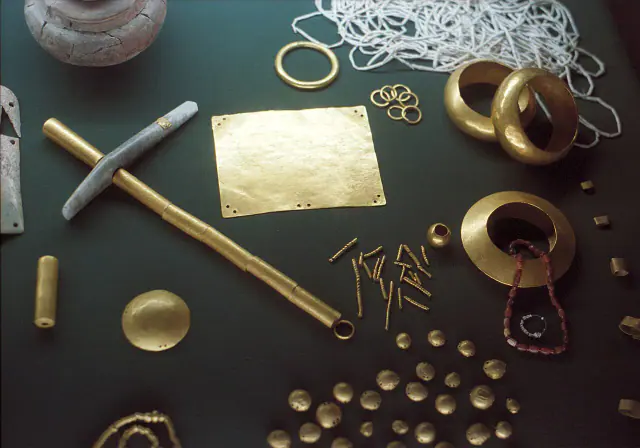
Towards 4600–4200 BCE
The Gold of Varna
Thracians
Date of the Varna funerary assemblage, not of an individual piece.
Read the record
III millennium BCE · usually towards 2650 BCE; approximate
Nippur Cubit
Sumer
Explicit indicative date in the 3rd millennium BCE
Read the record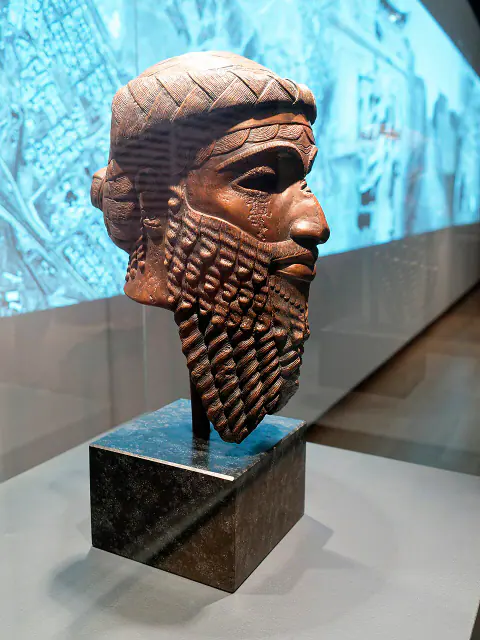
Akkadian period · 23rd century BCE
Akkadian sovereign head
Sumer
Approximate dating according to the record.
Read the record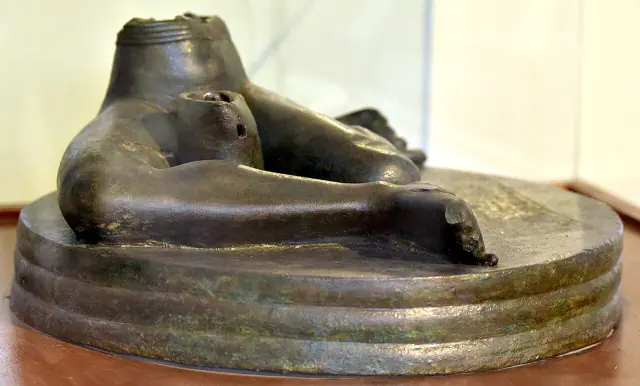
Akkadian period · 23rd century BCE
Bassetki Statue
Sumer
Approximate dating according to the record.
Read the record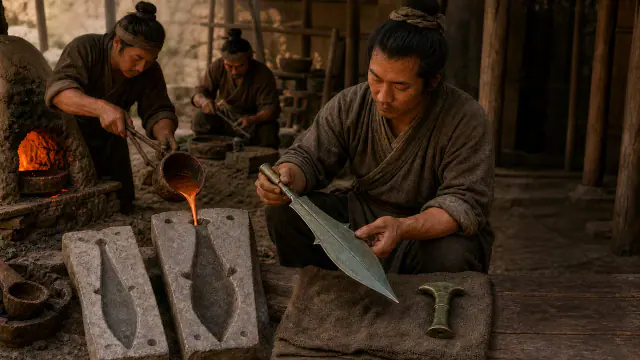
Towards 1000–400 BCE
The lute-shaped dagger
Gojoseon and early Korea
Typological framework of daggers; not a single manufacturing date.
Read the record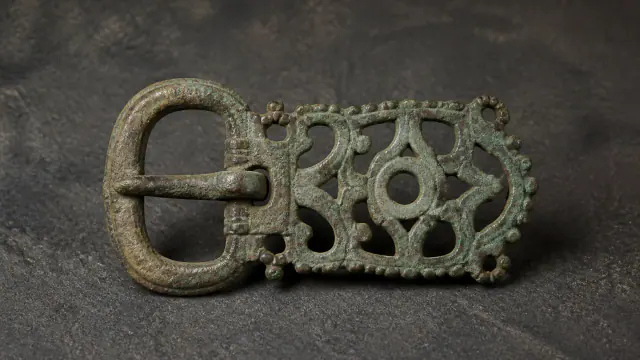
Second half of the IV century–V century CE
Simancas-type belt buckle
Iberians
The full 4th–5th centuries CE provide broad limits for chronological ordering; the record specifies the second half of the 4th century and the 5th.
Read the record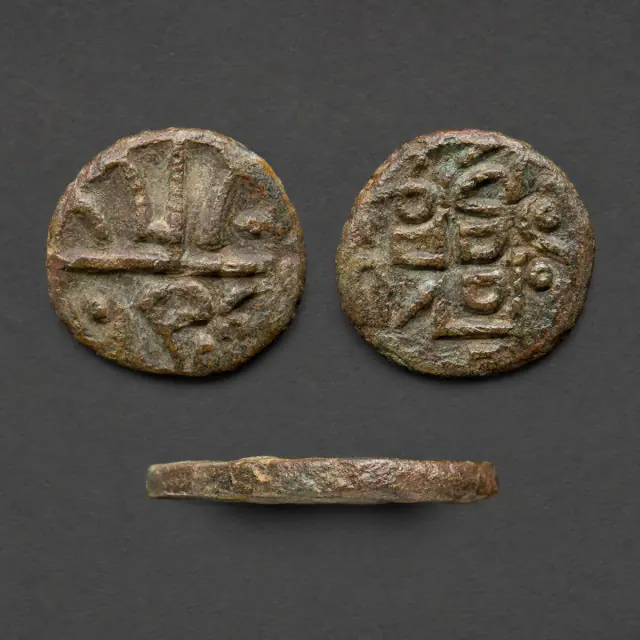
1482–1493
Kilwa coin
Bantu-speaking worlds
Read the record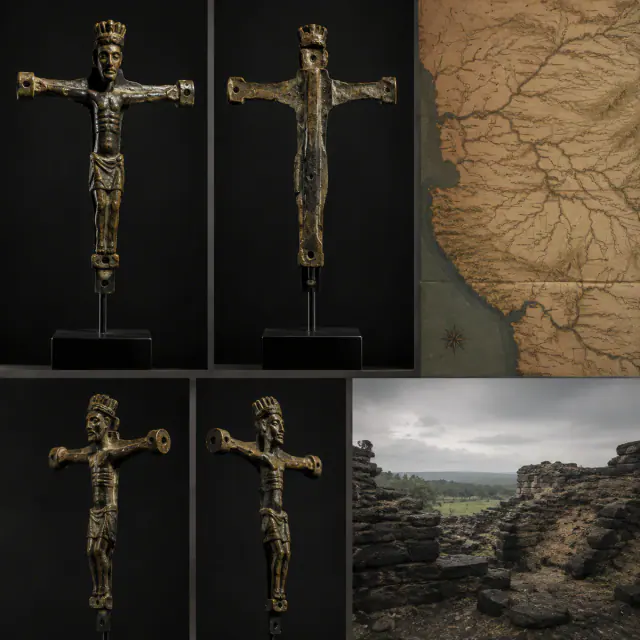
16th–17th centuries
Kongo crucifix
Bantu-speaking worlds
Read the record
Also connected, without a comparable date (2)
These objects are not placed after the others: an unknown date does not mean a more recent object.
- Copper and stoneAncient Egypt · ca. 3100–2700 BCE
- Translating faithBantu-speaking worlds · 16th–18th centuries
A closer look
About 1 min to read · 1 section. Further reading and sources · free access. Editorial review recorded: .
Workshops shared finishing problems
A study of mechanical treatments compares metalworking with jade and turquoise. In Erlitou, fine striations and flat surfaces on turquoise tesserae allow recognition of abrasion and regularisation before forming a mosaic. The author proposes that proximity between artisans of different materials facilitated the exchange of finishing techniques. This perspective broadens the history of bronze beyond the furnace: achieving smooth surfaces, defined edges and lustre effects also required tools, abrasives and knowledge that could circulate between trades.
Location and territory
LOCATED SITE
Erlitou · ChinaSettlement marker of ErlitouSources and references
Did you enjoy this exhibit?
Your opinion helps us improve the museum. You can change it whenever you like.
Loading your rating…