
 English
 Español
 Français
 Italiano
 Deutsch
 Русский
 Português
 Polski
 Română
 Svenska
 Norsk bokmål
 Suomi
 Türkçe
 العربية
 简体中文
 한국어
 हिन्दी
 Ελληνικά
TECHNOLOGY · MAGDALENIAN · LAUGERIE-BASSE
Bilateral harpoon
A point with barbs on both sides
The barbs helped secure the prey. We do not know which animal was caught with this piece.
Museum documentation · free public access, no account required.
Reconstruction · Declared visual hypothesis
Recreation contributed to the project. Not an archaeological photograph nor a metric facsimile. Materials, finish, proportions, and visible details may differ from the original. The image serves as visual support; the record and its sources distinguish the documented from the interpreted.
Explore in 3D
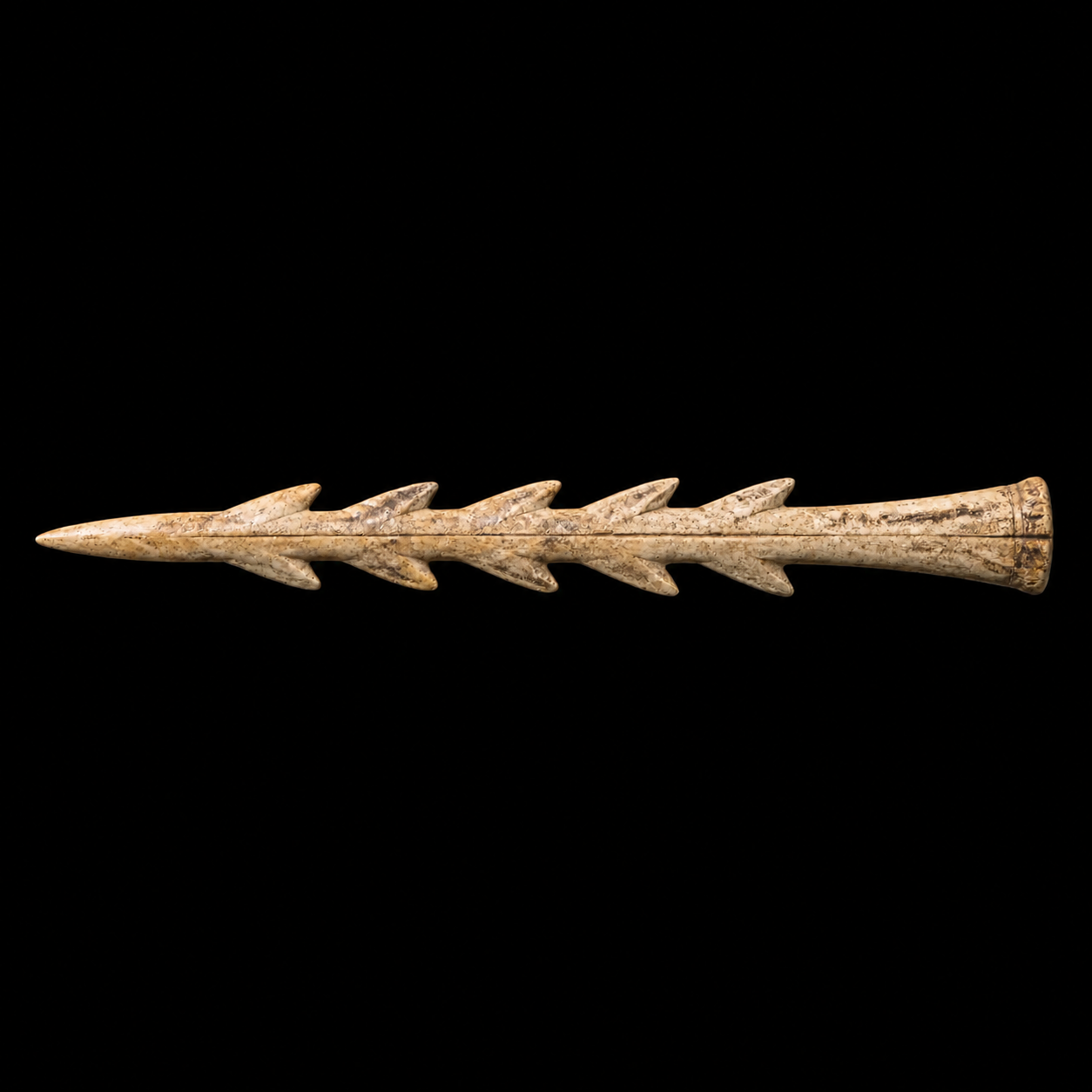
Load the model only when you want to explore it. Drag or use the arrow keys to turn it; + and − zoom. Closing it releases its memory.
User-supplied digital reconstruction; file metadata declare Tripo. It is not an archaeological scan nor a metric replica. The display scale is indicative, not a measurement of the original; the supplied geometry is preserved intact. Interpretation of the Laugerie-Basse harpoon. The barbs and proportions are not presented as a metric facsimile nor as an experimental demonstration of its functioning.
History and context
Carved from reindeer antler, the harpoon retains two rows of barbs in barely thirteen centimetres. Attached to a shaft or line, such a design could penetrate and make it difficult for the point to slip out of the prey's body.
The label 'hunting or fishing' summarises capabilities, not a proven scene. The object was in the Musée de l'Homme reserves: belonging to a collection does not imply permanent display.
Evidence and interpretation
Material, barbs, provenance and measurements are documented. Prey, exact hafting system and occasion of use are not preserved.
Catalogue facts
- Date
- ≈15,000 years · Magdalenian
- Location
- Laugerie-Basse · Les Eyzies, France
- Inventory
- MNHN-38.189.1775
- Material and measurements
- Reindeer antler · 13 × 2.1 × 0.7 cm
A SHARED TOPIC, DIFFERENT MOMENTS
Objects connected through time
Follow a topic across the collections. A shared tag is a way to compare objects, not proof that one culture influenced another.
The order uses the midpoint of each approximate date range; ranges can overlap. Spacing does not represent elapsed time. Swipe, scroll or use the arrows. With the sequence focused, use ← / →, Home or End.
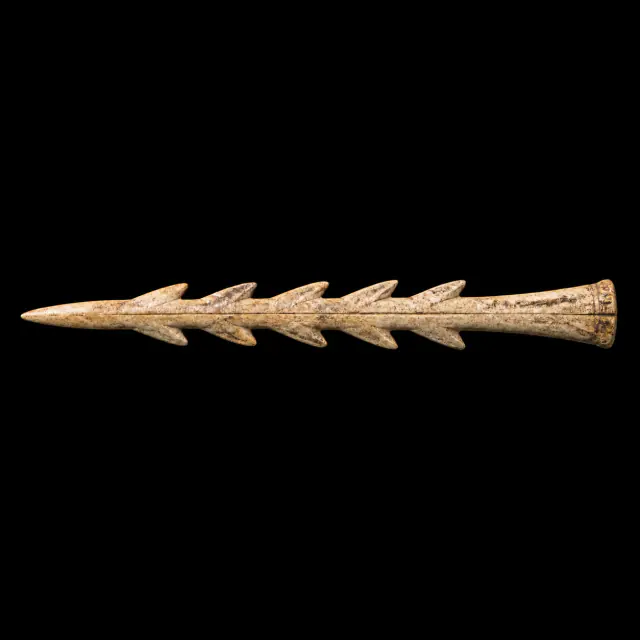
Antler1 dated object
Also connected, without a comparable date (1)
These objects are not placed after the others: an unknown date does not mean a more recent object.
- Fawn spear-throwerPrehistory · Middle Magdalenian
A closer look
About 4 min to read · 7 sections. Further reading and sources · free access. Editorial review recorded: .
People also lived on small prey
The Muséum links these points to the Magdalenian development of tools in bone, ivory and antler, and recalls the weight of fish, birds and small mammals in settlement remains. It is a counterweight to scenes dominated by large animals that often represent the Palaeolithic. This harpoon comes from the collections assembled by Paul de Vibraye in the 19th century and entered the museum in 1896. Its history combines an ancient technology with the modern process that made that diversity of foods visible.
One point, several parts to examine
The central point and the two rows of teeth play distinct roles: one opens the way; the others hinder the object from detaching. Observe also the opposite end, where its connection to the rest of the equipment would have been resolved. The name 'harpoon' often makes us automatically imagine a fisherman, a line and a wooden handle. However, what is preserved here is a piece of antler. The photograph does not by itself show how the complete instrument was mounted.
Working antler required decisions
Antler does not become a tool merely by sharpening one end. The study of bone industries distinguishes operations such as scraping, grooving and sawing, which allow blanks to be obtained and shaped. Recognising those operations helps separate the starting material from the chosen product. In this piece we see the result; to reconstruct its entire manufacture one would need to study its marks and compare them with other specimens. It is not enough for a modern procedure to produce a similar shape.
Was it really a harpoon?
In the technical sense, a harpoon is defined by its functioning, not merely by having barbs. The researcher Jean-Marc Pétillon warns that the form of many Magdalenian points does not allow us to be sure they were detachable heads secured by a line. Some may have been part of other hunting equipment. 'Barbed point' is therefore a more cautious description when the mounting pieces are missing. The museum's traditional designation is retained, but it does not turn a possible reconstruction into a certainty.
Animal bones also tell a story
To check whether these points were particularly associated with the capture of small animals, Pétillon compared their abundance with faunal remains at sites in the northern Pyrenees. The result did not confirm a clear relationship. This teaches something important: finding fish and a barbed point in a region does not prove that point was used to catch them. Contexts, frequencies and traces must be cross-checked. The question remains open without the instrument being any less interesting.
A much older comparison
At Katanda, in the present-day Democratic Republic of the Congo, barbed bone points dating to approximately 90,000–80,000 years ago were found, associated by researchers with the fishing of large catfish. They are much older than this French piece and belong to another context. Comparing them avoids telling the story as if every technical solution originated only once in Europe. A formal similarity allows questions about similar needs to be raised, but does not demonstrate a direct chain of transmission between the two places.
- Museum · Smithsonian Human Origins — Katanda bone harpoon pointAccess recorded: .
A kit was not made of a single material
Late Palaeolithic collections combine stone tools with others of bone, antler and ivory. Each material offered different possibilities; communities experimented and developed their own regional toolkits. That is why this harpoon is better understood alongside the tools used to work its surfaces, and not as an isolated invention. A good exercise is to compare the piece with a needle: both exploit animal materials, but their form responds to different tasks. They are not stages on a single ladder of progress.
- Museum · Smithithsonian Human Origins — Later Stone Age toolsAccess recorded: .
Location and territory
LOCATED SITE
Laugerie-Basse · FranceMarker for the archaeological rock shelter at Les Eyzies.Where it is held
Musée de l'Homme · MNHN
Item or group in the record · Library or archive
The institutional record places it in reserves.
The holding institution is documented; public display may change. Check its official record before visiting.
Sources and references
- Muséum national d’Histoire naturelle — Double-row barbed harpoon
- Jean-Marc Pétillon — Writing the history of techniques: the bone industries of the Late Palaeolithic
- Jean-Marc Pétillon — What are barbs for? (Palethnologie, 2009)
- Smithsonian Human Origins — Katanda bone harpoon point
- Smithithsonian Human Origins — Later Stone Age tools
Did you enjoy this exhibit?
Your opinion helps us improve the museum. You can change it whenever you like.
Loading your rating…