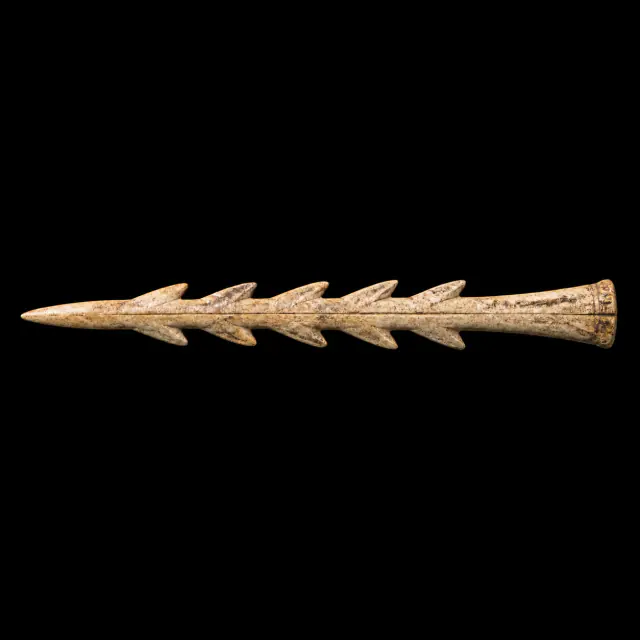
Declared visual reconstruction, created for museographic contextualisation; not a photograph of the original nor does it constitute documentary evidence.
History and context
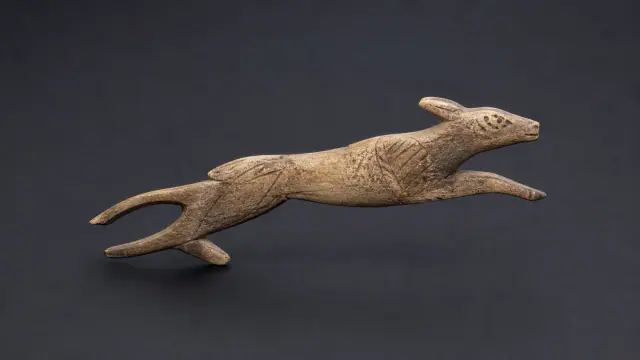
Carved from reindeer antler, the spear-thrower measures around 32 centimetres and combines a functional hook with an animal turning its head towards a form expelled beneath the tail. Its carving requires understanding volume, balance, and the stress the object would receive when propelling a dart.
The nickname "fawn with birds" summarises a traditional reading. An ibex, a doe giving birth, or a symbolic scene have also been seen. The museum preserves the ambiguity: we observe anatomy and composition, not the narrative that explained them.
Evidence and interpretation
Support, hook, carving, and provenance are observable. Species, sex, "birds", birth, and ritual function are debated interpretations; institutional sources disagree even on the exact year of discovery.
Catalogue facts
Date
Middle Magdalenian
Location
Mas-d'Azil Cave · Ariège, France
Material and measurement
Reindeer antler · ≈32 cm
Function
Spear-thrower with hook · open iconography
A SHARED TOPIC, DIFFERENT MOMENTS
Objects connected through time
Follow a topic across the collections. A shared tag is a way to compare objects, not proof that one culture influenced another.
The order uses the midpoint of each approximate date range; ranges can overlap. Spacing does not represent elapsed time. Swipe, scroll or use the arrows. With the sequence focused, use ← / →, Home or End.
THE CURRENT OBJECT
Its date is not sufficiently established to place it on the timeline. We keep it here, separate from the dated objects.
About 1 min to read · 1 section. Further reading and sources · free access. Editorial review recorded: .
The perforations pointing to a missing part
At the base of the spear-thrower, three perforations are preserved. The site interpretation proposes they served to attach it to a wooden handle, now lost: what we see could be only part of a composite instrument. Its delicate form also poses a tension between efficacy and fragility. That it can launch a dart does not prove it withstood repeated hunting. The proposal of a ceremonial use stems from that functional problem, but remains a hypothesis and not an observable property of the adornment.

 English
 Español
 Français
 Italiano
 Deutsch
 Русский
 Português
 Polski
 Română
 Svenska
 Norsk bokmål
 Suomi
 Türkçe
 العربية
 简体中文
 한국어
 हिन्दी
 Ελληνικά
 You are viewing