
 English
 Español
 Français
 Italiano
 Deutsch
 Русский
 Português
 Polski
 Română
 Svenska
 Norsk bokmål
 Suomi
 Türkçe
 العربية
 简体中文
 한국어
 हिन्दी
 Ελληνικά
24 · TREASURE · early 20th century
Hunter’s tunic
Mandé hunter’s tunic
The garment combines textiles, leather and elements believed to offer protection, associated with the hunter’s occupation.
Museum documentation · free public access, no account required.
Editorial visualisation · Contextual correspondence
Declared editorial visualisation, based on the cartography and sources of the fact sheet; it is not an exact historical frontier.
History and context
A garment made of textile, leather and packets/elements associated with protection and the hunter’s occupation.
Its history can open a discussion about ethics, specialisation and change, rather than illustrate medieval clothing. Limitation: its contents and attributed powers may be subject to restrictions; a catalogue entry does not grant cultural permission to reveal them.
Evidence and interpretation
VIVA+CUR. A garment made of textile, leather and packets/elements associated with protection and the hunter’s occupation. What this does not establish: its contents and attributed powers may be subject to restrictions; a catalogue entry does not grant cultural permission to reveal them.
Catalogue facts
- Narrative date
- early 20th century
- Location
- Mali or Côte d’Ivoire according to the museum record
- Material
- culturally sensitive clothing in a museum collection
- Context
- New York, accession 2000.160.57a,b. Custody: The Metropolitan Museum of Art.
- Curatorial reading
- The documented fact and its interpretation appear separately in the evidence block.
- Dossier axis
- daily-life
- Research record
- MANDE · EVI-10
- Documentary coverage
- 2 museum, heritage, primary corpus or research sources for this stop.
A SHARED TOPIC, DIFFERENT MOMENTS
Objects connected through time
Follow a topic across the collections. A shared tag is a way to compare objects, not proof that one culture influenced another.
The order uses the midpoint of each approximate date range; ranges can overlap. Spacing does not represent elapsed time. Swipe, scroll or use the arrows. With the sequence focused, use ← / →, Home or End.
Clothing3 dated objects
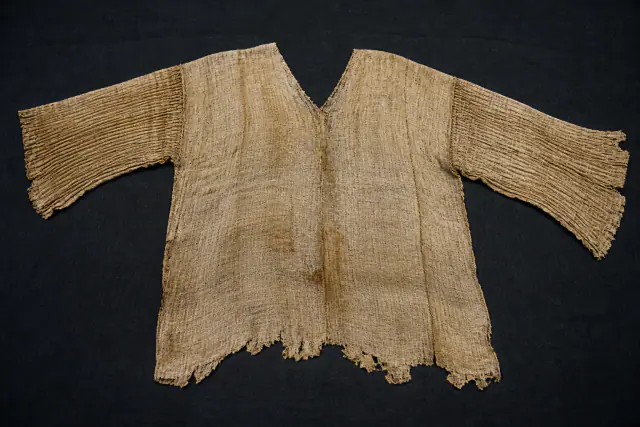
ca. 3482–3102 BCE (95 % probability)
Tarkhan Dress
Ancient Egypt
Published radiocarbon interval with 95 % probability.
Read the record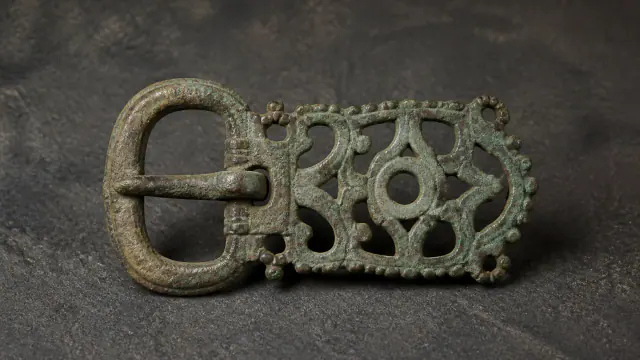
Second half of the IV century–V century CE
Simancas-type belt buckle
Iberians
The full 4th–5th centuries CE provide broad limits for chronological ordering; the record specifies the second half of the 4th century and the 5th.
Read the record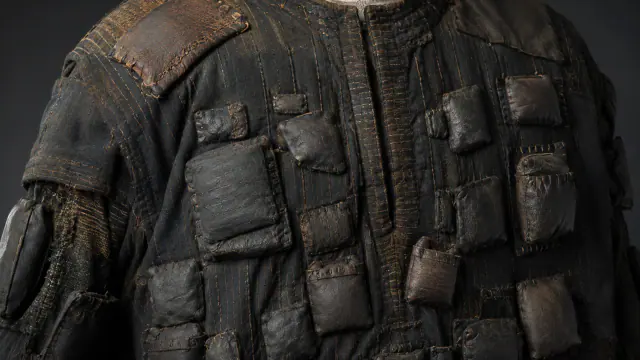 You are viewing
early 20th century
Hunter’s tunic
Mande Worlds
The full span of the 20th century provides the outer bounds for chronological ordering; the record specifies the early part of the century. The date refers to the garment, not to the origin of the hunters’ tradition.
Current record
Also connected, without a comparable date (2)
These objects are not placed after the others: an unknown date does not mean a more recent object.
- Bone needlePrehistory · No individual dating published on this record
- Dressing to be seenIberians · 6th–1st centuries BCE
A closer look
About 1 min to read · 1 section. Further reading and sources · free access. Editorial review recorded: .
From a worn garment to a collection record
The Metropolitan records this tunic with a height of 73.7 centimetres and a width of 71.1: dimensions that return a bodily scale to the image. It arrived at the museum as a donation from John B. Elliott, through The Mercer Trust, in 2000. That date belongs to its collection history, while its manufacture dates to the early twentieth century. Separating these chronologies allows following a concrete displacement: from a garment conceived to be worn on the body to an object conserved and catalogued.
Where it is held
The Metropolitan Museum of Art
Item or group in the record · Documented collection
The holding institution is documented; public display may change. Check its official record before visiting.
Sources and references
Did you enjoy this exhibit?
Your opinion helps us improve the museum. You can change it whenever you like.
Loading your rating…