
 English
 Español
 Français
 Italiano
 Deutsch
 Русский
 Português
 Polski
 Română
 Svenska
 Norsk bokmål
 Suomi
 Türkçe
 العربية
 简体中文
 한국어
 हिन्दी
 Ελληνικά
CLOTHING · WORK AND REPRESENTATION
Dressing to be seen
Cloak, belt, colour and jewellery constructed a social body
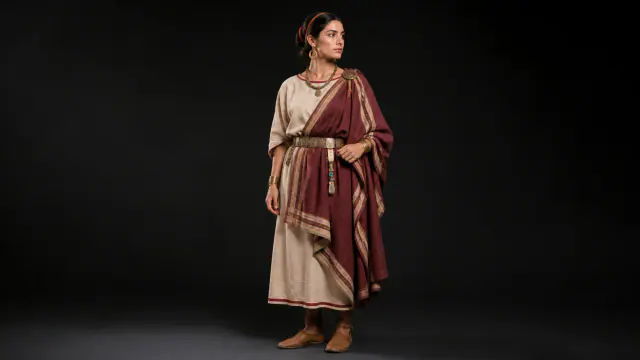
Sculptures and ceramics show tunics, cloaks, belts and jewellery of Iberian clothing.
Museum documentation · free public access, no account required.
Generated reconstruction · Declared visual hypothesis
Declared visual reconstruction; not a photograph of the original nor documentary evidence.
History and context
Sculptures and ceramics show superimposed tunics, heavy cloaks, veils, mitres, plaque belts, fibulae, earrings, necklaces, bracelets and intense colours. Residual polychromy reminds us that the figures were not conceived in white stone.
Dressing was a chain of actions: spinning and weaving, dyeing, fastening a fibula, adjusting a belt, balancing a jewel and deciding what object did not accompany work. Each layer required owners, artisans and care.
There is no uniform Iberian costume. Region, date, represented gender, age, rank and ritual context modified repertoires that art selects and idealises.
Evidence and interpretation
Documented fact: garments, broches, belts, jewellery and pigments appear in objects and representations. Interpretation and caution: images of elites or rituals do not describe the everyday clothing of the whole population.
Catalogue facts
- Narrative date
- 6th–1st centuries BCE
- Location
- Mediterranean and southern Iberian regions
- Material
- Linen, wool, leather, metal, pigments and polychrome stone
- Context
- Clothing as technique, identity and representation
- Classification
- Iberian collection or explicit interpretive resource
- Visual reference
- Comparison of polychromy, garments and jewellery in MAN and MARQ
A SHARED TOPIC, DIFFERENT MOMENTS
Objects connected through time
Follow a topic across the collections. A shared tag is a way to compare objects, not proof that one culture influenced another.
The order uses the midpoint of each approximate date range; ranges can overlap. Spacing does not represent elapsed time. Swipe, scroll or use the arrows. With the sequence focused, use ← / →, Home or End.
THE CURRENT OBJECT
Its date is not sufficiently established to place it on the timeline. We keep it here, separate from the dated objects.
 You are viewing
6th–1st centuries BCE
Dressing to be seen
Iberians
Synthesis of clothing over several centuries, not a dated garment.
Current recordClothing3 dated objects
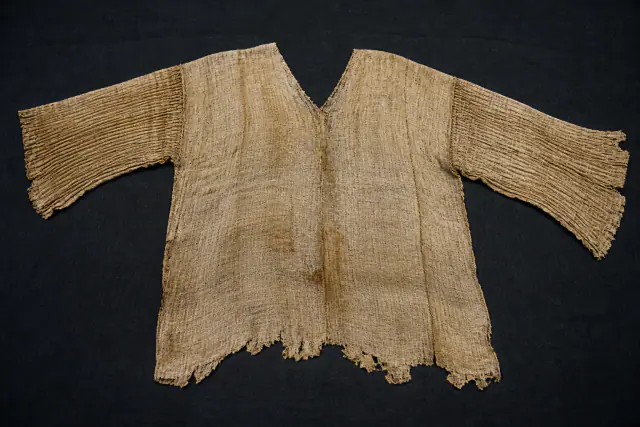
ca. 3482–3102 BCE (95 % probability)
Tarkhan Dress
Ancient Egypt
Published radiocarbon interval with 95 % probability.
Read the record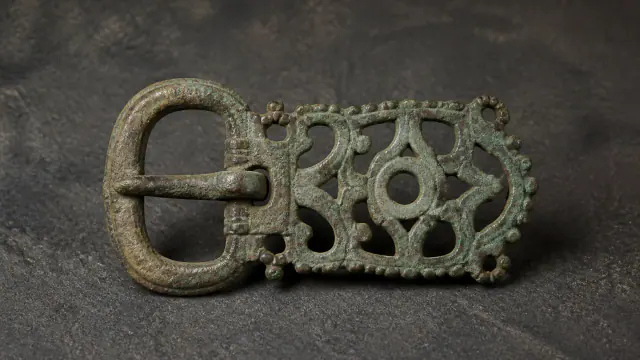
Second half of the IV century–V century CE
Simancas-type belt buckle
Iberians
The full 4th–5th centuries CE provide broad limits for chronological ordering; the record specifies the second half of the 4th century and the 5th.
Read the record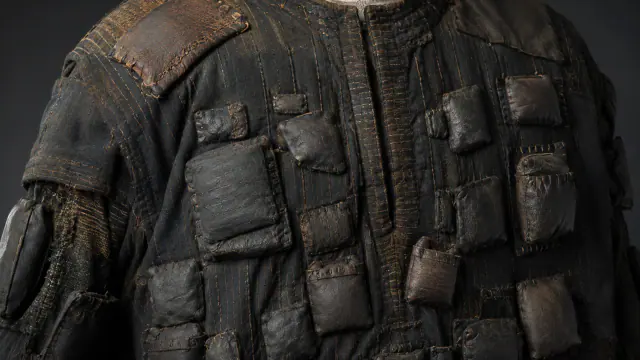
early 20th century
Hunter’s tunic
Mande Worlds
The full span of the 20th century provides the outer bounds for chronological ordering; the record specifies the early part of the century. The date refers to the garment, not to the origin of the hunters’ tradition.
Read the record
Also connected, without a comparable date (1)
These objects are not placed after the others: an unknown date does not mean a more recent object.
- Bone needlePrehistory · No individual dating published on this record
A closer look
About 1 min to read · 1 section. Further reading and sources · free access. Editorial review recorded: .
Hair, hairpieces and small fastenings
In her study of clothing, María Luisa de la Bandera distinguished representations of bands that would imitate braided hair and others interpreted as passementerie. These latter, called ínfulas in her classification, present cords, pendants and sometimes small chains with discs. In sculptures such as the Great Offering Lady of Cerro de los Santos she proposed recognising elements added to the natural hairstyle. The rosettes situated near the temples would be needle heads that helped to fix them. It is a reconstruction based on sculpted images: it allows asking what is braided, what hangs and what is fastened, without confusing all components with hair.
- Research · María Luisa de la Bandera · Female Iberian attire (II)Access recorded: .
Location and territory
REGIONAL AREA
Mediterranean and southern Iberian regionsMediterranean fringe and southern peninsula; not all Iberia was Iberian. The footprint indicates the orientative centre of the area, not a boundary nor an exact point.Sources and references
Did you enjoy this exhibit?
Your opinion helps us improve the museum. You can change it whenever you like.
Loading your rating…