
 English
 Español
 Français
 Italiano
 Deutsch
 Русский
 Português
 Polski
 Română
 Svenska
 Norsk bokmål
 Suomi
 Türkçe
 العربية
 简体中文
 한국어
 हिन्दी
 Ελληνικά
BELIEFS AND CURIOSITIES
Derveni Papyrus
Derveni: a book saved by fire
The fire destroyed the scroll and preserved its fragments.
Museum documentation · free public access, no account required.
Documentary original · Exact correspondence
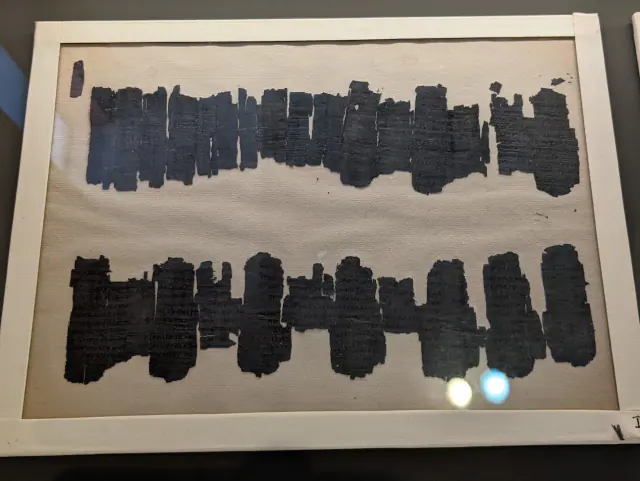
Fragments of the Derveni papyrus exhibited in the Archaeological Museum of Thessaloniki. Greek text of ritual and poetic commentary; not present it as a manuscript written in the Thracian language.
Katolophyromai · CC BY 4.0
History and context
The fire that destroyed much of the scroll also made it possible for its remains to survive. The charred fragments of the Derveni papyrus preserve a Greek reflection on religious practices and a poem attributed to Orpheus. The piece opens an exceptional window into the way sacred words were interpreted.
Derveni was found in Macedonia and is written in Greek. Its relationship with Thrace goes through traditions about Orpheus and contacts between neighboring societies. It is an exceptional testimony of the Greek world, but not a Thracian book nor proof that all Thracian peoples shared the same beliefs.
Evidence and interpretation
Macedonian find and Greek text. Comparison on Orphic traditions; no Thracian book nor proof of a Panthracian religion.
Catalogue facts
- Date
- copy conserved towards 340–320 BCE; comments on a previous text.
- Location
- Derveni · Central Macedonia, Greece
A SHARED TOPIC, DIFFERENT MOMENTS
Objects connected through time
Follow a topic across the collections. A shared tag is a way to compare objects, not proof that one culture influenced another.
The order uses the midpoint of each approximate date range; ranges can overlap. Spacing does not represent elapsed time. Swipe, scroll or use the arrows. With the sequence focused, use ← / →, Home or End.
Papyrus1 dated object
A closer look
About 1 min to read · 2 sections. Further reading and sources · free access. Editorial review recorded: .
Copy, poem and comment
The preserved writing is dated between 340 and 320 BCE; The commented composition is previous. Specialists reconstructed parts of 26 columns from the fragments. The document allows us to study how an ancient reader related a poem attributed to Orpheus with religious and philosophical questions.
- Museum · Thessaloniki Archaeological Museum: highlights, Derveni PapyrusAccess recorded: .
- Heritage · UNESCO: Derveni Papyrus, Memory of the WorldAccess recorded: .
A comparison with limits
The papyrus brings together different times: that of the poem attributed to a mythical figure, that of its interpretation and that of the copy that ended up next to a funeral pyre. Its author is not safely identified. The attribution to Euthyphro is an academic proposal, not a signature preserved on the scroll.
- Museum · Thessaloniki Archaeological Museum: highlights, Derveni PapyrusAccess recorded: .
- Heritage · UNESCO: Derveni Papyrus, Memory of the WorldAccess recorded: .
Location and territory
APPROXIMATE LOCATION
Derveni · Central Macedonia, GreeceApproximate reference of origin or production, not exact findspot.Where it is held
Thessaloniki Archaeological Museum
Item or group in the record · Documented collection
Greek papyrus found in Macedonia; comparative testimony, not Thracian writing.
The holding institution is documented; public display may change. Check its official record before visiting.
Sources and references
Did you enjoy this exhibit?
Your opinion helps us improve the museum. You can change it whenever you like.
Loading your rating…