
 English
 Español
 Français
 Italiano
 Deutsch
 Русский
 Português
 Polski
 Română
 Svenska
 Norsk bokmål
 Suomi
 Türkçe
 العربية
 简体中文
 한국어
 हिन्दी
 Ελληνικά
BELIEFS AND CURIOSITIES
Zalmoxis
Zalmoxis: immortality told from outside
Herodotus attributes to the Getae the belief in a life with Zalmoxis after death.
Museum documentation · free public access, no account required.
Contextual image · Contextual correspondence
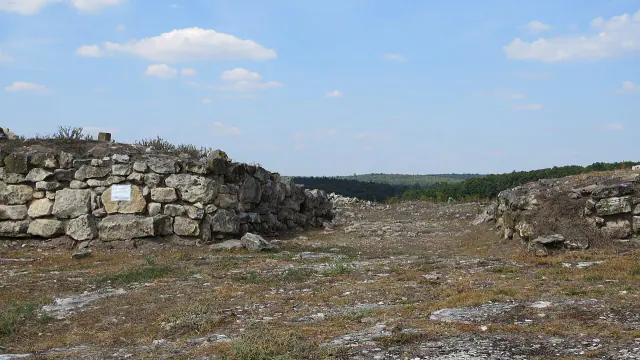
Southern gate of a Geta settlement at Sboryanovo/Sveshtari. Archaeological context, not the Zalmoxis cave or evidence of a cult in the photographed place. Archaeological and landscape context of the Getae, no portrait of Zalmoxis, no identified sanctuary of his, nor material evidence of the Greek stories about him. The toponymic identification with Helis is a historical proposal.
The original uploader was Octopus at Slovenian Wikipedia. · CC BY-SA 3.0
History and context
Herodotus says that the Getae conceived death as a transition to Zalmoxis. His story attributes a particular form of immortality to that belief. It is one of the most important ancient voices on the issue, but it comes through a Greek observer and the stories he heard.
The same author transmits another story: Zalmoxis would have taught notables during banquets and would have retired to an underground room before reappearing. Herodotus does not simply accept all the details. His story also preserves an ancient doubt about how to interpret that figure.
Evidence and interpretation
Geta tradition transmitted by Greek writers. There is no portrait or cave identified with certainty; The mythical story does not constitute a historical biography.
Catalogue facts
- Date
- testimony of Herodotus, 5th century BCE; no biographical date of the divinity.
- Location
- Geta area of the Lower Danube · textual tradition without its own site
A SHARED TOPIC, DIFFERENT MOMENTS
Objects connected through time
Follow a topic across the collections. A shared tag is a way to compare objects, not proof that one culture influenced another.
The order uses the midpoint of each approximate date range; ranges can overlap. Spacing does not represent elapsed time. Swipe, scroll or use the arrows. With the sequence focused, use ← / →, Home or End.
THE CURRENT OBJECT
Its date is not sufficiently established to place it on the timeline. We keep it here, separate from the dated objects.
 You are viewing
testimony of Herodotus, 5th century BCE; no biographical date of the divinity.
Zalmoxis
Thracians
Date of the testimony of Herodotus, not of the divinity or of a material piece.
Current recordArchives and documents8 dated objects
Above all 17th–13th centuries BCE
Boğazköy Archive
Hittites
Main date range for the archive, not a single date for all the tablets.
Read the record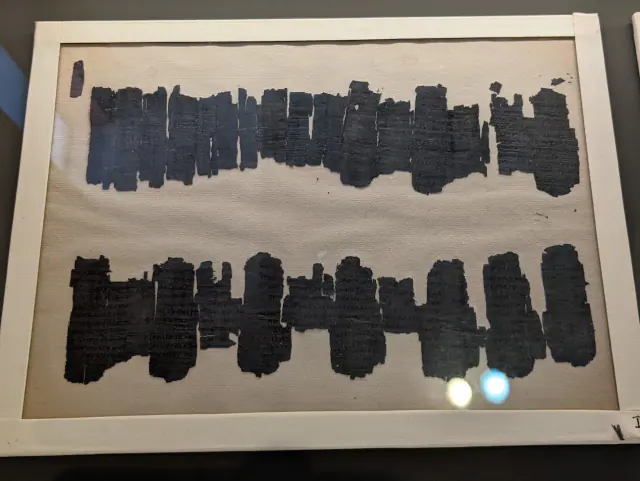
copy conserved towards 340–320 BCE; comments on a previous text.
Derveni Papyrus
Thracians
Date of preserved copy; The commented text is previous.
Read the record
Preserved manuscript: Postclassic, probably 13th–14th centuries; earlier knowledge
Venus in the codex
Maya worlds
Probable date of the preserved manuscript, not of the origin of its knowledge.
Read the record
28 April 1922
Bamum document
Bantu-speaking worlds
Year of the document dated 28 April.
Read the record
15 July 1952
Two songs, missing names
Batwa / Twa histories
Date of the concrete recording, not antiquity of the songs.
Read the record
1954
Batwa on a colonial record
Batwa / Twa histories
Date of the disc and its record, not of the origin of the musical tradition.
Read the record
2012–2013
A map with the right to be closed
Batwa / Twa histories
Date of the process and participatory cartographic document, not of the territory's occupation.
Read the record
Adopted April–May 2022; public portal 2025
Eleven articles
Batwa / Twa histories
Year of adoption of the decision; the portal's publication in 2025 is subsequent.
Read the record
Also connected, without a comparable date (9)
These objects are not placed after the others: an unknown date does not mean a more recent object.
- 49 Classical VoicesIberians · Authors and traditions between the 6th century BCE and 4th century CE
- Before Bantu WorldsBantu-speaking worlds · Modern linguistic reconstruction on historical and living languages
- Dance with weaponsThracians · Towards 400 BCE. Xenophon's story
- Kumbi SalehMande Worlds · medieval occupation; prominent phases between the 11th and 13th centuries
- Shum LakaBantu-speaking worlds · c. 8,000 and 3,000 years before present
- The Banquet of Seuthes IIThracians · Towards 400 BCE. Anabasis episode
- The cost of transcriptionSan histories · 19th century–current digital edition
- Translating faithBantu-speaking worlds · 16th–18th centuries
- Voices from outsideGaramantes · Fifth century BCE–Late Antiquity
A closer look
About 1 min to read · 2 sections. Further reading and sources · free access. Editorial review recorded: .
Herodotus also expresses doubts
The Histories 4.93–96 distinguish the description of the Getae and an explanation transmitted by Greeks from the Hellespont and Pontus. The relationship with Pythagoras belongs to that disputed tradition. Later, Plato presents Zalmoxis as a deified king to whom healing formulas are attributed.
- Ancient text · Herodotus, Histories 4.93–96, Perseus/TuftsAccess recorded: .
- Research · Alan H. Griffiths, Oxford Classical Dictionary: ZalmoxisAccess recorded: .
Text and archeology dialogue
A tomb preserves material decisions about the treatment of the dead; An ancient story conveys ideas about death. Both pieces of evidence are valuable, but they do not say exactly the same thing. The news about Zalmoxis does not alone identify the divinity venerated at Sveshtari or the function of other treasure vessels.
- Ancient text · Herodotus, Histories 4.93–96, Perseus/TuftsAccess recorded: .
- Research · Alan H. Griffiths, Oxford Classical Dictionary: ZalmoxisAccess recorded: .
Location and territory
REGIONAL AREA
Geta area of the Lower Danube · textual tradition without its own siteRegional framework of the northern Aegean to the eastern Balkans and Lower Danube; not the border of a single state. The museum breaks down changes by period. The footprint indicates the orientative centre of the area, not a border nor an exact point.Sources and references
Did you enjoy this exhibit?
Your opinion helps us improve the museum. You can change it whenever you like.
Loading your rating…