
 English
 Español
 Français
 Italiano
 Deutsch
 Русский
 Português
 Polski
 Română
 Svenska
 Norsk bokmål
 Suomi
 Türkçe
 العربية
 简体中文
 한국어
 हिन्दी
 Ελληνικά
BEFORE THE DISPERSAL · RECONSTRUCTED LANGUAGES AND INHABITED LANDSCAPES
Before Bantu Worlds
Before the spread of Bantu languages
Comparing languages allows proposing ancient relationships, but not reconstructing a single route followed by all their communities.
Museum documentation · free public access, no account required.
Editorial visualisation · Contextual correspondence
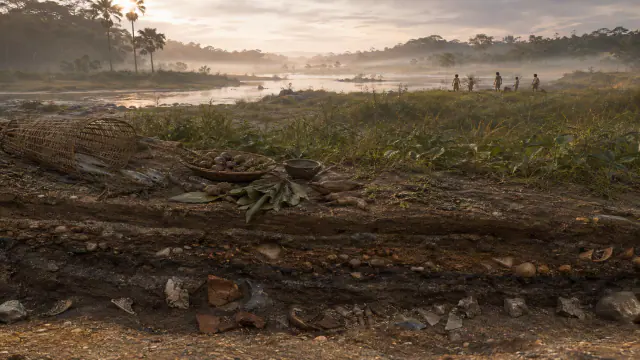
Declared editorial visualisation, based on the cartography and sources of the fact sheet; it is not an exact historical frontier.
History and context
Long before the expansion of Bantu languages, central and western Africa hosted communities with diverse technologies, mobilities and economies. The proposed Grassfields region for proto-Bantu was not an empty starting point nor a homeland with borders.
Historical linguistics compares sounds and vocabularies to reconstruct kinships. Archaeology, palaeoenvironment and genetics formulate complementary questions, but no pot speaks a language and no gene carries a complete cultural identity.
Evidence and interpretation
Documented fact: Hundreds of languages show systematic correspondences that allow reconstructing ancestral forms and ramifications. Interpretation and caution: A linguistic tree simplifies contact, bilingualism, displacement and adoption; it does not equal a biological tree of peoples. Historical transition: The museum’s start is not a departure date, but the gradual convergence of linguistic branches, populations and archaeological assemblages in several corridors. Limit of the transition: Do not automatically attribute all Iron Age pottery or metallurgy to Bantu speakers, nor suppose that agriculture, iron and language travelled together in a single movement.
Catalogue facts
- Previous period
- Late Pleistocene–≈3000 BCE
- Sphere of influence
- West-central Africa · forests, savannas and networks prior to proto-Bantu diversification
- Threshold element
- The proto-Bantu reconstruction: an object that does not exist
- Element date
- Modern linguistic reconstruction on historical and living languages
- Location
- West-central Africa · debated region of origin
- Material or support
- Phonological series, compared vocabularies and phylogenetic models
- Bantu means
- A branch of Niger-Congo languages and the societies that speak them; not a homogeneous civilisation
- Method
- Cross linguistics, archaeology, palaeoenvironment, genetics and oral history while maintaining their boundaries
- Scale
- More than five hundred languages and hundreds of regional histories, not a single demographic march
- Caution
- Ceramics, iron, cultivation, genes and language do not always move together
- Visual credit
- OpenAI ImageGen · editorial direction Tracekeepers · original visualisation for the project
A SHARED TOPIC, DIFFERENT MOMENTS
Objects connected through time
Follow a topic across the collections. A shared tag is a way to compare objects, not proof that one culture influenced another.
The order uses the midpoint of each approximate date range; ranges can overlap. Spacing does not represent elapsed time. Swipe, scroll or use the arrows. With the sequence focused, use ← / →, Home or End.
THE CURRENT OBJECT
Its date is not sufficiently established to place it on the timeline. We keep it here, separate from the dated objects.
 You are viewing
Modern linguistic reconstruction on historical and living languages
Before Bantu Worlds
Bantu-speaking worlds
Modern linguistic reconstruction; not an individual ancient document or object.
Current recordLanguages1 dated object

Also connected, without a comparable date (5)
These objects are not placed after the others: an unknown date does not mean a more recent object.
- 49 Classical VoicesIberians · Authors and traditions between the 6th century BCE and 4th century CE
- Ba-ntuBantu-speaking worlds · A long linguistic history; an academic term since the 19th century
- Clicks and contactBantu-speaking worlds · precolonial contacts with varying chronologies and subsequent continuity
- Indian Ocean KiswahiliBantu-speaking worlds · from the first millennium CE; major development in medieval and modern times
- Voices from outsideGaramantes · Fifth century BCE–Late Antiquity
A closer look
About 1 min to read · 1 section. Further reading and sources · free access. Editorial review recorded: .
A plant name that predates the branching
Bostoen, Grollemund and Koni Muluwa examine the reconstruction *-téndé, related to the oil palm. Its distribution is not limited to Bantu languages: it also appears in related external branches, allowing a pre-Proto-Bantu inheritance to be proposed. In some eastern languages, continuators of the term came to designate other palms when the vegetation changed. The example offers a concrete window onto the preceding period: plant knowledge could be inherited and later transformed semantically. The relative antiquity of a word does not need to become an exact migration date.
The region before this culture
Late Pleistocene–≈3000 BCE · West-central Africa · forests, savannas and networks prior to proto-Bantu diversification
Before the 3rd millennium BCE · Documented
Pre-kingdom Landscapes
Diverse communities occupy savannas and forests before an identifiable dispersal of Bantu languages.
≈3000–1500 BCE · Debated
Reconstructed Proto-Bantu
Linguistic comparison proposes an ancestral community and vocabulary, not a text nor a state.
II millennium BCE · Debated
Early diversifications
Western and eastern routes are modelled using evidence still under review.
What changes and what we should not assume
The museum’s start is not a departure date, but the gradual convergence of linguistic branches, populations and archaeological assemblages in several corridors.
Do not automatically attribute all Iron Age pottery or metallurgy to Bantu speakers, nor assume that agriculture, iron and language travelled together in a single movement.
The proto-Bantu reconstruction: an object that does not exist
Modern linguistic reconstruction on historical and living languages · West-central Africa · debated region of origin
Makes visible that the earliest evidence is primarily a relationship between languages, not a single archaeological relic.
Hundreds of languages show systematic correspondences that allow reconstruction of ancestral forms and branches.
A linguistic tree simplifies contact, bilingualism, displacement and adoption; it does not equal a biological tree of peoples.
Phonological series, compared vocabularies and phylogenetic models
Tracekeepers · ImageGen · OpenAI ImageGen · editorial direction Tracekeepers · Original visualization for the project
- Bantu means
- A branch of Niger-Congo languages and the societies that speak them; not a homogeneous civilisation
- Method
- Cross linguistics, archaeology, palaeoenvironment, genetics and oral history while maintaining their boundaries
- Scale
- More than five hundred languages and hundreds of regional histories, not a single demographic march
- Caution
- Ceramics, iron, cultivation, genes and language do not always move together
Location and territory
REGIONAL AREA
West-central Africa · debated region of originCurrent maximum linguistic envelope and historical corridors; it was not a single political territory nor was it occupied simultaneously. The footprint indicates the indicative centre of the sphere, not a border or an exact point.Sources and references
- Tracekeepers · ImageGen · original visualisation for the project
- UNESCO · Ecosystem and Relict Cultural Landscape of Lopé-Okanda
- Nature · Genetic legacy of the Bantu-speaking expansions
- Comptes Rendus Géoscience · Bostoen, Grollemund y Koni Muluwa, Climate-induced vegetation dynamics and the Bantu Expansion, 2013
Did you enjoy this exhibit?
Your opinion helps us improve the museum. You can change it whenever you like.
Loading your rating…