
 English
 Español
 Français
 Italiano
 Deutsch
 Русский
 Português
 Polski
 Română
 Svenska
 Norsk bokmål
 Suomi
 Türkçe
 العربية
 简体中文
 한국어
 हिन्दी
 Ελληνικά
AMERICAS · PATAGONIA
Cueva de las Manos
Hands marked with pigment
To leave these silhouettes, pigment was applied around hands placed on the rock.
Museum documentation · free public access, no account required.
Documentary original · Exact correspondence
Documentary photograph of the original or the site indicated in the record.
CC BY-SA 2.0
History and context
Hundreds of negative silhouettes cover the walls of the Pinturas River canyon. The technique is as simple as it is powerful: place the hand and spray pigment around it. What remains visible is not the painting of a hand, but the exact place a body occupied and then left.
Reds, ochres, yellows, whites and blacks coexist with guanacos and hunting scenes. The animals depicted still roam the region. That continuity makes the wall not only human memory: it is also an archive of persistent relationships with the Patagonian landscape.
Evidence and interpretation
The general sequence is situated approximately between 9300 and 1300 BP; the early hunting scenes, between 9400 and 7700 BP. Not all hands on the panel have been dated one by one and the state of conservation does not depend on a modern pictorial restoration.
Catalogue facts
- Date
- Sequence ≈9300–1300 BP
- Location
- Pinturas River Canyon · Santa Cruz, Argentina
- Technique
- Negative stencilling with sprayed pigment
- Subject
- Hands, guanacos and hunting scenes
- Landscape
- Guanacos still inhabit the region
- Conservation
- Exceptionally preserved ensemble, not repainted
A SHARED TOPIC, DIFFERENT MOMENTS
Objects connected through time
Follow a topic across the collections. A shared tag is a way to compare objects, not proof that one culture influenced another.
The order uses the midpoint of each approximate date range; ranges can overlap. Spacing does not represent elapsed time. Swipe, scroll or use the arrows. With the sequence focused, use ← / →, Home or End.
Pigments14 dated objects
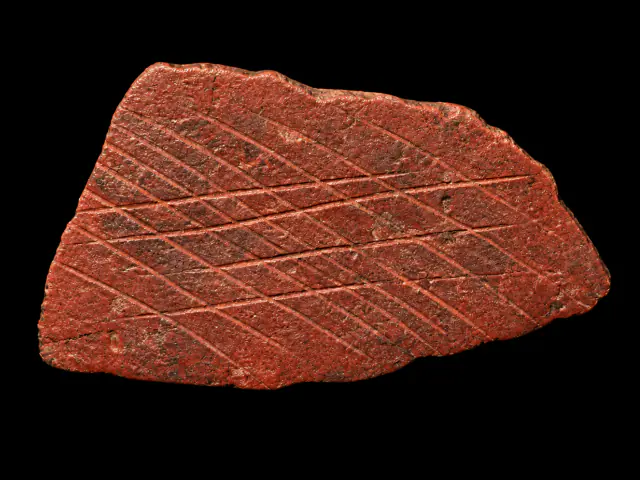
≈77,000–75,000 years
Engraved ochre from Blombos
Prehistory
Approximate catalogue age; editorial reference 2026 for ordering only, not calibrated dating.
Read the record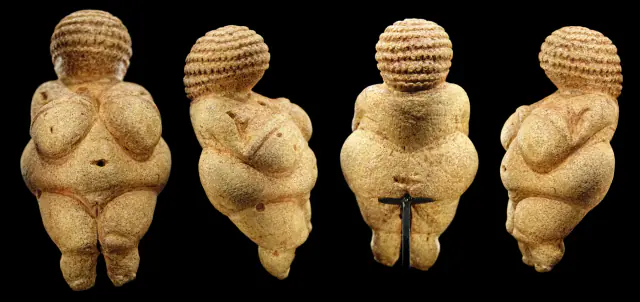
≈29,500 years
Willendorf
Prehistory
Approximate catalogue age; editorial reference 2026 for ordering only, not calibrated dating.
Read the record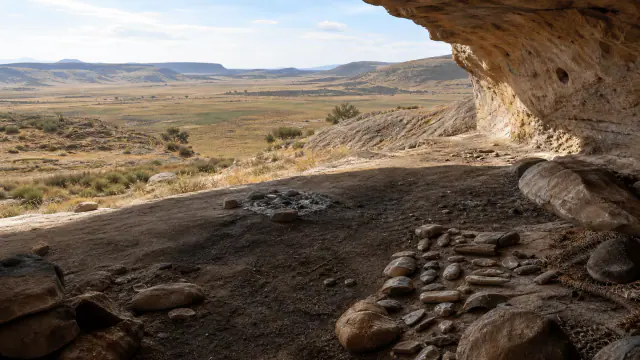
≈25.500–23.500 BCE
Before the San
San histories
Date of the representative element, not ethnic attribution of its authors.
Read the record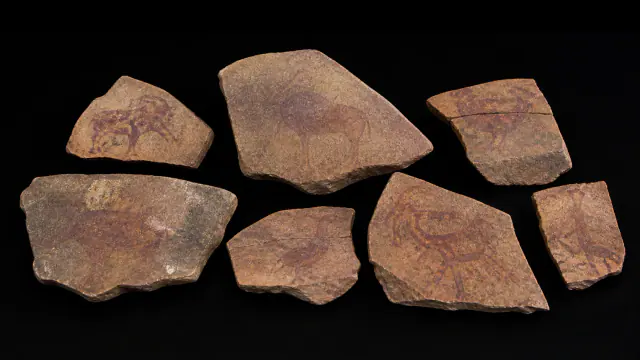
≈25.500–23.500 BCE
Before the name San
San histories
Dating of the context of the slabs; anonymous authors.
Read the record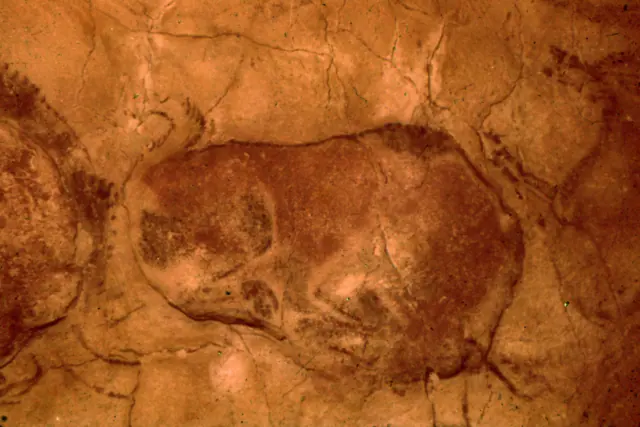
Assemblage ≈36,000–13,000 BP · bison ≈18,400–15,300 cal BP
Altamira
Prehistory
Assemblage range ≈36,000–13,000 BP, converted with 1950 origin; not a single date for the bison. It is an approximate scale conversion for ordering; not a new radiocarbon calibration.
Read the record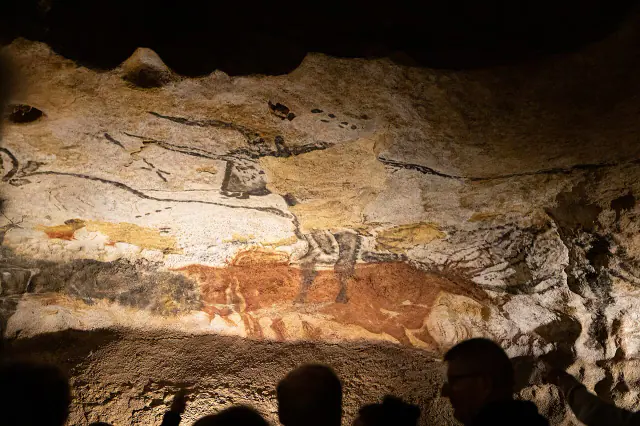
≈23,500–21,000 cal BP · debated contextual estimate
Lascaux
Prehistory
≈23,500–21,000 cal BP with 1950 origin; debated contextual estimate, replica image. It is an approximate scale conversion for ordering; not a new radiocarbon calibration.
Read the record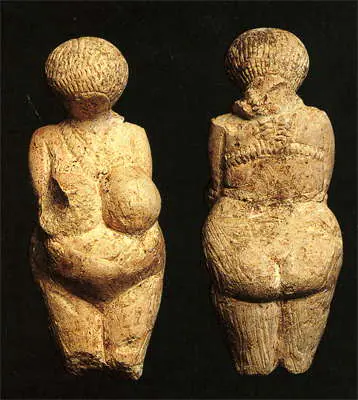
≈23,000–21,000 years
Kostenki I
Prehistory
Approximate catalogue age; editorial reference 2026 for ordering only, not calibrated dating.
Read the record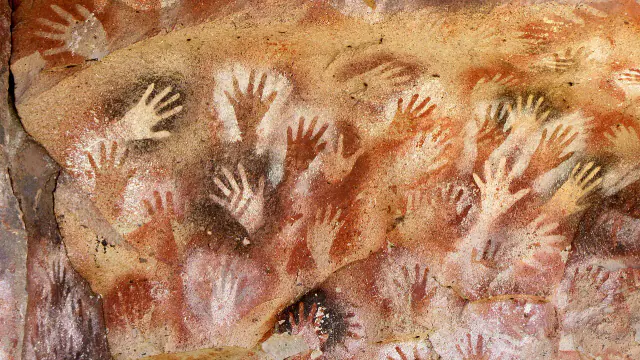 You are viewing
Sequence ≈9300–1300 BP
Cueva de las Manos
Prehistory
Sequence ≈9300–1300 BP converted with 1950 origin; not a single date for all images. It is an approximate scale conversion for ordering; not a new radiocarbon calibration.
Current record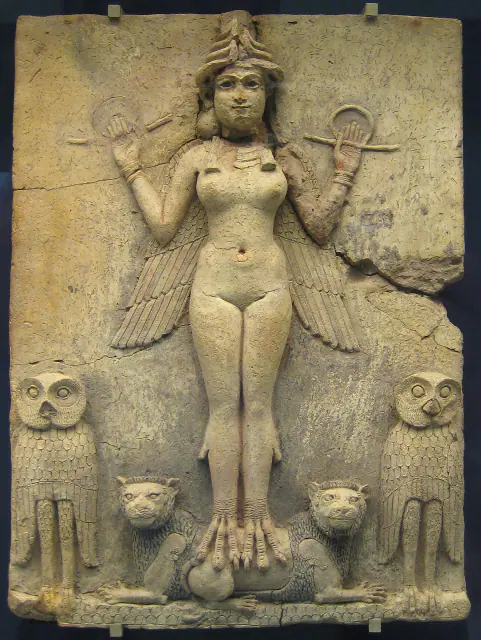
19th–18th centuries BCE
Overlapping datesQueen of the Night
Sumer
Approximate dating according to the record.
Read the record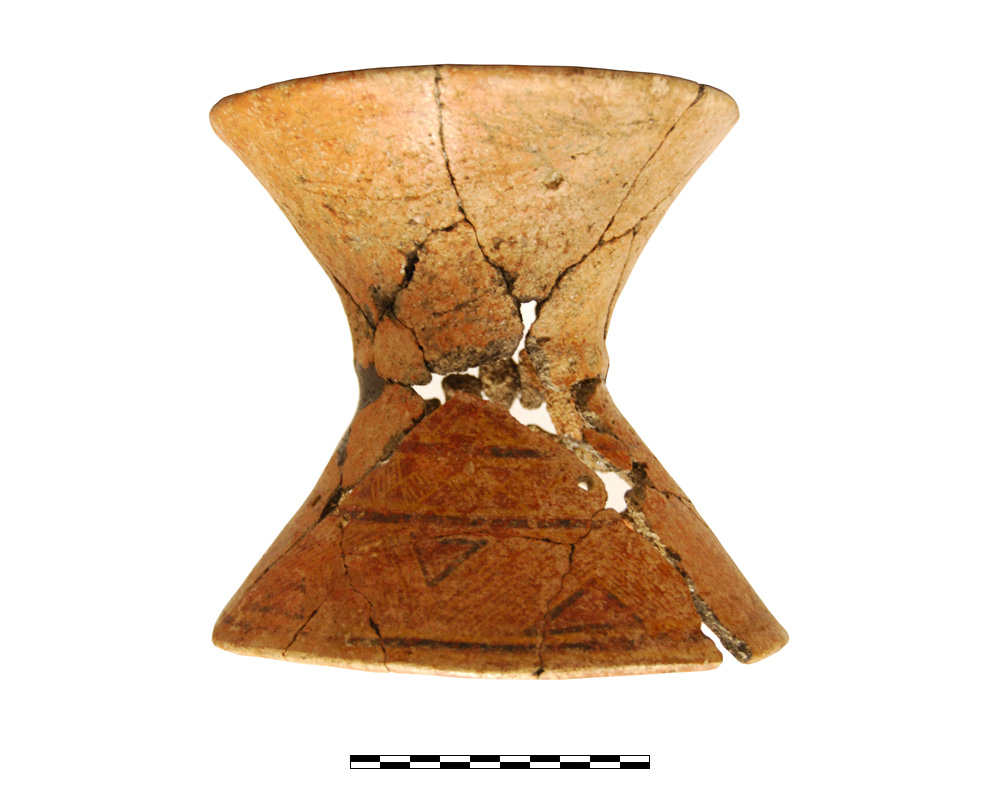
8th–7th centuries BCE · orientalizing
Overlapping datesCeramic stand 1010
Iberians
Chronology of the funerary context of Tomb 5, Orientalising horizon.
Read the record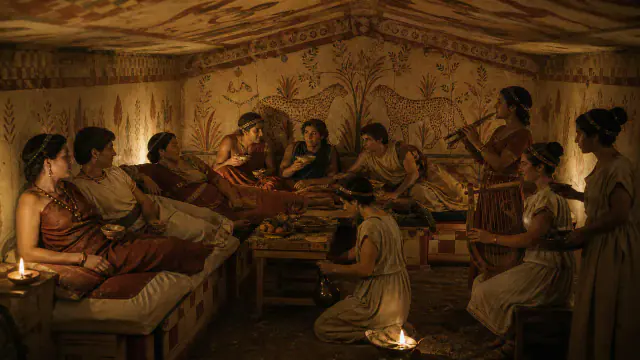
Around 480–470 BCE
Overlapping datesBanquet under leopards
Etruscans and Rome
Approximate dating according to the record.
Read the record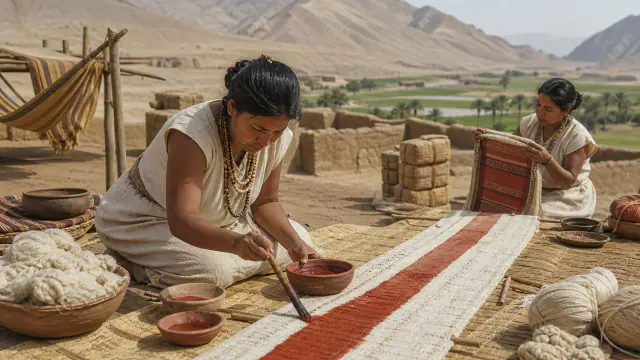
4th–3rd centuries BCE
Overlapping datesThe Karwa textile
Pre-Inca cultures
Approximate dating according to the record.
Read the record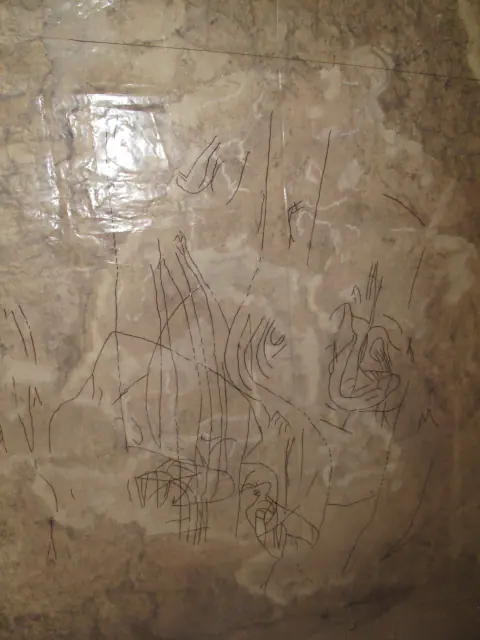
c. 100 BCE
Overlapping datesThe walls of San Bartolo
Maya worlds
Approximate dating according to the record.
Read the record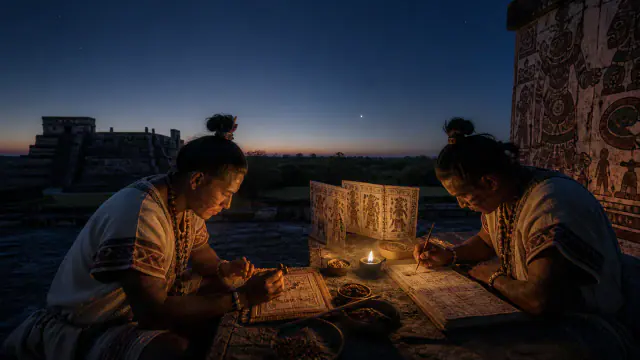
Preserved manuscript: Postclassic, probably 13th–14th centuries; earlier knowledge
Venus in the codex
Maya worlds
Probable date of the preserved manuscript, not of the origin of its knowledge.
Read the record
Also connected, without a comparable date (9)
These objects are not placed after the others: an unknown date does not mean a more recent object.
- BhimbetkaPrehistory · Mesolithic–historical and medieval period
- Blue that does not yieldMaya worlds · Documented use from the Classic, c. 300–1500 CE
- Eland CavePrehistory · Regional tradition of ≈4,000 years · up to historical period
- Game Pass ShelterSan histories · Regional rock art chronology · panel not dated in isolation
- KakaduPrehistory · Regional corpus ≈20,000 BP–contemporary era
- Leang KarampuangPrehistory · Minimum 51,200 years · dating published in 2024
- Quinkan CountryPrehistory · Regional art up to ≈27,000 BP · modern continuity
- Sierra de San FranciscoPrehistory · Broad tradition with direct dates ≈5290–295 BP
- Tassili n’AjjerPrehistory · Corpus ≈6000 BCE–first centuries CE
A closer look
About 1 min to read · 1 section. Further reading and sources · free access. Editorial review recorded: .
A wall with layers of time
Superpositions allow part of the figures to be ordered: a painting that covers another had to be made later, even if we do not know the year. Studies combine that relationship with colours, sectors and excavated remains. The palette includes iron oxides, kaolin, natrojarosite and manganese compounds, prepared with some binder. Thus, the ensemble is not read as a work executed at once. The same wall was chosen again, and each intervention left a material relationship with images that were already there.
Location and territory
LOCATED SITE
Cueva de las Manos · ArgentinaMarker for the Pinturas River Canyon and its rock art ensemble.Sources and references

Did you enjoy this exhibit?
Your opinion helps us improve the museum. You can change it whenever you like.
Loading your rating…