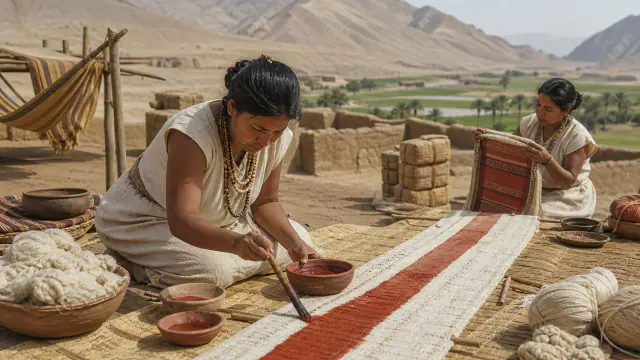
Declared visual reconstruction for museographic context; it is not a photograph of the original nor documentary evidence.
History and context
A fragment of cotton attributed to the Ica region bears, painted with red earth, a being with bird claws, fangs and serpentine hair. Its design approximates Chavín carvings, but the support belongs to the long textile mastery of the coast.
Textiles could carry images, knowledge and prestige between regions more easily than a monolith. The ancient provenance of this specimen was recorded as ‘said to be’ from Karwa: its comparative value is great, but the precise archaeological trajectory is incomplete.
Coastal cotton bears a clawed, fanged, serpent-haired being painted with ferruginous earth. A portable support could carry highland conventions much farther than a monolith.
The museum record notes a provenance attributed to Karwa, not a fully documented modern excavation. Its iconographic comparison is valuable, while the exact itinerary of the piece remains incomplete.
Evidence and interpretation
Documented fact: the Met fragment is cotton painted with ferruginous earth pigment, dated to the IV–III centuries BCE, with motifs related to Chavín. Interpretation and caution: facilitating diffusion is a functional proposal; the Karwa/Ica provenance does not derive from a fully documented modern excavation.
Catalogue facts
Narrative date
4th–3rd centuries BCE
Location
Ica Region, southern coast of Peru, attributed provenance
Material
Woven cotton · refined ferruginous earth pigment
Context
Portable textile, visual circulation and cautious provenance
Curatorial reading
The documented fact and its interpretation appear separately in the evidence block.
Date
4th–3rd centuries BCE
Location
Ica Region, southern coast of Peru, attributed provenance
Support
Woven cotton · refined ferruginous earth pigment
Documentary coverage
3 museum, heritage, primary corpus or research sources for this stop.
A SHARED TOPIC, DIFFERENT MOMENTS
Objects connected through time
Follow a topic across the collections. A shared tag is a way to compare objects, not proof that one culture influenced another.
The order uses the midpoint of each approximate date range; ranges can overlap. Spacing does not represent elapsed time. Swipe, scroll or use the arrows. With the sequence focused, use ← / →, Home or End.
About 1 min to read · 1 section. Further reading and sources · free access. Editorial review recorded: .
An image that continued beyond the fragment
The Metropolitan fragment preserves only part of a composition that could have repeated indefinitely. The red octagons surround a supernatural being and the serpentine forms end in profile heads; two of them, one inverted, in turn form another mouth with fangs. This play allows reading the image at several scales, moving from detail to a larger being. The slip dates the painting to the IV–III centuries BCE. Understanding the repeatable pattern avoids treating the current broken edge as if it were the artist’s originally designed limit.
Ica Region, southern coast of Peru, attributed provenanceCoast, highlands and Altiplano: seven areas and overlapping chronologies, not a frontier nor a single civilisation. The footprint marks the orientative centre of the realm, not a frontier nor an exact point.

 English
 Español
 Français
 Italiano
 Deutsch
 Русский
 Português
 Polski
 Română
 Svenska
 Norsk bokmål
 Suomi
 Türkçe
 العربية
 简体中文
 한국어
 हिन्दी
 Ελληνικά