IRON TECHNOLOGY · THE COLLADOS
Falcata from Almedinilla Three sheets, silver and the risk of welding
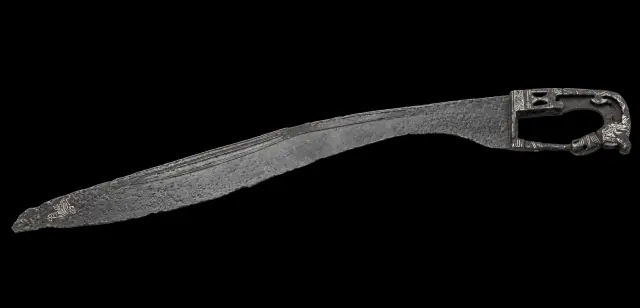
This sword combines several iron sheets, silver decoration and a hilt with a horse's head.
ON THIS PAGE
History and context Evidence and facts Objects connected through time Further reading Reference images Where it is held Sources and references Comments Museum documentation · free public access, no account required.
⛶ Enlarge image← Previous Image 1 of 2 · Main image Next →
Main image 2 RECONSTRUCTION FROM THE ORIGINAL · AI · CC BY-SA 3.0 Reconstruction · Declared visual hypothesis
Interpretive reconstruction with AI from two photographs by Luis García (Zaqarbal): full view CC BY-SA3.0 and hilt detail CC BY-SA2.0. Adaptation distributed CC BY-SA3.0. Changes: black background, moderate turn and conservative surface finish. It is not an archaeological photograph nor a certified restitution. Microdetails, finish and colour are interpretive approximations.
Tracekeepers / OpenAI ImageGen; source photograph: Luis García (Zaqarbal) · National Archaeological Museum of Spain · Inventory: MAN 10475 · CC BY-SA 3.0
View full image: RECONSTRUCTION FROM THE ORIGINAL · AI · CC BY-SA 3.0 RECONSTRUCTION FROM THE ORIGINAL · AI · CC BY-SA 3.0 Reconstruction · Declared visual hypothesis
Interpretive reconstruction with AI from two photographs by Luis García (Zaqarbal): full view CC BY-SA3.0 and hilt detail CC BY-SA2.0. Adaptation distributed CC BY-SA3.0. Changes: black background, moderate turn and conservative surface finish. It is not an archaeological photograph nor a certified restitution. Microdetails, finish and colour are interpretive approximations.
Tracekeepers / OpenAI ImageGen; source photograph: Luis García (Zaqarbal) · National Archaeological Museum of Spain · Inventory: MAN 10475 · CC BY-SA 3.0
View full image: ORIGINAL PHOTOGRAPH · Luis García (Zaqarbal) · CC BY-SA 3.0 ORIGINAL PHOTOGRAPH · Luis García (Zaqarbal) · CC BY-SA 3.0 Documentary original · Exact correspondence
Documentary photograph without semantic retouching. Preserves the condition and visible details of the reference piece.
Luis García (Zaqarbal) · National Archaeological Museum of Spain · Inventory: MAN 10475 · CC BY-SA 3.0
History and context The MAN piece was made by forging together several iron sheets; the central one continued within a horse-head-shaped hilt. The curvature displaces mass towards the striking zone. This example lacks a back edge: not all falcatas shared exactly the same blade.
Damascening inlays silver into iron and turns technology into prestige. The quality of falcatas varied: carburisation, welding, tempering and finish did not respond to a uniform industrial recipe, and a defective weld could ruin work and reputation.
It was found in 1867 in a tomb at Los Collados. The incomplete ancient context obliges separating the secure biography of the object from the probable reconstruction of its owner.
Evidence and interpretation Documented fact: iron, welded construction, silver decoration, chronology and funerary provenance. Interpretation and caution: not all falcatas had identical microstructure, patina or efficacy; nor were they the universal sword of all Iberian peoples.
Catalogue facts
Narrative date 4th–3rd centuries BCE
Location Necropolis of Los Collados, Almedinilla (Córdoba)
Material Iron/steel and silver damascening
Context Prestige weapon from a tomb
Classification Iberian collection or explicit interpretive resource
Visual reference Official photograph of the falcata · MAN, room 11
In this grouping Iron weapon from a tomb; its deposit alone does not reconstruct a battle. Iron7 Silver19 Arms and military equipment29 Metalworking23 Funerary contexts64
The order uses the midpoint of each approximate date range; ranges can overlap. Spacing does not represent elapsed time. Swipe, scroll or use the arrows. With the sequence focused, use ← / →, Home or End.
Earlier Later
2 / 3 In the centre: Falcata from Almedinilla
Also connected, without a comparable date (4) These objects are not placed after the others: an unknown date does not mean a more recent object.
You can scroll the first group without JavaScript. The other topics are also available below.
Silver The goat from PG 1237 · ca. 2600–2400 BCE · SumerStag Vessel · 14th–13th centuries BCE · HittitesBefore the Iberias · Final Bronze, c. 1000 BCE · IberiansTwenty-six voiceless signs · 5th–4th centuries BCE · Scythians and SakaRogozen · mainly 5th–4th centuries BCE; The set has a history of accumulation, not a single manufacturing date. · ThraciansThe silver amphora of Chertomlyk · 4th century BCE · Greek worldsTreasure of Jávea · 4th century BCE · IberiansThoth in the form of a baboon · 664–30 BCE · Ancient EgyptPoroina Mare Rhyton · Second half of the 4th century BCE · ThraciansBorovo · 4th century BC C.; 350–300 BCE in the ISAW catalog. · ThraciansFalcata from Almedinilla · 4th–3rd centuries BCE · Iberians — You are viewingTreasure of Cheste · Jewellery from the 4th–3rd centuries BCE; concealment at the end of the 3rd century BCE. · IberiansMairena Hoard · 3rd century BCE · IberiansChão de Lamas pectoral · 3rd–2nd centuries BCE · concealed in the early 1st century BCE · IberiansVase from Chão de Lamas · Piece: III–II centuries BCE · concealment ≈110–76 BCE · IberiansHorse fibula · 2nd century BCE · disputed chronology · IberiansThe dismantled cauldron · 2nd–1st centuries BCE · Celtic worldsPatera from Perotito · Second half of the 2nd–beginnings of the 1st century BCE · IberiansDenarius of Carisius · ≈25–23 BCE · IberiansArms and military equipment Bilateral harpoon · ≈15,000 years · Magdalenian · PrehistoryNahal Hemar Knives · 8th millennium BCE · Pre-Pottery Neolithic B context · PrehistoryHolmegaard bow · ≈7000 BCE · PrehistoryGebel el-Arak knife · 3600–3200 BCE · Naqada II C–D · Ancient EgyptNarmer Palette · ca. 3100 BCE · Ancient EgyptStele of the Vultures · Towards 2450–2425 BCE · SumerNaram-Sin Stele · Reign of Naram-Sin, 2254–2218 BCE · SumerBefore Phoenicia · 20th–18th centuries BCE · PhoeniciansTalayotic sword · ≈1200–1000 BCE · destruction of the talayot towards 790 BCE · IberiansThe lute-shaped dagger · Towards 1000–400 BCE · Gojoseon and early KoreaSteppe kurgans · 7th–4th centuries BCE · Scythians and SakaBow and arrows in a case · 5th–4th centuries BCE · Scythians and SakaCoțofenești helmet · Second half of the 5th century – beginning of the 4th century BCE · ThraciansGrave goods of Baza and Toya · First half of the 4th century BCE · IberiansA battle on a comb · Early 4th century BCE · Scythians and SakaThe Solokha gold comb · 4th century BCE · Greek worlds453 astragali from Alarcos · 4th–3rd centuries BCE · necropolis chronology · IberiansFalcata from Almedinilla · 4th–3rd centuries BCE · Iberians — You are viewingThe blade became straight · 5th–1st centuries BCE · Gojoseon and early KoreaVas dels Guerrers · 3rd–early 2nd century BCE · IberiansWarriors' Vase · 3rd–2nd centuries BCE · IberiansThe Shield that Did Not Fight · Around 350–50 BCE · Celtic worldsGladiators Cup of Chavagnes · 25–75 CE · Etruscans and RomeThracian Gladiator from Cádiz · 67–100 CE · Etruscans and RomeWithout a comparable date (not part of the chronological order):
Metalworking The Gold of Varna · Towards 4600–4200 BCE · ThraciansBefore Phoenicia · 20th–18th centuries BCE · PhoeniciansValchitran · second half of the 14th century–beginning of the 13th century BCE, according to NAIM; other publications use wider intervals from the Late Bronze. · ThraciansGold at Kuntur Wasi · c. 800–550 BCE · Pre-Inca culturesCondomina Earring · 6th century BCE · IberiansBow and arrows in a case · 5th–4th centuries BCE · Scythians and SakaCoțofenești helmet · Second half of the 5th century – beginning of the 4th century BCE · ThraciansThe Solokha gold comb · 4th century BCE · Greek worldsTreasure of Jávea · 4th century BCE · IberiansFalcata from Almedinilla · 4th–3rd centuries BCE · Iberians — You are viewingMarina Alta Hoard · Jewellery: 5th–2nd centuries BCE; concealment probably around 80–73 BCE. · IberiansPanagyurishte · late 4th century – early 3rd century BCE, towards 300 BCE · ThraciansThe Shield that Did Not Fight · Around 350–50 BCE · Celtic worldsSimancas-type belt buckle · Second half of the IV century–V century CE · IberiansMoulds for gold · 9th–11th centuries CE · Mande WorldsGold rhinoceros · ca. 1220–1290; found in 1933 · Bantu-speaking worldsWithout a comparable date (not part of the chronological order):
Funerary contexts Brno II Articulated Figure · ≈28,000 years cal BP · by funerary association · Prehistory'Jamila's' necklace · ≈7250–7000 BCE · PrehistoryThe Gold of Varna · Towards 4600–4200 BCE · ThraciansEl Miradero spatula-idols · ≈4000–3800 cal BCE · PrehistoryGuadancil idol-plaque · 3750–2500 cal BCE · IberiansStaff of Anta 4 · Late 4th–first half of the 3rd millennium BCE. · PrehistoryAbydos Boats · ca. 3000 BCE · Ancient EgyptQueen's Lyre · ca. 2600–2500 BCE · SumerPuabi headdress · ca. 2600–2450 BCE · SumerStandard of Ur · ca. 2600–2400 BCE · SumerCemetery R-37 · ca. 2550–2030 BCE · Indus civilisationKerma vessel · c. 1802–1640 BCE · Nubia, Kerma and KushGrave Circle A and Chrysolakkos · 18th–16th centuries BCE · Greek worldsBurial at K IV · circa 1750–1550 BCE · Nubia, Kerma and KushBefore Vedic India · c. 1900–1300 BCE · Vedic and later Indian worldsOsmankayası and Ilıca · ca. 1700/1650–1200 BCE · HittitesTutankhamun's grave goods · death towards 1323 BCE · Ancient EgyptFu Hao’s burial goods · ca. 1200 BCE · Ancient ChinaThe voice of Ahiram · c. 11th–10th century BCE · PhoeniciansBefore Etruscans and Rome · ca. 850–800 BCE · Etruscans and RomeThe urn under the helmet · 9th–8th centuries BCE · Etruscans and RomeTomb 1 at Kuntur Wasi · c. 800 BCE · Pre-Inca culturesBeads from Cerro de los Vientos · 8th–7th centuries BCE · orientalizing · IberiansCeramic stand 1010 · 8th–7th centuries BCE · orientalizing · IberiansRegolini-Galassi tomb · ca. 675–650 BCE · Etruscans and RomeShabti of Psamtek · 570–526 BCE · Ancient EgyptTwo voices in an urn · 530–520 BCE · Etruscans and RomeThe great Greek krater of Vix · ≈530–500 BCE · Greek worldsSteppe kurgans · 7th–4th centuries BCE · Scythians and SakaVix Tomb · c. 500 BCE · Celtic worldsLa Venta grave goods · ca. 600–400 BCE · Maya worldsSarcophagus of Eshmunazar · first quarter of the 5th century BCE · PhoeniciansBanquet under leopards · Around 480–470 BCE · Etruscans and RomeTwenty-six voiceless signs · 5th–4th centuries BCE · Scythians and SakaThe oldest knotted carpet · 5th–4th centuries BCE · Scythians and SakaThe statue was the urn · First half of the 4th century BCE · IberiansGrave goods of Baza and Toya · First half of the 4th century BCE · IberiansThe Attic krater that took on a new life in Cástulo · 4th century BCE · Greek worldsThe silver amphora of Chertomlyk · 4th century BCE · Greek worldsThe Kul-Oba vase · 4th century BCE · Greek worldsSusa grave goods · c. 350 BCE · Achaemenid PersiaFaces of the Steppe · Second half of the 4th century BCE · Scythians and SakaLady of Ibiza · 4th–3rd centuries BCE · Phoenicians453 astragali from Alarcos · 4th–3rd centuries BCE · necropolis chronology · IberiansLady of Ibiza · 4th–3rd centuries BCE · IberiansFalcata from Almedinilla · 4th–3rd centuries BCE · Iberians — You are viewingGolyamata Kosmatka · End of the 4th century – beginning of the 3rd century BCE; ritual burial at the beginning of the III according to Iskra. · ThraciansThe blade became straight · 5th–1st centuries BCE · Gojoseon and early KoreaGeometry in very fine lines · 3rd–2nd centuries BCE · Gojoseon and early KoreaNorthern mound · 2nd–1st centuries BCE · Yayoi JapanTwo rows of coffins · Mainly Middle Yayoi, 2nd century BCE–1st century CE · Yayoi JapanKabusanza, ca. 400 · ca. 400 CE · Batwa / Twa historiesPakal’s grave goods · sealed on 28 August 683 CE · Maya worldsMissing grave goods · 13th–15th centuries according to the heritage overview · Bantu-speaking worldsWithout a comparable date (not part of the chronological order):
A closer look About 1 min to read · 1 section. Further reading and sources · free access. Editorial review recorded: September 5, 2026 .
A blade with a bird and grooves Near the tip is a small bird made by silver inlay, appearing to emerge from a vegetal motif. The decoration, therefore, is not concentrated solely on the hilt: it reaches a zone of the blade that directly participated in its use. The MAN study also describes deep grooves intended to lighten it. This falcata measures 59 centimetres and lacks a back edge. It is an important difference from other examples of the same family, whose tip does present two cutting edges: the common name does not imply identical construction.
Reference images and provenance View full-size photograph ⛶ ORIGINAL PHOTOGRAPH · Luis García (Zaqarbal) · CC BY-SA 3.0 Documentary photograph without semantic retouching. Preserves the condition and visible details of the reference piece.
Documentary original · Exact correspondence
Luis García (Zaqarbal) · National Archaeological Museum of Spain · Inventory: MAN 10475
Where it is held Item or group in the record · Permanent exhibition
Room 11 · display case 11.5.
The holding institution is documented; public display may change. Check its official record before visiting.
See Falcata from Almedinilla in the museum Find this record in its gallery and save your route, favourites and places to explore later.
Open this exhibit in the museum → Museum access requires a free account. You can read this page's documentation without registering.
Did you enjoy this exhibit? Your opinion helps us improve the museum. You can change it whenever you like.
Loading your rating…

 English
 Español
 Français
 Italiano
 Deutsch
 Русский
 Português
 Polski
 Română
 Svenska
 Norsk bokmål
 Suomi
 Türkçe
 العربية
 简体中文
 한국어
 हिन्दी
 Ελληνικά
 You are viewing
 View full-size photograph ⛶
