
 English
 Español
 Français
 Italiano
 Deutsch
 Русский
 Português
 Polski
 Română
 Svenska
 Norsk bokmål
 Suomi
 Türkçe
 العربية
 简体中文
 한국어
 हिन्दी
 Ελληνικά
09 · Northwest · a technology that did not arrive alone
Iron changes the frontier
Iron and bronze in Yongyeon-dong
Iron swords, axes and tools appeared in the same corridor through which coins and refugees travelled.
Museum documentation · free public access, no account required.
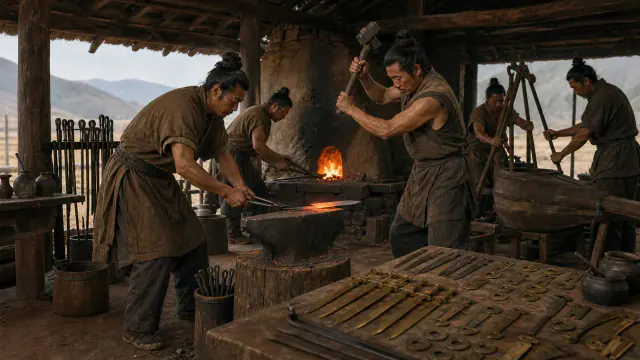
Generated reconstruction · Declared visual hypothesis
Declared visual reconstruction for museographic context; it is not a photograph of the original nor documentary evidence.
History and context
Northwestern peninsula assemblages show iron alongside bronzes and objects of Chinese contact. The new metal offered resistant edges and another productive scale, but it needed ore, fuel, furnaces and specialists.
The expansion of iron coincided with movements from Yan and with the consolidation of Wiman Joseon. Coincidence does not mean that a single person introduced the technology: innovations travel through networks and are adapted in local workshops.
Iron arrived in a landscape that already had bronze specialists. For generations, iron axes and knives coexisted with bronze daggers, mirrors and bells because each material occupied different supply chains and functions.
Population movements from Yan may have accelerated techniques and demand, but local production needed ore, charcoal, furnaces and learning. The technology did not travel inside a single suitcase nor with a sole founder.
Evidence and interpretation
Documented fact: Korean institutional history links the 3rd–2nd centuries BCE with iron expansion from the Warring States and records implements from Yongyeon-dong. Interpretation and caution: attributing the introduction of iron exclusively to Wiman oversimplifies a gradual process. Expanded documented fact: Historical syntheses and studies of the slender bronze dagger culture situate iron objects and Yan styles in the northwest during the 3rd–2nd centuries BCE. Expanded interpretation and caution: Yongyeon-dong does not demonstrate that Wiman personally introduced iron nor that bronze became obsolete.
Catalogue facts
- Narrative date
- 3rd–2nd centuries BCE
- Location
- Yongyeon-dong, Wiwon, northwestern peninsula basin
- Material
- Iron, bronze, charcoal and pottery
- Context
- Technological transition and border contact
- Curatorial reading
- The documented fact and its interpretation appear separately in the evidence block.
- Coexistence
- Prestige bronze and utilitarian iron appear together in Final Bronze/Early Iron assemblages.
- Production chain
- Casting and forging required fuel, thermal control and specialists distinct from those of bronze.
- Mobility
- The transition coincides with migrations and contacts from Yan, without a single demonstrable cause.
- Documentary coverage
- 3 museum, heritage, primary corpus or research sources for this stop.
A SHARED TOPIC, DIFFERENT MOMENTS
Objects connected through time
Follow a topic across the collections. A shared tag is a way to compare objects, not proof that one culture influenced another.
The order uses the midpoint of each approximate date range; ranges can overlap. Spacing does not represent elapsed time. Swipe, scroll or use the arrows. With the sequence focused, use ← / →, Home or End.
THE CURRENT OBJECT
Its date is not sufficiently established to place it on the timeline. We keep it here, separate from the dated objects.
 You are viewing
3rd–2nd centuries BCE
Iron changes the frontier
Gojoseon and early Korea
Technological synthesis of several objects, not a dated piece.
Current recordIron3 dated objects
Final Bronze, c. 1000 BCE
Before the Iberias
Iberians
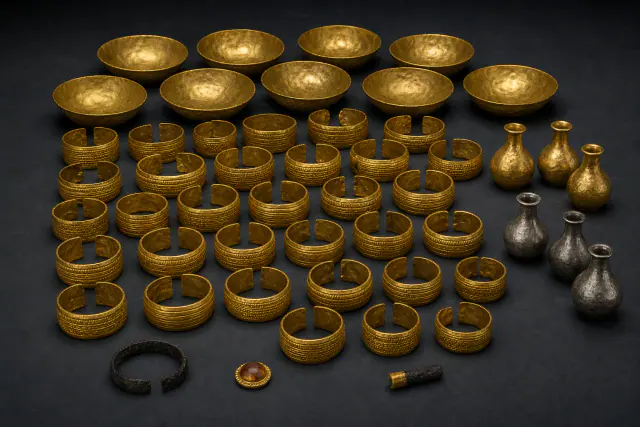
Date of the treasure, not of the preceding general period.
Read the record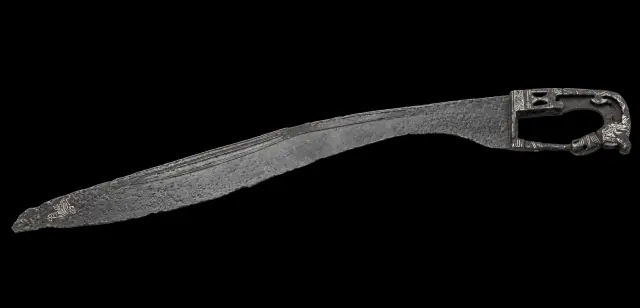
4th–3rd centuries BCE
Falcata from Almedinilla
Iberians
Approximate dating according to the record.
Read the record
ca. 400 CE
Kabusanza, ca. 400
Batwa / Twa histories
Approximate date of the Kabusanza context; no automatic ethnic attribution.
Read the record
Also connected, without a comparable date (3)
These objects are not placed after the others: an unknown date does not mean a more recent object.
- The workshop inside the ditchYayoi Japan · 4th century BCE–3rd century CE, peak in Middle and Late Yayoi
- Tools in relationBatwa / Twa histories · ca. 1947
- Weapons under the LakeCeltic worlds · Mainly 3rd–1st centuries BCE
A closer look
About 1 min to read · 1 section. Further reading and sources · free access. Editorial review recorded: .
A particular object marks the meeting of routes
The National Museum of Korea catalogue identifies a fourteen-centimetre copper-alloy coin from Yongyeon-dong, in Wiwon, with collection number Bongwan10420-1. It relates it to Yan emissions and to the circulation of the late Warring States. This record connects the site name with a verifiable piece, in addition to the general narrative about technology. The museum links the arrival of these coins with a horizon of iron-technique transmission; the coin, by itself, does not demonstrate that a furnace existed at the place where it was found.
- Museum · National Museum of Korea · Chinese Coin, MyeongdojeonAccess recorded: .
Location and territory
DEBATED LOCATION
Yongyeon-dong, Wiwon, northwestern peninsula basinLiaoning and northern Korea; the precise extent remains debated. The mark indicates the orienting centre of the scope, not a boundary or an exact point.Sources and references
Did you enjoy this exhibit?
Your opinion helps us improve the museum. You can change it whenever you like.
Loading your rating…