
 English
 Español
 Français
 Italiano
 Deutsch
 Русский
 Português
 Polski
 Română
 Svenska
 Norsk bokmål
 Suomi
 Türkçe
 العربية
 简体中文
 한국어
 हिन्दी
 Ελληνικά
06 · Lake Neuchâtel · the site that gave its name to an epoch
Weapons under the Lake
The deposits of the La Tène bridge
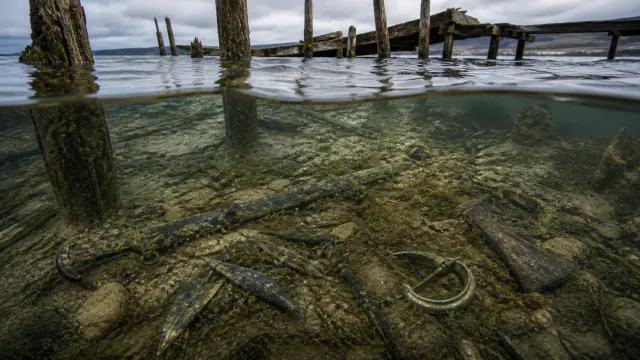
Beside a wooden walkway appeared weapons, tools, ornaments and human remains.
Museum documentation · free public access, no account required.
Generated reconstruction · Declared visual hypothesis
Declared visual reconstruction; not a photograph of the original nor documentary evidence.
History and context
At La Tène thousands of objects were recovered alongside wooden structures: weapons, tools, ornaments and bones. The site would end up giving its name to the art and to the late phase of the Iron Age in much of Europe.
Were offerings thrown into the water, loot displayed, accident or violent destruction? The position and condition of the finds support several hypotheses. The halt shows how a very secure name can hide an interpretation still in motion.
Discovered in 1857 and excavated systematically between 1907 and 1917, the site ended up giving its name to a continental phase. That typological authority preceded a secure understanding of how the deposit formed.
The university project initiated in 2007 reviewed scattered archives, contexts and taphonomy. Its synthesis proposes a battle monument erected at the end of the 3rd century BCE in a passage between lake and river, a better-argued interpretation but still open to testing.
Evidence and interpretation
Documented fact: the Laténium and the University of Neuchâtel document the lacustrine site, its bridges and systematic excavations. Interpretation and caution: the proportion of ritual deposit, catastrophe and violence does not enjoy a unique consensus. Documented expansion: La Tène contains wooden structures, weapons, tools, ornaments, bones and a long history of excavation and dispersal of collections. Expanded interpretation and caution: Do not describe all objects as offerings to the lake nor present the battle monument hypothesis as definitive consensus.
Catalogue facts
- Narrative date
- Mainly 3rd–1st centuries BCE
- Location
- La Tène, Lake Neuchâtel, Switzerland
- Material
- Iron, bronze, wood, bone and organic matter
- Context
- Passage zone and lakeshore margin deposits
- Curatorial reading
- The documented fact and its interpretation appear separately in the evidence block.
- Discovery
- 1857
- Exhaustive excavation
- Paul Vouga, 1907–1917
- Modern review
- Interdisciplinary project since 2007; synthesis in 2022
- Documentary coverage
- 2 museum, heritage, primary corpus or research sources for this stop.
A SHARED TOPIC, DIFFERENT MOMENTS
Objects connected through time
Follow a topic across the collections. A shared tag is a way to compare objects, not proof that one culture influenced another.
The order uses the midpoint of each approximate date range; ranges can overlap. Spacing does not represent elapsed time. Swipe, scroll or use the arrows. With the sequence focused, use ← / →, Home or End.
THE CURRENT OBJECT
Its date is not sufficiently established to place it on the timeline. We keep it here, separate from the dated objects.
 You are viewing
Mainly 3rd–1st centuries BCE
Weapons under the Lake
Celtic worlds
A set of lake deposits, not the dated manufacture of an individual object.
Current recordIron3 dated objects
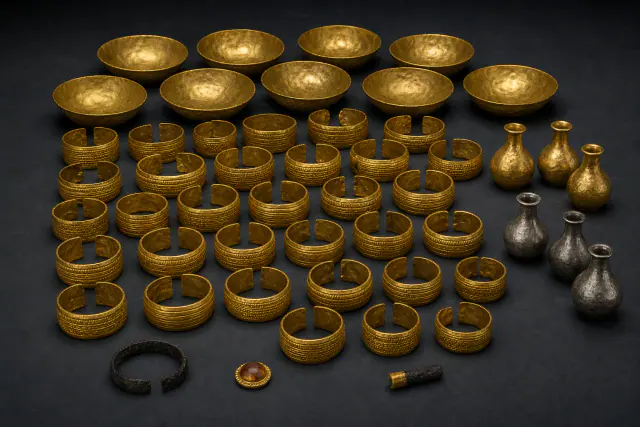
Final Bronze, c. 1000 BCE
Before the Iberias
Iberians
Date of the treasure, not of the preceding general period.
Read the record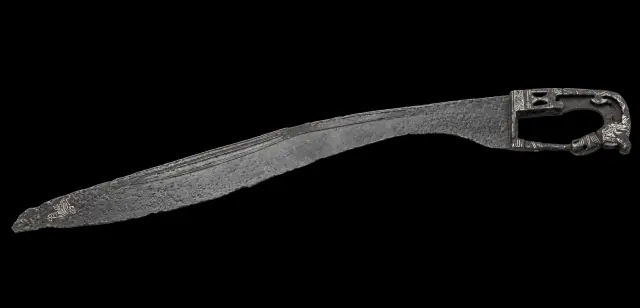
4th–3rd centuries BCE
Falcata from Almedinilla
Iberians
Approximate dating according to the record.
Read the record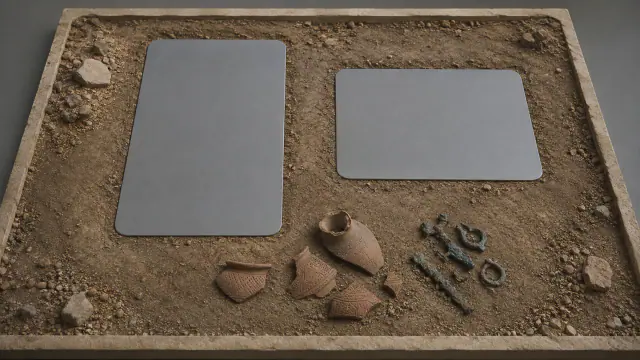
ca. 400 CE
Kabusanza, ca. 400
Batwa / Twa histories
Approximate date of the Kabusanza context; no automatic ethnic attribution.
Read the record
Also connected, without a comparable date (3)
These objects are not placed after the others: an unknown date does not mean a more recent object.
- Iron changes the frontierGojoseon and early Korea · 3rd–2nd centuries BCE
- The workshop inside the ditchYayoi Japan · 4th century BCE–3rd century CE, peak in Middle and Late Yayoi
- Tools in relationBatwa / Twa histories · ca. 1947
A closer look
About 1 min to read · 1 section. Further reading and sources · free access. Editorial review recorded: .
Weapons whose surfaces preserve traces of past actions
The Laténium’s collection brings together swords, scabbards, spears, javelins and shield elements from La Tène. The lack of oxygen preserved some iron surfaces under a relatively light patina, making it possible to examine marks that deeper corrosion would have erased. Guillaume Reich’s study focused on distinguishing combat damage and intentional alterations by comparison and experimentation. His interest lies in treating each weapon as a sequence of actions: manufacture, use, wear and deposition may have left distinct signals on the same metal.
Where it is held
Laténium · Parc et musée d’archéologie
Component of the group · Documented collection
The Laténium holds around 20,000 finds from the eponymous site; the label describes a collective deposit, not a single object nor the entirety of its collections.
The holding institution is documented; public display may change. Check its official record before visiting.
Sources and references
Did you enjoy this exhibit?
Your opinion helps us improve the museum. You can change it whenever you like.
Loading your rating…