
 English
 Español
 Français
 Italiano
 Deutsch
 Русский
 Português
 Polski
 Română
 Svenska
 Norsk bokmål
 Suomi
 Türkçe
 العربية
 简体中文
 한국어
 हिन्दी
 Ελληνικά
URALS · C. 10,000 BCE · APPROXIMATE AND DEBATED DATING
Shigir Idol
Carved faces and lines in wood
The sculpture was preserved in a peat bog. Its exact date and the meaning of its figures remain under discussion.
Museum documentation · free public access, no account required.
Reconstruction · Declared visual hypothesis
Contributed recreation for the project. Not an archaeological photograph or a measured facsimile. Materials, finish, proportions and visible details may differ from the original. The figure is stylised; it does not faithfully reproduce every face, motif or break of the Shigir Idol.
Explore in 3D
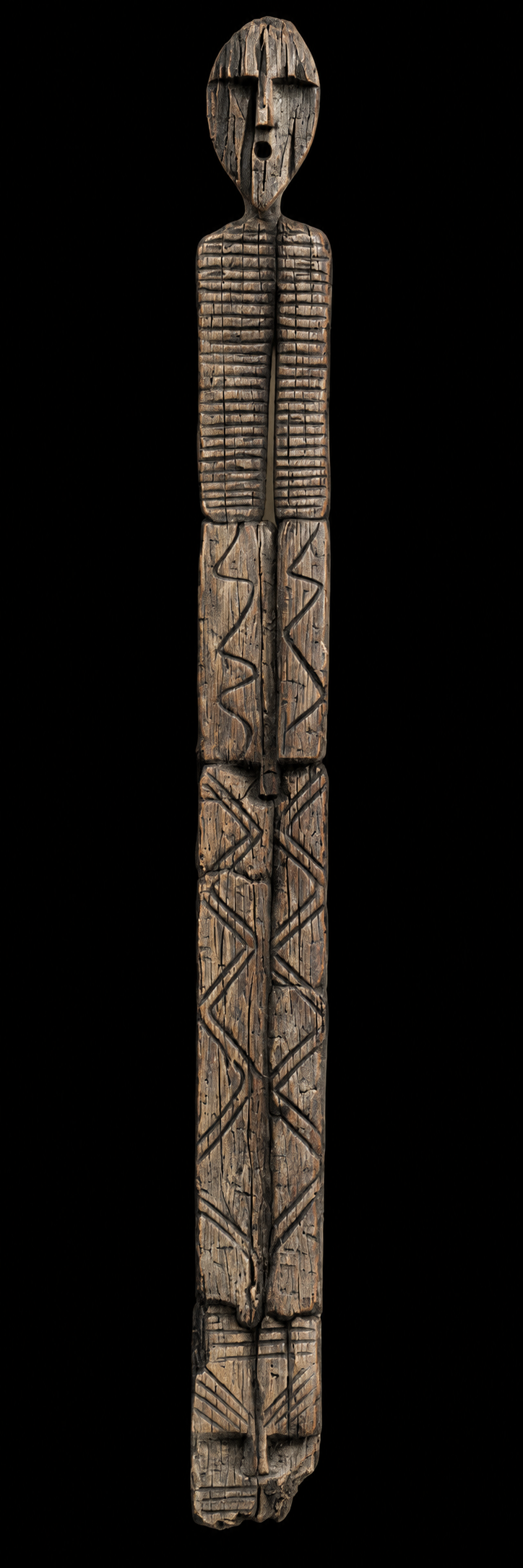
Load the model only when you want to explore it. Drag or use the arrow keys to turn it; + and − zoom. Closing it releases its memory.
User-contributed digital reconstruction; file metadata declares Tripo. Not an archaeological scan or a measured replica. Display scale is indicative, not a measurement of the original; the contributed geometry is preserved intact. Interpretation of the Shigir idol. Its faces and motifs are not an archaeological transcription; the height is adapted to the gallery and does not reconstruct lost parts as certainties.
History and context
The Great Shigir Idol appeared in 1890 during gold extraction work in a peat bog in the Urals. It was carved from larch wood and preserves faces and geometric motifs. The wet, oxygen-poor environment helped the wood survive.
The preserved sculpture measures about 3.4 metres; a historical reconstruction proposed 5.3 metres including parts later lost. Modern datings place its manufacture near the beginning of the Holocene, although its exact age is debated. Calling it an "idol" does not identify a deity.
Evidence and interpretation
Wood, carvings and fragments are material evidence. Date proposals depend on samples, preservatives and the age of the tree rings. The image and model provided are a stylised interpretation, not a facsimile: they do not certify the proportions nor every face or incision of the original.
Catalogue facts
- Date
- C. 10,000 BCE · approximation; debated dating
- Findspot
- Shigir peat bog · Middle Urals, Russia
- Material
- Carved larch wood
- Height
- ≈3.4 m preserved · 5.3 m in historical reconstruction
A SHARED TOPIC, DIFFERENT MOMENTS
Objects connected through time
Follow a topic across the collections. A shared tag is a way to compare objects, not proof that one culture influenced another.
The order uses the midpoint of each approximate date range; ranges can overlap. Spacing does not represent elapsed time. Swipe, scroll or use the arrows. With the sequence focused, use ← / →, Home or End.
Wood13 dated objects
 You are viewing
C. 10,000 BCE · approximation; debated dating
Shigir Idol
Prehistory
Approximation expressed in the record; dating debated.
Current record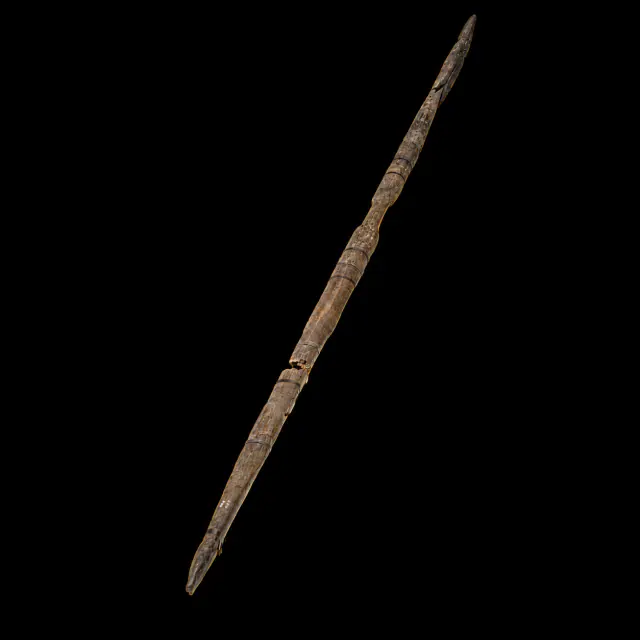
≈7000 BCE
Holmegaard bow
Prehistory
Date of the Holmegård bow; the Albuñol strings compared in the record date to ≈5300–4900 BCE.
Read the record
ca. 3000 BCE
Abydos Boats
Ancient Egypt
Approximate dating of the set of boats.
Read the record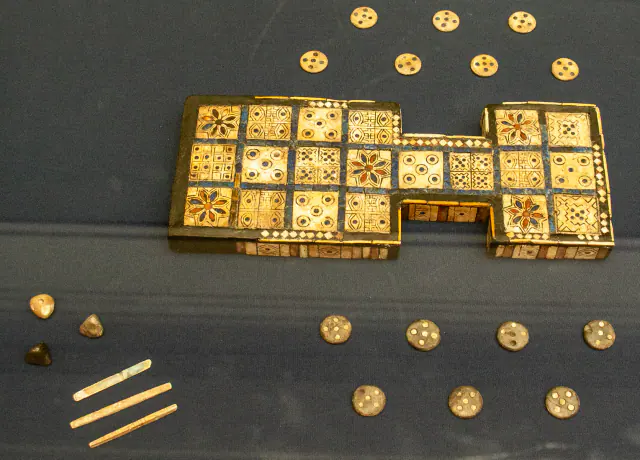
2600–2400 BCE
Royal Game of Ur
Sumer
Approximate dating according to the record.
Read the record
ca. 2600–2400 BCE
Standard of Ur
Sumer
Unknown function; The scenes do not prove that it was a banner.
Read the record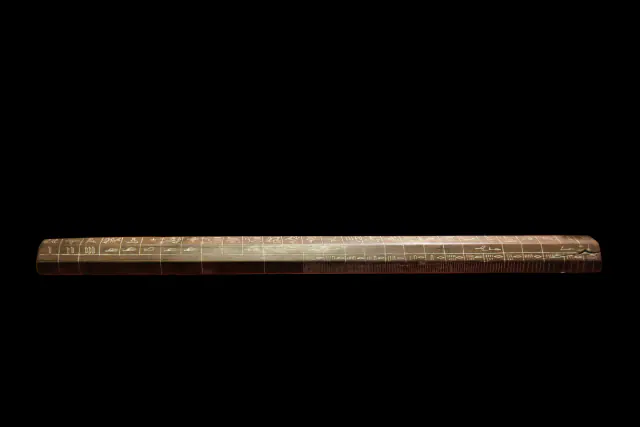
1330–1295 BCE · end of the 18th dynasty
Maya's cubit
Ancient Egypt
Approximate dating according to the record.
Read the record
c. 1600–1000 BCE, in several phases
Wooden faces
Maya worlds
Deposit made in several phases; not simultaneous manufacture.
Read the record
Second half of the 7th century BCE
Mazarrón 1
Phoenicians
Second half of the 7th century BCE
Read the record
Second half of the 7th century BCE
Mazarrón 2
Phoenicians
Date of the shipwreck and its context; the cargo brings together several objects.
Read the record
5th–4th centuries BCE
Bow and arrows in a case
Scythians and Saka
Typological set of slings; no date for a single specimen.
Read the record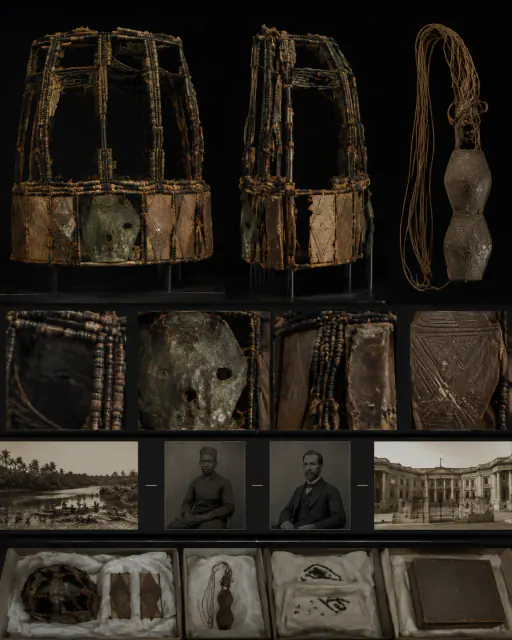
ca. 1760
Kuba ndop
Bantu-speaking worlds
Approximate dating according to the record.
Read the record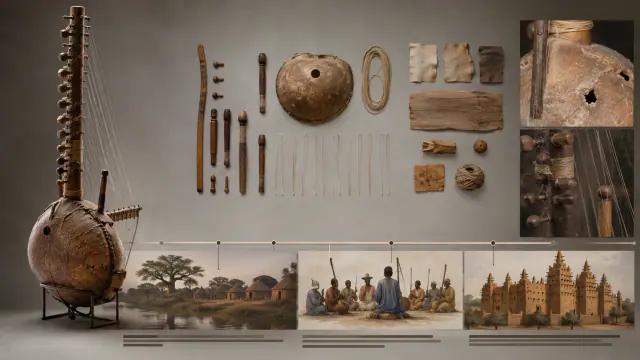
19th century
19th-century kora
Mande Worlds
The century of the surviving instrument, not the origin of the musical tradition.
Read the record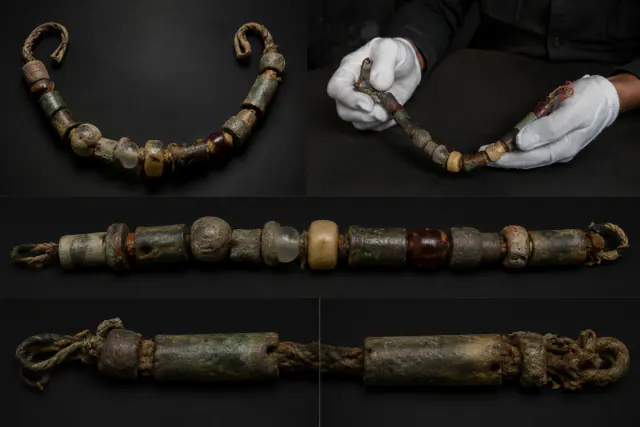
19th–20th centuries
Lukasa
Bantu-speaking worlds
Date range of the catalogued object, not the origin of the memory tradition.
Read the record
Also connected, without a comparable date (4)
These objects are not placed after the others: an unknown date does not mean a more recent object.
- Memory in performanceBantu-speaking worlds · 19th–20th centuries and transmitted practice
- Rice on stiltsYayoi Japan · Especially 1st–3rd centuries CE
- Rome learns in terracottaEtruscans and Rome · End of the sixth century BCE
- Tools in relationBatwa / Twa histories · ca. 1947
A closer look
About 4 min to read · 10 sections. Further reading and sources · free access. Editorial review recorded: .
One sculpture, several reconstructions
The first modern assembly brought together only a portion of the fragments. In 1914 Vladimir Tolmachev proposed a taller figure. A lower portion was subsequently lost: that is why the 5.3 metres of that assembly are not the height preserved today. The object's biography also includes modern decisions and losses.
- Museum · Sverdlovsk Regional Museum / ARTEFACT · Great Shigir IdolAccess recorded: .
Dating wood is not reading the day of carving
The 2018 study placed the sculpture at approximately 9600 BCE. The revision published in 2021 proposed a manufacture date close to 10100 BCE, prioritising inner samples and accounting for the tree's growth years. Radiocarbon dates the formation of the sampled wood, not directly the gesture of the carver.
Why we retain an approximate date
The object's conservation, the samples selected and their find context have generated debate. In 2024 Savchenko defended the piece's great antiquity against other proposals. The label summarises this debate with 'c. 10,000 BCE': it does not offer an exact date or present the controversy as resolved.
- Research · Savchenko · discussion of Shigir dating (2024)Access recorded: .
Faces without a deciphered narrative
The carvings allow the study of tools, composition and woodworking. They do not provide names of beings, a translatable text or an identified religion. The image and model in this record are a stylised interpretation contributed to the project, not a facsimile. To compare proportions or incisions one must return to the documented original.
A carving to view from both sides
The body has a relatively flat form, but the decoration is not limited to the front. There are figures and lines on both faces, while the upper head has volume. A single view, therefore, does not allow the whole composition to be known. The museum display distinguishes the faces distributed along the body from the head that crowns it. To observe the original it is advisable to follow its distribution and compare the two faces, without assuming that all the figures were meant to be seen at once or from a specific position.
- Museum · Sverdlovsk Regional Museum / ARTEFACT · Great Shigir IdolAccess recorded: .
From a mining operation to a public collection
The sculpture's recovery was not a modern archaeological excavation. It appeared during gold extraction and passed, by order of Count Alexander Stenbock-Fermor, to the museum of the Ural Society of Natural Science Lovers. That institution is the antecedent of the regional collection that conserves it. The difference matters: we do not have a record of its position comparable to that of a modern excavation. Keeping the fragments allowed them to be studied later, but does not restore all the information that may have been lost when they were removed from the ground.
- Museum · Sverdlovsk Regional Museum / ARTEFACT · Great Shigir IdolAccess recorded: .
Working the wood before it dried
The technical examination published in 2018 found clean cuts without the fibre compression one would expect from other working methods. The researchers interpreted these as indications of carving on fresh wood. They also distinguished marks compatible with an adze and several polished stone chisels. These are not tools recovered alongside the sculpture: the identification is proposed from their marks. The surface thus allows the study of concrete operations, from shaping the trunk to opening up the details, without needing metal tools.
The tree is still recognisable within the figure
The rings and the points where branches grew provide information on how the larch was used. According to the study, the orientation of those branches allows recognition that the head was placed towards the upper part of the trunk. Visible rings in different fragments also support that they belonged to a single tree. Separate pieces were not chosen for each face. These observations bring the sculpture closer to carpentry work: selecting a portion of the trunk, preparing a long surface and organising the design taking the wood into account.
The wood that did not reach us
The 2021 revision places Shigir within a long history of woodworking and recalls that its archaeological scarcity depends heavily on preservation. Stone survives in circumstances where other materials disappear. That is why we cannot count ancient sculptures and conclude that wood was barely carved. Shigir allows us to broaden our image of hunter-gatherer communities: they could produce large-scale works of elaborate composition. Its exceptional survival does not prove, by itself, that it was the only one of its time.
Comparing Shigir with other ancient works
Researchers compare its lines and zigzags with motifs present on objects from the Late Palaeolithic and Early Mesolithic of Eurasia. They also cite Göbekli Tepe as a distant reference for thinking about monumental representations. That comparison does not prove a journey, a direct influence or a shared religion. It serves to ask what capacities were present in distinct societies. Shigir is better understood within that broad repertoire than as an impossible anomaly: scale, material and composition may vary without a work having to derive from another.
Location and territory
REGIONAL AREA
Shigir peat bog · Middle Urals, RussiaIndicative marker of the peat bog, not of the exact 1890 mining site nor the Yekaterinburg museum.Where it is held
Sverdlovsk Regional Museum O. E. Kler · Museum of History and Archaeology of the Urals
Item or group in the record · Documented collection
Yekaterinburg Collection, Russia. The institutional record identifies the display museum; visiting conditions may change.
The holding institution is documented; public display may change. Check its official record before visiting.
Sources and references
- Sverdlovsk Regional Museum / ARTEFACT · Great Shigir Idol
- Zhilin et al. · Early art in the Urals: new research on the wooden sculpture from Shigir, Antiquity (2018)
- Terberger, Zhilin and Savchenko · revision of Shigir age (2021)
- Savchenko · discussion of Shigir dating (2024)
- Terberger, Zhilin and Savchenko · The Shigir idol in the context of early art in Eurasia, Quaternary International (2021)
Did you enjoy this exhibit?
Your opinion helps us improve the museum. You can change it whenever you like.
Loading your rating…