
 English
 Español
 Français
 Italiano
 Deutsch
 Русский
 Português
 Polski
 Română
 Svenska
 Norsk bokmål
 Suomi
 Türkçe
 العربية
 简体中文
 한국어
 हिन्दी
 Ελληνικά
BEFORE THE NAMES SCYTHIAN AND SAKA · 1200–700 BCE
Before the Scythians and Sakas
The steppe before the Scythians
Communities in Mongolia and neighbouring regions already raised tombs and stelae decorated with deer before references to Scythians and Sakas.
Museum documentation · free public access, no account required.
Generated reconstruction · Declared visual hypothesis
Declared visual reconstruction for museographic context; it is not a photograph of the original nor documentary evidence.
History and context
Before Greek sources spoke of Scythians and Persian sources of Saka, the communities of the Eurasian steppe transformed their relationship with the horse, herding and funerary landscapes. In Mongolia and neighbouring regions they raised deer stones and khirigsuurs: monuments associated with ceremonies, sacrifices and collective memory.
During the 9th and 8th centuries BCE, large barrows such as Arzhan show elites, horses and connections over enormous distances. Some animal images anticipate traits of later steppe art, but there is no simple ethnic genealogy. Historical names arrived later to a mobile world that already possessed its own monumental traditions.
Evidence and interpretation
Documented fact: Deer stones are concentrated especially in Mongolia and neighbouring areas. Interpretation and caution: The chronological interval of the assemblage is broad and the exact function of each stone continues to be debated; avoid calling it the gravestone of a specific warrior. Historical transition: From these equestrian and funerary networks emerged the horizons that historical sources would call Scythian and Saka, connected from the Black Sea to Central Asia. Limit of the transition: Deer stones are not automatically Scythian: they belong to earlier and diverse communities. Their visual resemblance to later art indicates possible connections, not a demonstrated identity.
Catalogue facts
- Previous period
- ca. 1200–700 BCE
- Sphere of influence
- Eurasian steppes, from Mongolia and the Altai to Kazakhstan and the western corridors
- Threshold element
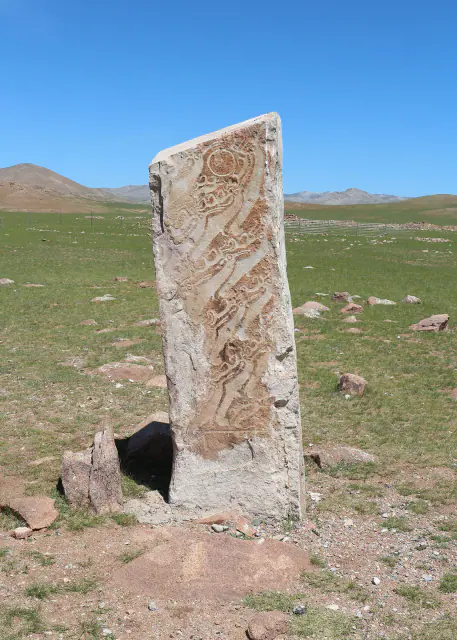
- Deer stone of Uushigiin Övör
- Element date
- Final Bronze–Initial Iron, ca. 1200–600 BCE
- Location
- Uushigiin Övör, Khövsgöl province, Mongolia
- Material or support
- Carved granite
- Documented fact 01
- Deer stones are concentrated especially in Mongolia and neighbouring areas.
- Documented fact 02
- They are often integrated into complexes with khirigsuurs and horse deposits.
- Documented fact 03
- The carved motifs include deer, weapons, belts and solar signs.
- Documented fact 04
- Arzhan 1 precedes much of the historical record of Scythians and Sakas.
- Documented fact 05
- Scythian and Saka are broad historical names, not a uniform archaeological culture.
- Visual credit
- Bernard Gagnon · CC0 1.0
A SHARED TOPIC, DIFFERENT MOMENTS
Objects connected through time
Follow a topic across the collections. A shared tag is a way to compare objects, not proof that one culture influenced another.
The order uses the midpoint of each approximate date range; ranges can overlap. Spacing does not represent elapsed time. Swipe, scroll or use the arrows. With the sequence focused, use ← / →, Home or End.
Granite4 dated objects
 You are viewing
Final Bronze–Initial Iron, ca. 1200–600 BCE
Before the Scythians and Sakas
Scythians and Saka
Framework of the representative monument, not of the entire preceding period.
Current record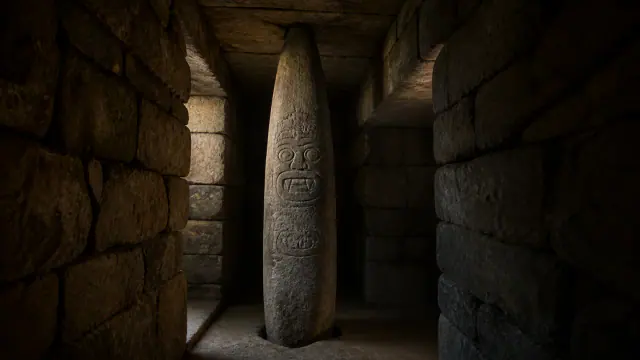
c. 900–500 BCE
Overlapping datesThe Lanzón
Pre-Inca cultures
Approximate dating according to the record.
Read the record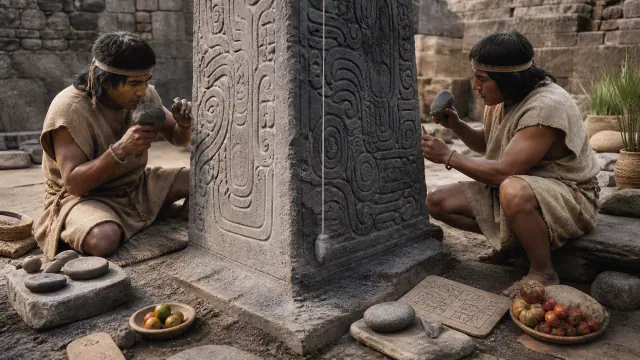
c. 800–500 BCE
Overlapping datesThe Tello Obelisk
Pre-Inca cultures
Approximate dating according to the record.
Read the record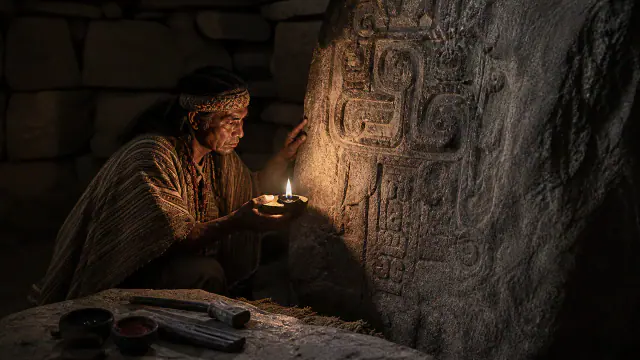
c. 400–200 BCE according to MNAAHP
The Raimondi Stele
Pre-Inca cultures
Approximate dating according to the record.
Read the record
A closer look
About 1 min to read · 1 section. Further reading and sources · free access. Editorial review recorded: .
Dating a stele by what surrounds it
The age of an engraved stone is not obtained directly from the granite. The Smithsonian Mongolian project used teeth of horses sacrificed alongside the stelae and associated burial mounds to establish dates by radiocarbon. At Bor Hujiriin Gol, teeth and charcoal pointed to approximately 1000 BCE. The same programme incorporated hundreds of three-dimensional scans and georeferenced records: they allow comparing reliefs, recognising displaced pieces and documenting damage. Thus, the excavated surroundings and the digitised surface offer complementary information on these monuments, preceding Scythian Iron Age art.
The region before this culture
ca. 1200–700 BCE · Eurasian steppes, from Mongolia and the Altai to Kazakhstan and the western corridors
ca. 1200–900 BCE · Documented
Deer stones and khirigsuurs
Pastoral communities build ceremonial landscapes of megaliths, mounds and horse deposits.
end of the 9th–beginning of the 8th century BCE · Documented
Arzhan 1
A large barrow in Tuva brings together timber architecture, horse sacrifices and an early supralocal power.
second half of the 7th century BCE · Documented
Arzhan 2 and the animal language
A princely tomb documents fully developed goldwork and zoomorphic repertoires.
What changes and what we should not assume
From these equestrian and funerary networks emerged the horizons that historical sources would call Scythian and Saka, connected from the Black Sea to Central Asia.
Deer stones are not automatically Scythian: they belong to earlier and diverse communities. Their visual resemblance to later art indicates possible connections, not a demonstrated identity.
Deer stone of Uushigiin Övör
Final Bronze–Initial Iron, ca. 1200–600 BCE · Uushigiin Övör, Khövsgöl province, Mongolia
On the stone, stylised deer appear to ascend or fly around weapons, belts and solar motifs. The monument was part of a larger ritual landscape, not an isolated statue. Its graphic energy anticipates the animal taste of the steppe and raises the question of who were the people capable of mobilising communities to erect it.
Deer stones are concentrated especially in Mongolia and neighbouring areas.
The chronological range of the group is broad and the exact function of each stone continues to be debated; avoid calling it the gravestone of a specific warrior.
Carved granite
Wikimedia Commons · record of Deer stone of Uushigiin Övör · Bernard Gagnon · CC0 1.0
- Documented fact 01
- Deer stones are concentrated especially in Mongolia and neighbouring areas.
- Documented fact 02
- They are often integrated into complexes with khirigsuurs and horse deposits.
- Documented fact 03
- The carved motifs include deer, weapons, belts and solar signs.
- Documented fact 04
- Arzhan 1 precedes much of the historical record of Scythians and Sakas.
- Documented fact 05
- Scythian and Saka are broad historical names, not a uniform archaeological culture.
Sources and references
- UNESCO · Deer Stone Monuments and Related Bronze Age Sites
- Smithsonian Research Online · Deer stones and khirigsuurs
- Radiocarbon · Chronology of key Scythian monuments of Eurasia
- Wikimedia Commons · file of Deer stone of Uushigiin Övör · CC0 1.0
- Smithsonian · Preserving Mongolian Culture at the Edge of the Arctic

Did you enjoy this exhibit?
Your opinion helps us improve the museum. You can change it whenever you like.
Loading your rating…