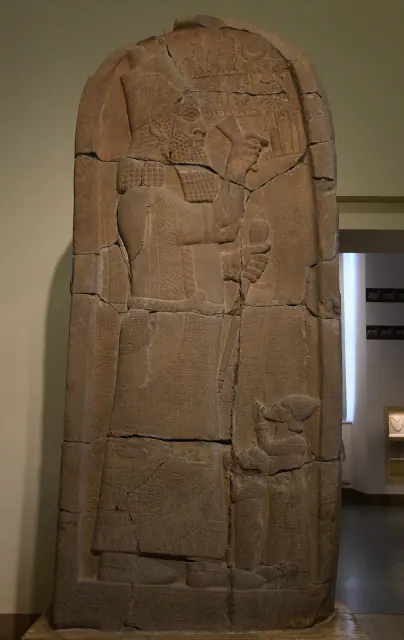
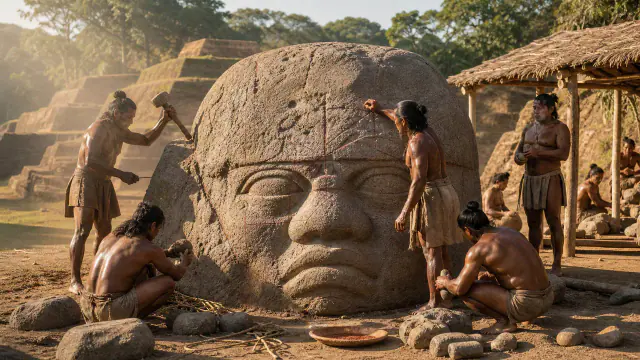
Declared visual reconstruction for museographic context; it is not a photograph of the original nor documentary evidence.
History and context
Colossal Head 2 has distinctive features and a close-fitting headdress, not a generic face. The dominant interpretation understands it as a portrait of a ruler, part of a series of seventeen known heads that made power visible in plazas and processions.
The rock appears to have had a previous life as a monumental throne or altar. Converting it into a head was not recycling due to scarcity: it could have rewritten the memory of whoever sat on the stone and turned their authority into a permanent presence.
Colossal Head 2 preserves an unrepeated combination of eyes, mouth, cheeks and headdress. This individualisation supports the portrait reading: the stone does not present an abstract human type, but a recognisable presence for an audience that knew codes now lost.
Indications of a previous form suggest the block could have been a throne or altar before becoming a head. Reworking a seat of authority would have transferred material memory to the new face, although neither the moment of transformation nor the identity of the person can be recovered.
Evidence and interpretation
Documented fact: Colossal Head 2 comes from San Lorenzo and was carved in basalt; INAH records indications of throne reuse and the portrait reading is the most accepted. Interpretation and caution: ruler, ancestor, warrior or player are proposals; we do not know the identity, exact social sex or function of the headdress.
Expanded documentation: The piece comes from San Lorenzo, is carved in basalt and shows signs compatible with the reuse of a monument of another form.
Expanded interpretation and caution: The interpretation as a portrayed ruler is dominant, but ‘helmet’, ‘warrior’, ‘player’ and even social sex remain without textual confirmation.
Catalogue facts
Narrative date
c. 1200–900 BCE
Location
San Lorenzo Tenochtitlán, Veracruz, Mexico
Material
Carved volcanic basalt
Context
Probable dynastic portrait and monumental reuse
Curatorial reading
The documented fact and its interpretation appear separately in the evidence block.
Evidence
Archaeological context, materiality and chronology.
Caution
Do not convert stylistic diffusion or contact into political domination.
Documentary coverage
3 museum, heritage, primary corpus or research sources for this stop.
A SHARED TOPIC, DIFFERENT MOMENTS
Objects connected through time
Follow a topic across the collections. A shared tag is a way to compare objects, not proof that one culture influenced another.
The order uses the midpoint of each approximate date range; ranges can overlap. Spacing does not represent elapsed time. Swipe, scroll or use the arrows. With the sequence focused, use ← / →, Home or End.
About 1 min to read · 1 section. Further reading and sources · free access. Editorial review recorded: .
Three birds in the headdress
The band crossing the forehead of Colossal Head 2 is decorated with three heads of curved-beaked birds. The National Museum of Anthropology proposes they could allude to a name or lineage. Above appears an open weave and, behind, the knot that ties the set; the ear ornaments are large and circular. These details allow recognition of specific attire, not only an individualised face. The reading of the emblem remains open: observing three birds does not equate to recovering the pronounced name of the ruler.

 English
 Español
 Français
 Italiano
 Deutsch
 Русский
 Português
 Polski
 Română
 Svenska
 Norsk bokmål
 Suomi
 Türkçe
 العربية
 简体中文
 한국어
 हिन्दी
 Ελληνικά
 You are viewing