
 English
 Español
 Français
 Italiano
 Deutsch
 Русский
 Português
 Polski
 Română
 Svenska
 Norsk bokmål
 Suomi
 Türkçe
 العربية
 简体中文
 한국어
 हिन्दी
 Ελληνικά
TREASURES · FOOD · PRE-POTTERY NEOLITHIC
Grinding stone from Çakmaktepe
Grinding before having crop fields
At Çakmaktepe, stones for grinding food were found, preceding fully established agriculture.
Museum documentation · free public access, no account required.
Reconstruction · Declared visual hypothesis
Supplied reconstruction alongside an excavation photograph. It shows a stone vessel, but its correspondence with the basalt quern from House 2 published for Çakmaktepe has not been verified. The complete form and restored finish are interpretative.
Image supplied by the user
Explore in 3D
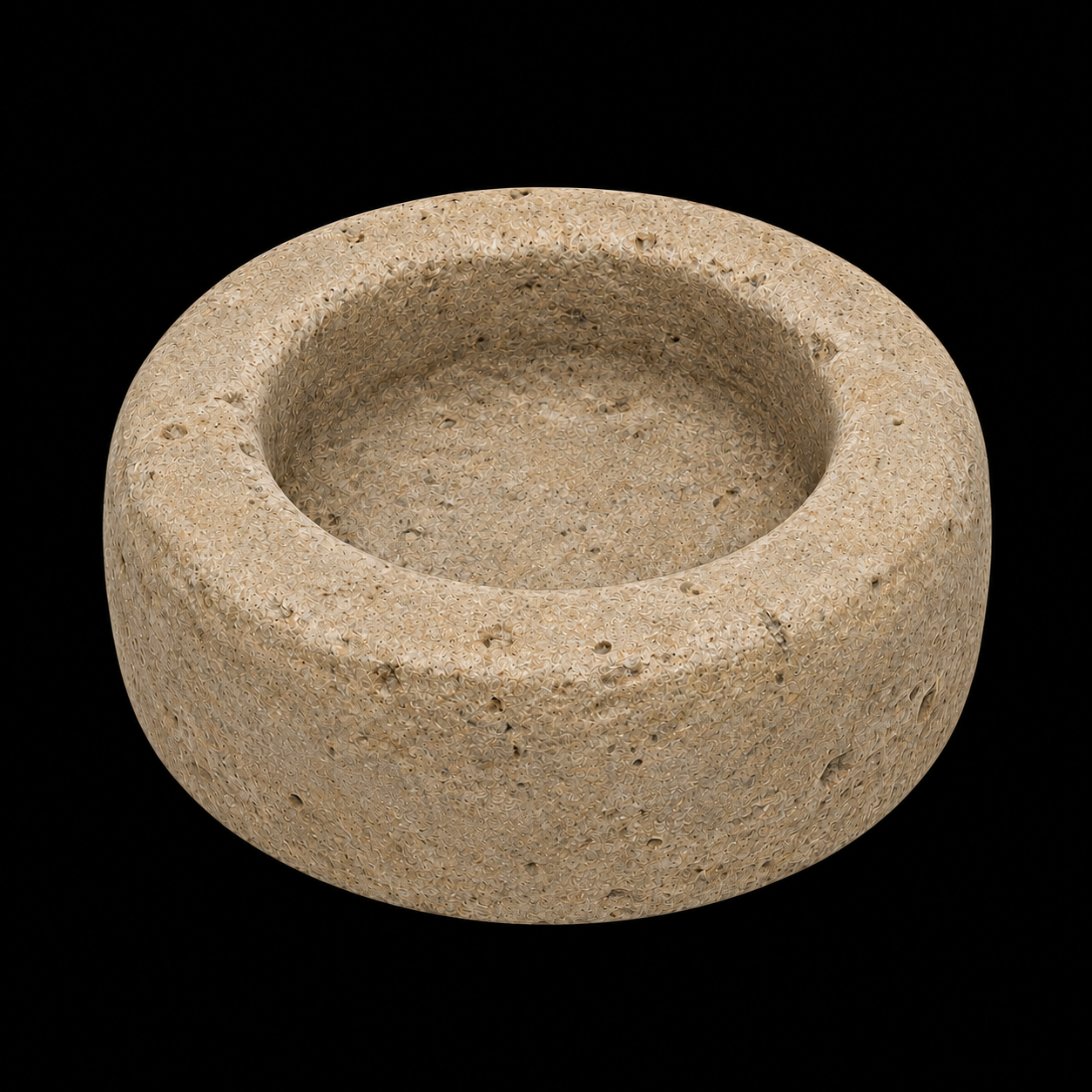
Load the model only when you want to explore it. Drag or use the arrow keys to turn it; + and − zoom. Closing it releases its memory.
Digital reconstruction supplied by the project and generated with Tripo. It is not an archaeological scan or a metric replica; the gallery scale is adapted for display. It represents the Çakmaktepe stone quern. Its form, finish and dimensions are interpretative; it is not a metric record of the published find.
History and context
On the floor of house 2 at Çakmaktepe, an almost complete basalt grinding stone was found. The report also records grinding stones in building 15. They are evidence of activities that shared the settlement with its communal buildings.
The gallery brings together a reconstruction of a stone vessel on a black background and the excavation photograph supplied to illustrate it. Its attribution to Çakmaktepe comes from the context received: we have not yet been able to link it to an inventory or identify it as the basalt quern from House 2. The third image shows grinding tools from Göbekli Tepe for comparison, not the same object.
Excavations at Çakmaktepe began in 2021 and have brought to light dwellings and communal buildings. One of the latter measures around 16 metres in diameter. Food preparation was part of the life of these communities, but finding a grinding stone does not by itself prove that they cultivated cereals.
Evidence and interpretation
Querns are documented by Şahin and Miyake (2025), pp. 4 and 8–9. The supplied photograph shows a vessel with a cavity: its function and its correspondence with the published querns are not verified. The reconstruction is not a facsimile and does not certify material, measurements or use.
The main item is a reconstruction of a stone vessel supplied to the project. The supplementary photograph preserves the visible excavation state, but does not include a verified inventory or authorship. The Göbekli Tepe plate is provided separately as a technical comparison. They are not three documentary photographs of the same quern.
Catalogue facts
- Chronological framework
- PPNA · ≈9600–8800 BCE, provisional proposal for the site
- Documented context
- Çakmaktepe · House 2 and other grinding contexts
- Published material
- Basalt in the House 2 specimen
- Function
- Grinding and plant resource preparation
- Limit
- Grinding does not necessarily equal cultivation
- Supplied image
- Stone vessel · correspondence with published quern not verified
A SHARED TOPIC, DIFFERENT MOMENTS
Objects connected through time
Follow a topic across the collections. A shared tag is a way to compare objects, not proof that one culture influenced another.
The order uses the midpoint of each approximate date range; ranges can overlap. Spacing does not represent elapsed time. Swipe, scroll or use the arrows. With the sequence focused, use ← / →, Home or End.
Basalt4 dated objects
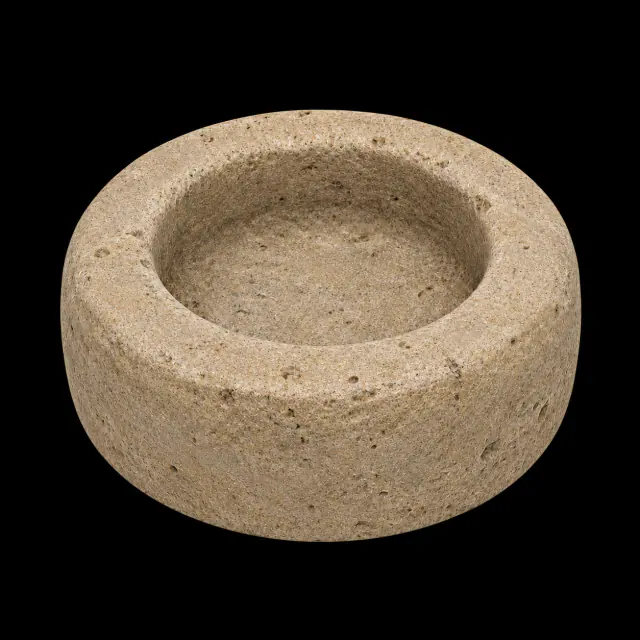 You are viewing
PPNA · ≈9600–8800 BCE, provisional proposal for the site
Grinding stone from Çakmaktepe
Prehistory
Provisional date range for the site and the published tools; the identification of the image is unverified.
Current record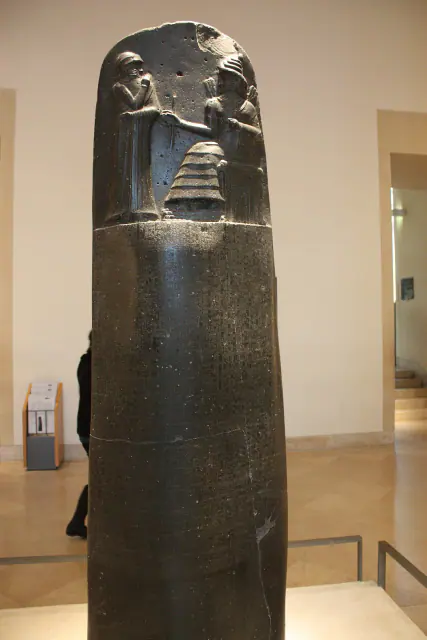
Towards 1750 BCE
Stele of Hammurabi
Sumer
Approximate dating according to the record.
Read the record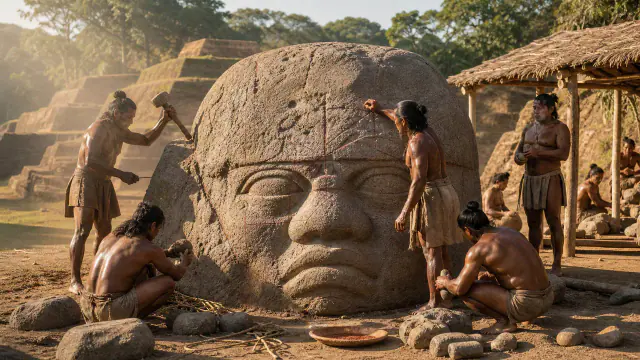
c. 1200–900 BCE
Head 2
Maya worlds
Approximate dating according to the record.
Read the record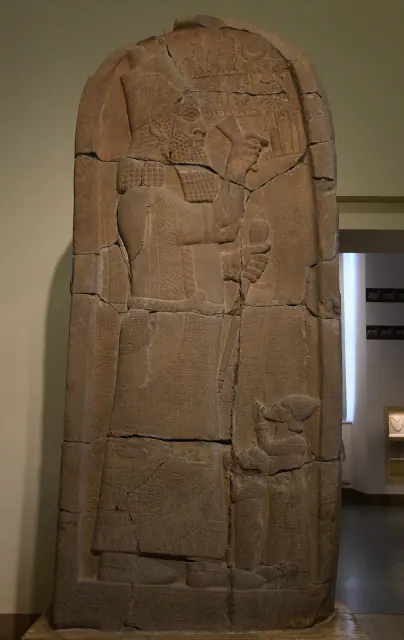
7th century BC C. · 671 campaign BCE
Stele of Esarhaddon
Sumer
Campaign dated explicitly on the record; indicative date of the commemoration.
Read the record
A closer look
About 2 min to read · 6 sections. Further reading and sources · free access. Editorial review recorded: .
What we know about the settlement
The Çakmaktepe team began excavating in 2021. They have documented dwellings, communal buildings and a circular building of around 16 metres in diameter. In another building, burnt skulls of wild animals were found placed alongside the walls. Their arrangement allows ritual activities to be proposed, but not a specific ceremony to be reconstructed.
- Heritage · Taş Tepeler · Çakmaktepe excavation projectAccess recorded: .
A still provisional date
Dating proposals do not coincide exactly. The project website proposes 10000–9500 BCE based on the knapped stone industry; the 2025 article proposes 9600–8800 BCE with a query and indicates that it did not yet have radiocarbon dates. For this reason we do not present an age difference of a thousand years relative to Göbekli Tepe as a definitively measured difference.
- Research · Şahin and Miyake (2025) · Çakmaktepe, pp. 4, 8–9 and fig. 15Access recorded: .
- Heritage · Taş Tepeler · Çakmaktepe excavation projectAccess recorded: .
How to compare the images
The photographed vessel has a deep cavity and unevenly preserved edges. The version on a black background proposes a complete form, but does not provide an archaeological identification. Without a scale, precise context or inventory we cannot be sure that it is the basalt quern from the report. The scientific plate from Göbekli Tepe shows other tools: it serves to compare techniques, not to identify this piece.
The difference between a base and a mortar
In friction grinding a handstone is moved over a base. A mortar works differently, using a vessel and an instrument for pounding or crushing. Grouping both tools under the word 'stone' conceals distinct technical choices. The Göbekli Tepe study compares form, use and experimentation.
Wear also provides information
Dietrich and Haibt compared archaeological tools with replicas used experimentally. They identified wear differences related to the preparation of finer or coarser products. These are controlled comparisons: they do not allow us to state that each quern produced bread nor to automatically transfer the Göbekli Tepe results to Çakmaktepe.
- Research · Dietrich and Haibt (2020) · grinding stone wearAccess recorded: .
An activity preceding agriculture
Gathering a wild plant and preparing it for eating does not require it to have been sown. To investigate cultivation, domestication and diet, additional evidence is needed. That is why the quern allows us to speak of the work of preparing food without turning every sedentary community into a fully formed farming society.
Reference images and provenance
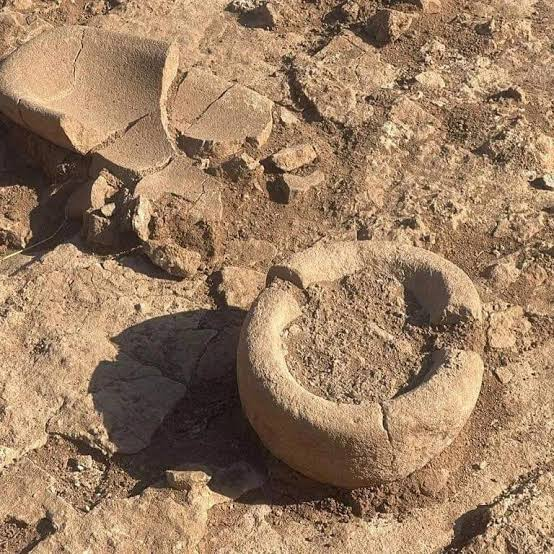 View full-size photograph ⛶
Photograph received from the user and preserved without cropping or semantic retouching; only lossless conversion to WebP. The attribution to Çakmaktepe comes from the supplied context. Authorship, original licence and object inventory not identified; not presented as proof of its functional identification as a quern.
Documentary original · Contextual correspondence
Authorship unidentified · photograph supplied to the project
Location and territory
REGIONAL AREA
Çakmaktepe surroundings · southwest of ŞanlıurfaIndicative regional marker: the article places Çakmaktepe about 20 km southwest of Şanlıurfa. It does not represent an excavation grid or the exact location of the piece.Sources and references
Did you enjoy this exhibit?
Your opinion helps us improve the museum. You can change it whenever you like.
Loading your rating…