
 English
 Español
 Français
 Italiano
 Deutsch
 Русский
 Português
 Polski
 Română
 Svenska
 Norsk bokmål
 Suomi
 Türkçe
 العربية
 简体中文
 한국어
 हिन्दी
 Ελληνικά
Paleo-Babylonian · first dynasty of Babylon
Stele of Hammurabi
Hammurabi and justice written in stone
Specific cases of justice accompany the image of the king before Shamash.
Museum documentation · free public access, no account required.
Documentary original · Exact correspondence
Photograph of the original stele of Hammurabi. The base is out of the frame.
Quique Olaso · Musée du Louvre, Oriental Antiquities · Inventory: SB 8 · AS 6064 · CC BY-SA 2.0
History and context
At the top, Hammurabi appears before Shamash. Below is an extensive inscription on conflicts and justice decisions. The relationship between image and text explains how the monarch wanted to link his authority with the protection of order.
The fame of this stele does not make it the first written law: previous traditions already appear in the museum, such as those linked to Ur-Namma. Nor does it establish universal equality. The social condition of people changes the responses proposed by their cases.
Evidence and interpretation
Collection of Paleo-Babylonian jurisprudence; not modern code or uniform application testing. It is not a Sumerian piece. Its height is 2,25 m.
Catalogue facts
- Date of piece
- Towards 1750 BCE
- Culture and period
- Paleo-Babylonian · first dynasty of Babylon
- Provenance
- Created in Mesopotamia; found in Susa, Iran
- Material
- Basalt, according to the Louvre catalog
- Inventory
- SB 8 AS 6064
A SHARED TOPIC, DIFFERENT MOMENTS
Objects connected through time
Follow a topic across the collections. A shared tag is a way to compare objects, not proof that one culture influenced another.
The order uses the midpoint of each approximate date range; ranges can overlap. Spacing does not represent elapsed time. Swipe, scroll or use the arrows. With the sequence focused, use ← / →, Home or End.
Basalt4 dated objects
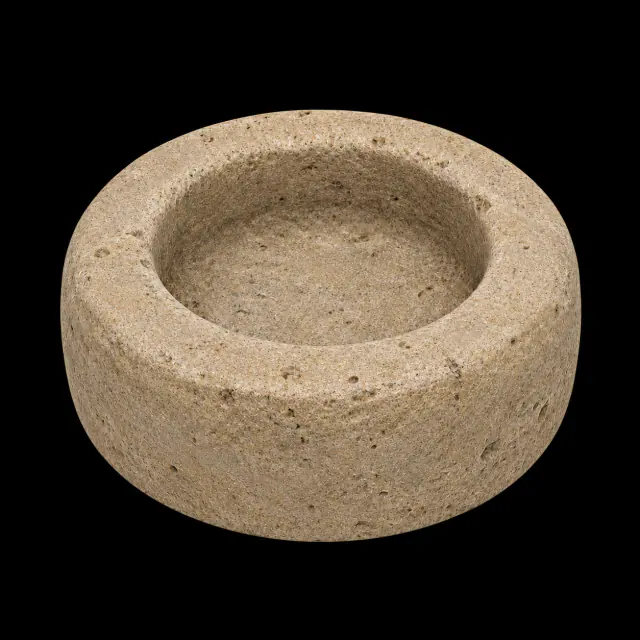
PPNA · ≈9600–8800 BCE, provisional proposal for the site
Grinding stone from Çakmaktepe
Prehistory
Provisional date range for the site and the published tools; the identification of the image is unverified.
Read the record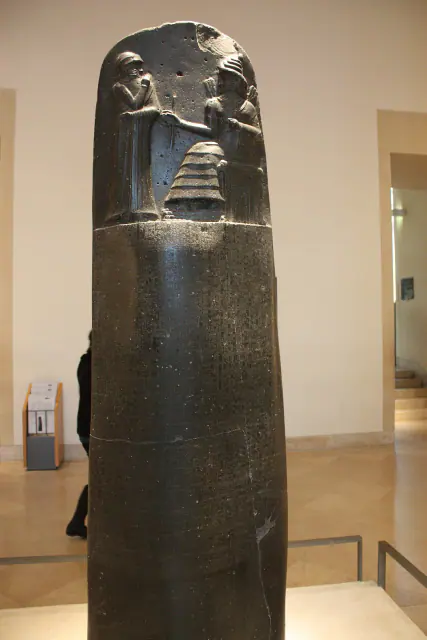 You are viewing
Towards 1750 BCE
Stele of Hammurabi
Sumer
Approximate dating according to the record.
Current record
c. 1200–900 BCE
Head 2
Maya worlds
Approximate dating according to the record.
Read the record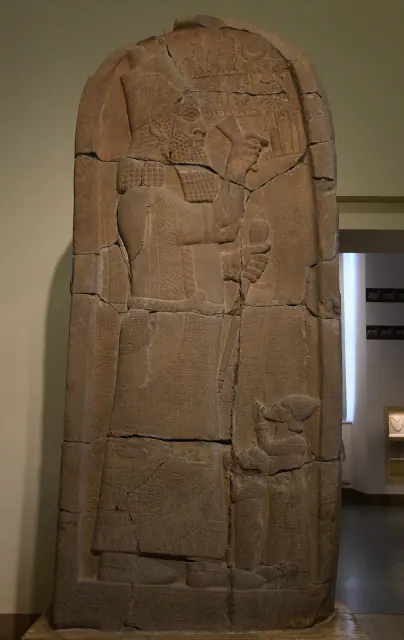
7th century BC C. · 671 campaign BCE
Stele of Esarhaddon
Sumer
Campaign dated explicitly on the record; indicative date of the commemoration.
Read the record
A closer look
About 1 min to read · 1 section. Further reading and sources · free access. Editorial review recorded: .
An old law is not a current code
Reading these cases requires attending to social categories and legal relationships typical of their time. The monument also presents an image of good governance. Its preservation does not demonstrate that each real controversy was resolved by literally applying a phrase from the stele: norm, propaganda and judicial practice are related, but different issues.
- Museum · Louvre · The Code of HammurabiAccess recorded: .
Location and territory
LOCATED SITE
Sousse IranAchaemenid city and palace marker.Where it is held
Musee du Louvre, Paris
Item or group in the record · Documented collection
Institution that preserves the piece; Check with the museum about its availability to visit.
Musee du Louvre
Item or group in the record · Documented collection
The holding institution is documented; public display may change. Check its official record before visiting.
Sources and references
Did you enjoy this exhibit?
Your opinion helps us improve the museum. You can change it whenever you like.
Loading your rating…