
 English
 Español
 Français
 Italiano
 Deutsch
 Русский
 Português
 Polski
 Română
 Svenska
 Norsk bokmål
 Suomi
 Türkçe
 العربية
 简体中文
 한국어
 हिन्दी
 Ελληνικά
08 · OBJECT · ABYDOS
Abydos Boats
Boats buried to continue moving
Wood, ropes and sand preserved boats associated with the world of the first kings.
Museum documentation · free public access, no account required.
Generated reconstruction · Declared visual hypothesis
Declared visual reconstruction for museographic context; it is not a photograph of the original nor documentary evidence.
History and context
Wooden boats buried in graves appeared near the funerary precincts of Abydos. Its construction allows us to recognize planks, joints and an extraordinary technical investment for the dynastic beginning.
We do not know every voyage they evoked. The act of burying them, however, shows that movement along the Nile could be carried over into ritual and royal memory.
The boats rested in boat-shaped adobe structures next to royal enclosures. The joined planks reveal a mature nautical tradition at a very early date.
Burying ships removed valuable timber from circulation. This material expense turned navigation—essential on the Nile—into a ritual and political affirmation.
Evidence and interpretation
Documented fact: Abydos preserves early funerary boats associated with royal complexes. Interpretation and caution: Explaining each boat as a literal vehicle of the deceased or a god imposes a precise function that the evidence does not completely resolve. Documented extension: At least twelve plank boat burials were documented at Abydos, near early royal complexes. Interpretation and expanded caution: Not all of them have been excavated and it is not known with certainty whether they sailed or to which king or rite each one corresponded.
Catalogue facts
- Narrative date
- ca. 3000 BCE
- Location
- Abydos, Egypt
- Material
- Wood, rope and plaster
- Context
- Graves of funeral boats
- Curatorial reading
- The documented fact and its interpretation appear separately in the evidence block.
- Date
- Around 3000 BCE
- Construction
- Plank hulls in pits or adobe structures
- Documentary coverage
- 2 museum, heritage, primary corpus or research sources for this stop.
A SHARED TOPIC, DIFFERENT MOMENTS
Objects connected through time
Follow a topic across the collections. A shared tag is a way to compare objects, not proof that one culture influenced another.
The order uses the midpoint of each approximate date range; ranges can overlap. Spacing does not represent elapsed time. Swipe, scroll or use the arrows. With the sequence focused, use ← / →, Home or End.
Wood13 dated objects
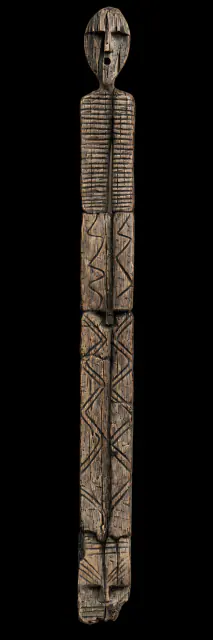
C. 10,000 BCE · approximation; debated dating
Shigir Idol
Prehistory
Approximation expressed in the record; dating debated.
Read the record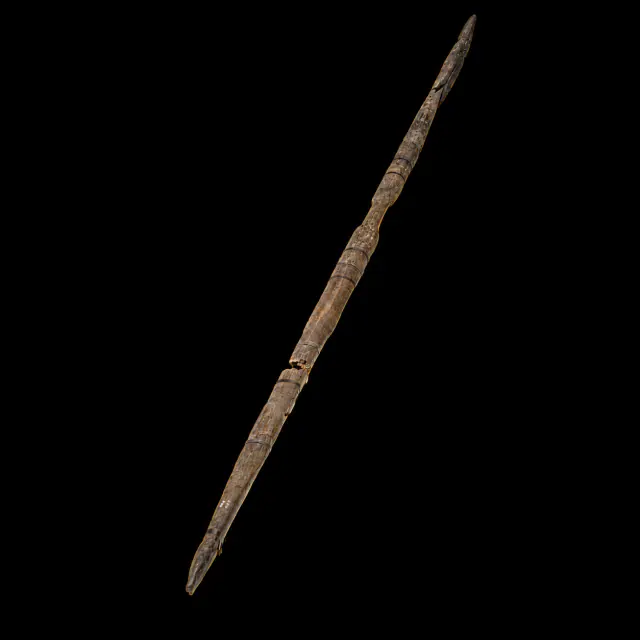
≈7000 BCE
Holmegaard bow
Prehistory
Date of the Holmegård bow; the Albuñol strings compared in the record date to ≈5300–4900 BCE.
Read the record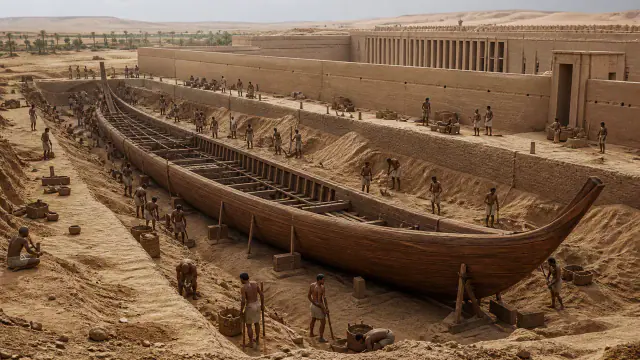 You are viewing
ca. 3000 BCE
Abydos Boats
Ancient Egypt
Approximate dating of the set of boats.
Current record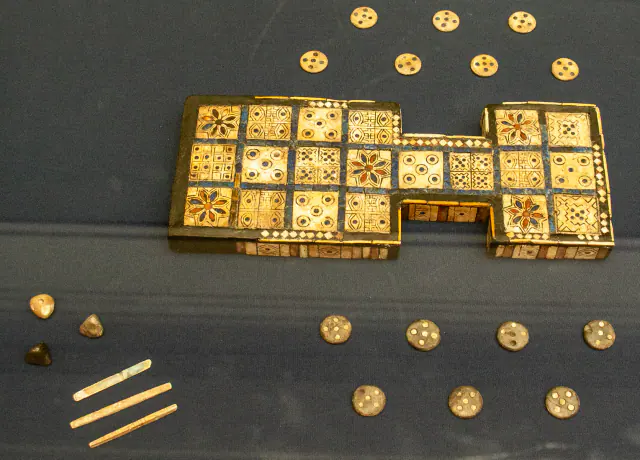
2600–2400 BCE
Royal Game of Ur
Sumer
Approximate dating according to the record.
Read the record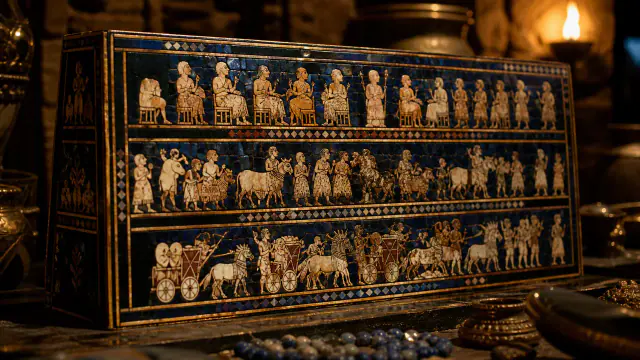
ca. 2600–2400 BCE
Standard of Ur
Sumer
Unknown function; The scenes do not prove that it was a banner.
Read the record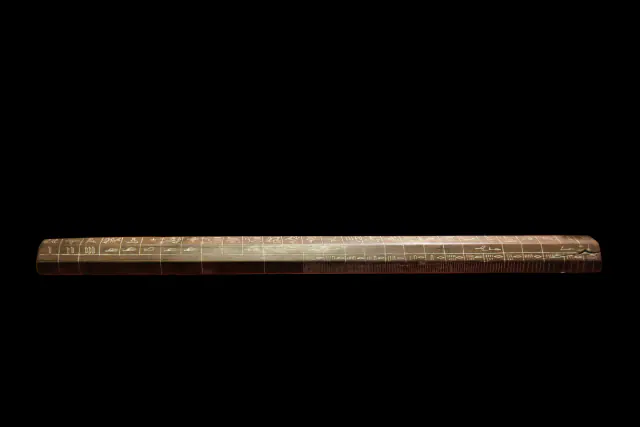
1330–1295 BCE · end of the 18th dynasty
Maya's cubit
Ancient Egypt
Approximate dating according to the record.
Read the record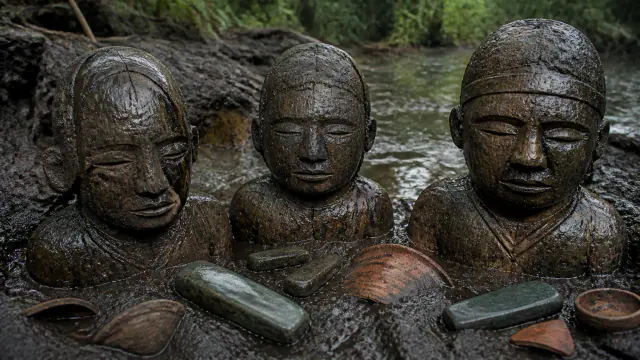
c. 1600–1000 BCE, in several phases
Wooden faces
Maya worlds
Deposit made in several phases; not simultaneous manufacture.
Read the record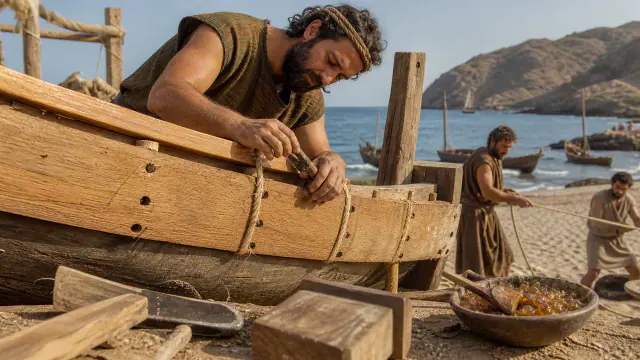
Second half of the 7th century BCE
Mazarrón 1
Phoenicians
Second half of the 7th century BCE
Read the record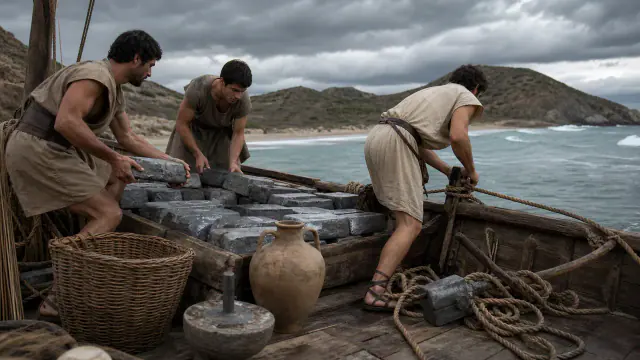
Second half of the 7th century BCE
Mazarrón 2
Phoenicians
Date of the shipwreck and its context; the cargo brings together several objects.
Read the record
5th–4th centuries BCE
Bow and arrows in a case
Scythians and Saka
Typological set of slings; no date for a single specimen.
Read the record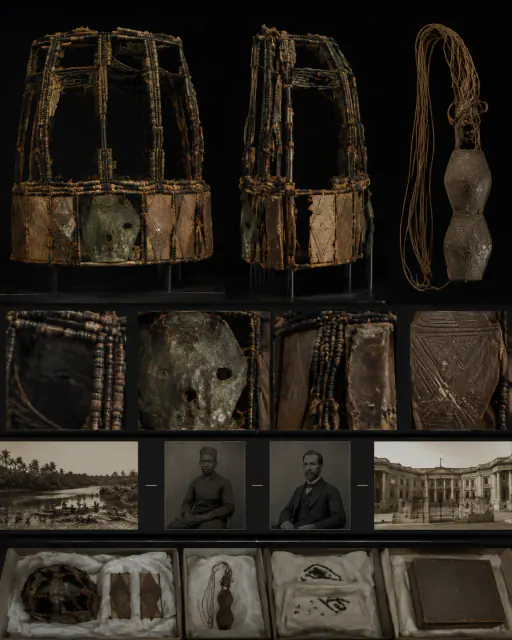
ca. 1760
Kuba ndop
Bantu-speaking worlds
Approximate dating according to the record.
Read the record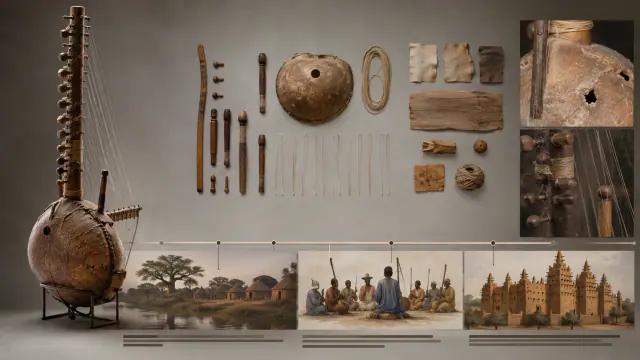
19th century
19th-century kora
Mande Worlds
The century of the surviving instrument, not the origin of the musical tradition.
Read the record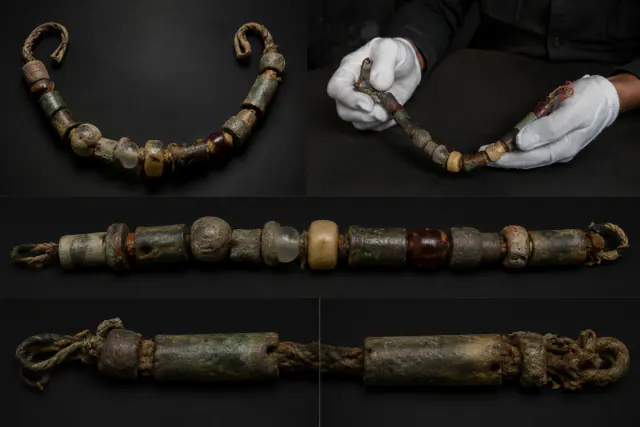
19th–20th centuries
Lukasa
Bantu-speaking worlds
Date range of the catalogued object, not the origin of the memory tradition.
Read the record
Also connected, without a comparable date (4)
These objects are not placed after the others: an unknown date does not mean a more recent object.
- Memory in performanceBantu-speaking worlds · 19th–20th centuries and transmitted practice
- Rice on stiltsYayoi Japan · Especially 1st–3rd centuries CE
- Rome learns in terracottaEtruscans and Rome · End of the sixth century BCE
- Tools in relationBatwa / Twa histories · ca. 1947
A closer look
About 1 min to read · 1 section. Further reading and sources · free access. Editorial review recorded: .
The seam was hidden in the boards
Cheryl Ward describes how a partial excavation resolved the union of the Abydos hulls. The mooring channels ran obliquely from the inside of the plank to an area located under the center of its edge. In some there were remains of the woven strips that held the pieces together. Bundles of reeds or grasses filled the joints to seal them. They are material indications of a sewn construction, not a deduction based only on images of boats. Observation allows this technique to be differentiated from known assemblies on real vessels from later periods.
Location and territory
LOCATED SITE
Abydos · EgyptMarker of the archaeological landscape of Abydos.Sources and references
Did you enjoy this exhibit?
Your opinion helps us improve the museum. You can change it whenever you like.
Loading your rating…