
 English
 Español
 Français
 Italiano
 Deutsch
 Русский
 Português
 Polski
 Română
 Svenska
 Norsk bokmål
 Suomi
 Türkçe
 العربية
 简体中文
 한국어
 हिन्दी
 Ελληνικά
05 · Storage · surplus is also power
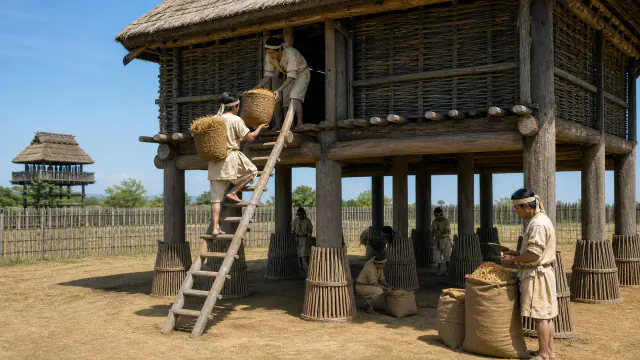
Rice on stilts
The raised granary of Yoshinogari
Raising the ground protected the harvest from moisture and animals, but doors controlled who could enter.
Museum documentation · free public access, no account required.
Generated reconstruction · Declared visual hypothesis
Declared visual reconstruction for museographic context; it is not a photograph of the original nor documentary evidence.
History and context
Sturdy posts supported elevated buildings interpreted as granaries. Ventilation and separation from the ground helped preserve seed rice, tribute and market goods, while removable stairs limited rodents and human access.
The reconstructions are based on post holes, not complete preserved buildings. Their location near enclosures and exchange areas suggests collective or elite management; we do not know exactly what part of the harvest belonged to each family.
Raising the ground favoured ventilation and separated the contents from moisture and rodents; discs or solutions on the posts could hinder animal ascent. The ladder could be removed to control access.
Some elevated buildings may have stored seed, offerings or trade goods, while others may have been residences. Function is inferred from size, position and parallels, because grains and walls are not always preserved.
Evidence and interpretation
Documented fact: the park documents numerous stores, elevated structures and areas interpreted as market and depot. Interpretation and caution: specific function of each building, tributary system and full elevation are reasoned reconstructions. Expanded documented fact: Post holes and the park's reconstruction document elevated buildings near ceremonial and storage areas. Expanded interpretation and caution: Do not call every granary a treasury nor reproduce a specific structure as an original complete preserved building.
Catalogue facts
- Narrative date
- Especially 1st–3rd centuries CE
- Location
- Yoshinogari, Saga, Kyushu
- Material
- Posts, planks, thatch, ropes and rice
- Context
- Elevated stores in residential and commercial sectors
- Curatorial reading
- The documented fact and its interpretation appear separately in the evidence block.
- Conservation
- The interpretation is based on post holes, ground levels and position, not intact elevations.
- Seed
- The park proposes that some stores contained seed rice for offerings or for the following year.
- Ambiguity
- Square elevated buildings may also be interpreted as residence or ritual depot.
- Documentary coverage
- 2 museum, heritage, primary corpus or research sources for this stop.
A SHARED TOPIC, DIFFERENT MOMENTS
Objects connected through time
Follow a topic across the collections. A shared tag is a way to compare objects, not proof that one culture influenced another.
The order uses the midpoint of each approximate date range; ranges can overlap. Spacing does not represent elapsed time. Swipe, scroll or use the arrows. With the sequence focused, use ← / →, Home or End.
THE CURRENT OBJECT
Its date is not sufficiently established to place it on the timeline. We keep it here, separate from the dated objects.
 You are viewing
Especially 1st–3rd centuries CE
Rice on stilts
Yayoi Japan
Granaries of several phases; no individual date of a preserved structure.
Current recordWood13 dated objects
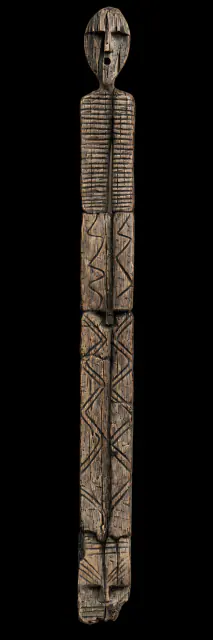
C. 10,000 BCE · approximation; debated dating
Shigir Idol
Prehistory
Approximation expressed in the record; dating debated.
Read the record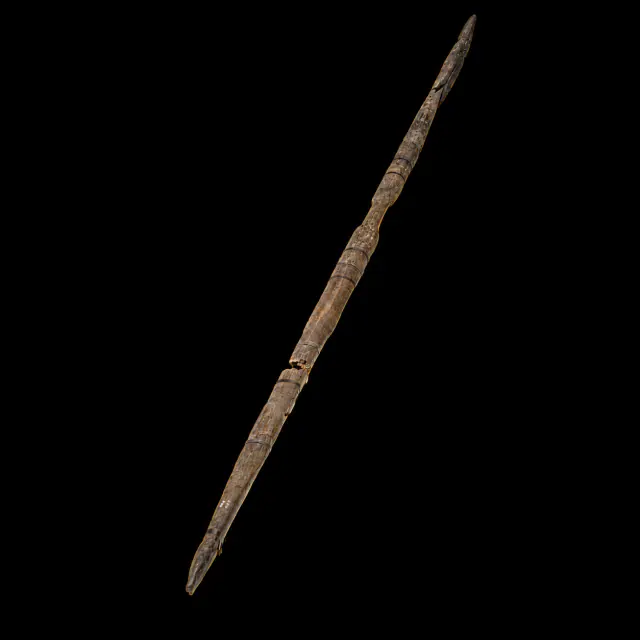
≈7000 BCE
Holmegaard bow
Prehistory
Date of the Holmegård bow; the Albuñol strings compared in the record date to ≈5300–4900 BCE.
Read the record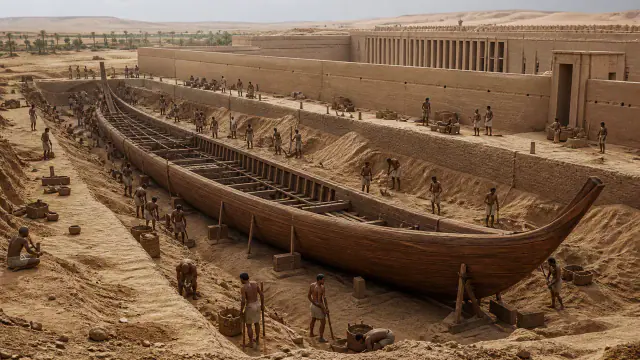
ca. 3000 BCE
Abydos Boats
Ancient Egypt
Approximate dating of the set of boats.
Read the record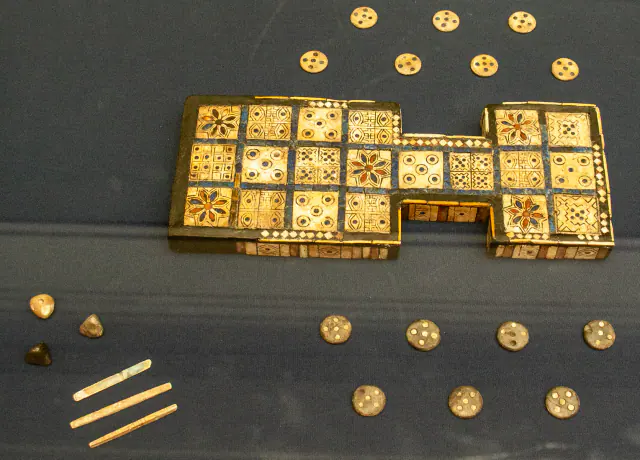
2600–2400 BCE
Royal Game of Ur
Sumer
Approximate dating according to the record.
Read the record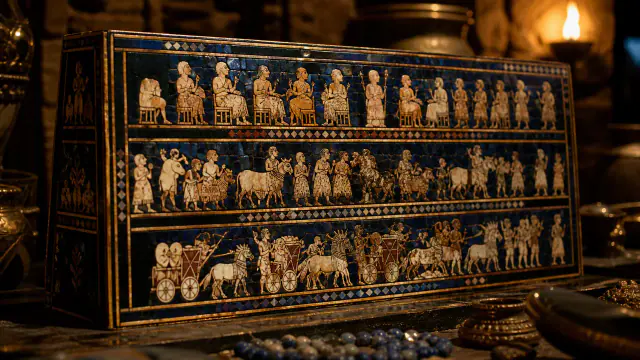
ca. 2600–2400 BCE
Standard of Ur
Sumer
Unknown function; The scenes do not prove that it was a banner.
Read the record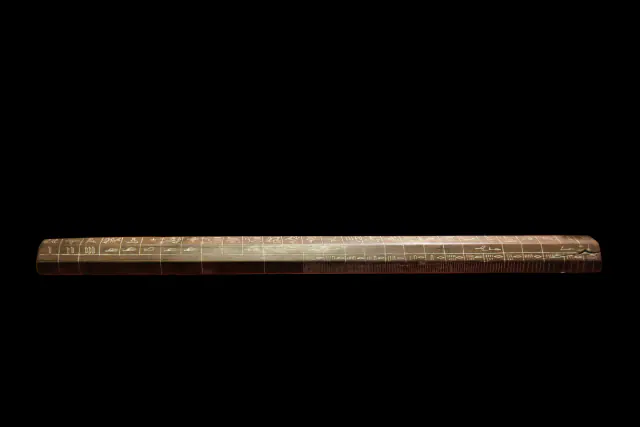
1330–1295 BCE · end of the 18th dynasty
Maya's cubit
Ancient Egypt
Approximate dating according to the record.
Read the record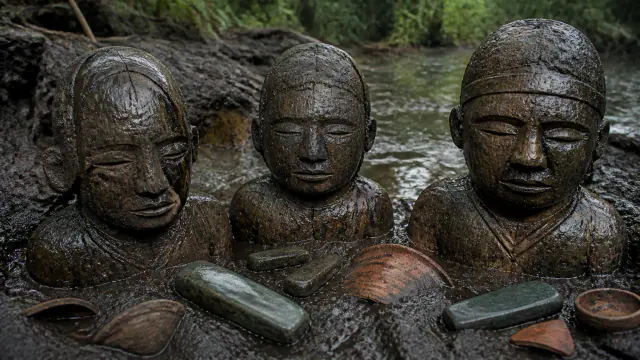
c. 1600–1000 BCE, in several phases
Wooden faces
Maya worlds
Deposit made in several phases; not simultaneous manufacture.
Read the record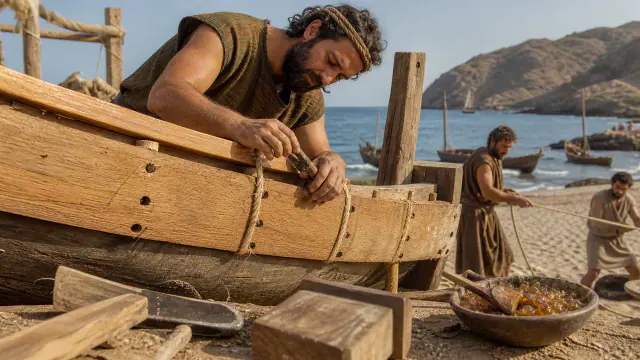
Second half of the 7th century BCE
Mazarrón 1
Phoenicians
Second half of the 7th century BCE
Read the record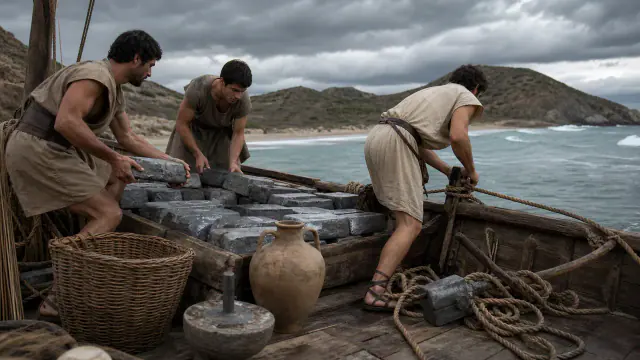
Second half of the 7th century BCE
Mazarrón 2
Phoenicians
Date of the shipwreck and its context; the cargo brings together several objects.
Read the record
5th–4th centuries BCE
Bow and arrows in a case
Scythians and Saka
Typological set of slings; no date for a single specimen.
Read the record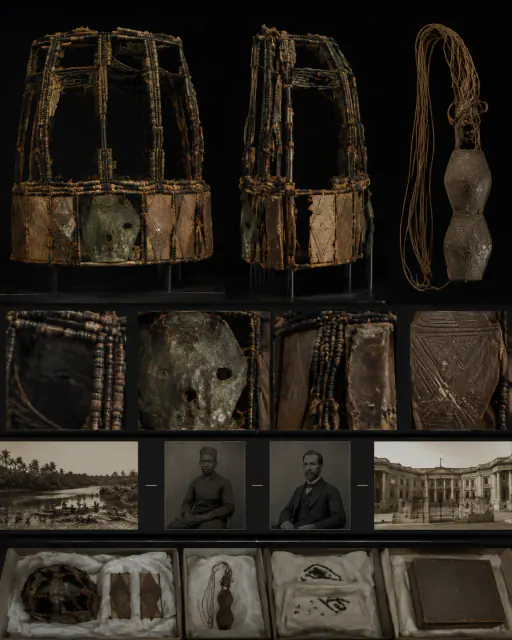
ca. 1760
Kuba ndop
Bantu-speaking worlds
Approximate dating according to the record.
Read the record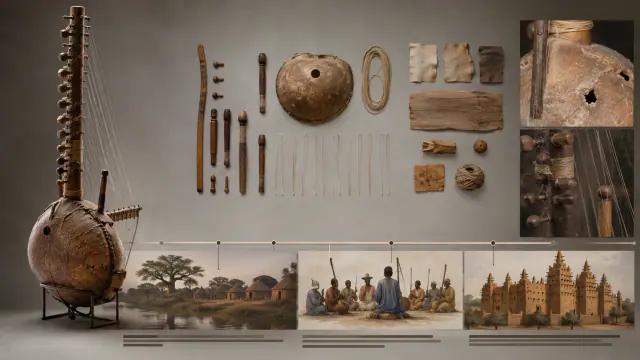
19th century
19th-century kora
Mande Worlds
The century of the surviving instrument, not the origin of the musical tradition.
Read the record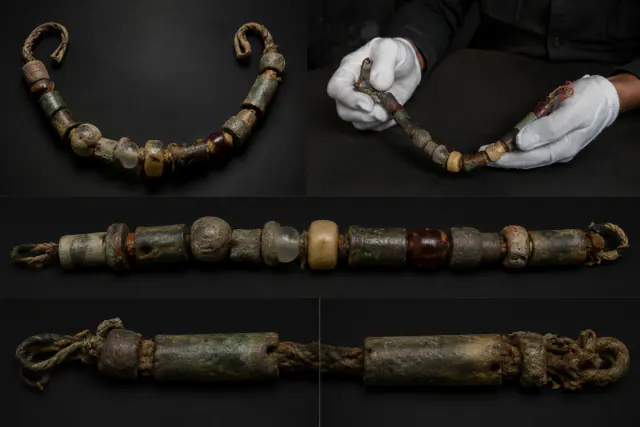
19th–20th centuries
Lukasa
Bantu-speaking worlds
Date range of the catalogued object, not the origin of the memory tradition.
Read the record
Also connected, without a comparable date (3)
These objects are not placed after the others: an unknown date does not mean a more recent object.
- Memory in performanceBantu-speaking worlds · 19th–20th centuries and transmitted practice
- Rome learns in terracottaEtruscans and Rome · End of the sixth century BCE
- Tools in relationBatwa / Twa histories · ca. 1947
A closer look
About 1 min to read · 1 section. Further reading and sources · free access. Editorial review recorded: .
Storehouses near a waterway
The commercial interpretation of Kura to Ichi is not based solely on finding elevated buildings. The park notes the ancient proximity of a river by which boats could travel, delimitation by ditches and organisational similarities with Chinese market representations. This position brought together transport possibilities, product concentration and access control. This combination makes it reasonable to propose exchange and storage, although it does not prove a fiscal office with known rules. Viewing the granary within this network allows asking how goods arrived and who could remove them, as well as how they were protected.
- Heritage · Yoshinogari Historical Park · Kura to IchiAccess recorded: .
Location and territory
LOCATED SITE
Yoshinogari · JapanMarker of the Yayoi settlement.Sources and references
Did you enjoy this exhibit?
Your opinion helps us improve the museum. You can change it whenever you like.
Loading your rating…