
 English
 Español
 Français
 Italiano
 Deutsch
 Русский
 Português
 Polski
 Română
 Svenska
 Norsk bokmål
 Suomi
 Türkçe
 العربية
 简体中文
 한국어
 हिन्दी
 Ελληνικά
03 · ARCHAEOBOTANY · ≈900–400 BCE
Seeds of the oasis
Wheat, barley, dates, vines and figs before the great system
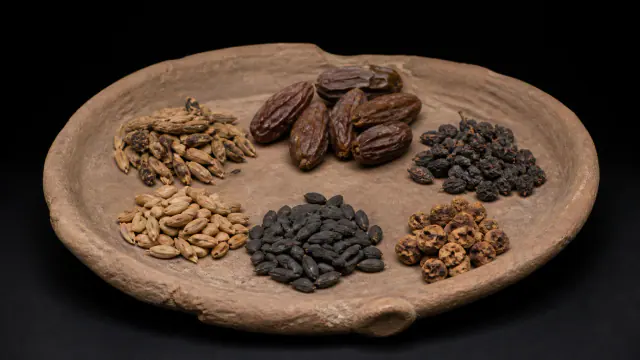
Plant remains show that cereals and fruit trees were already cultivated in the earliest oases.
Museum documentation · free public access, no account required.
Generated reconstruction · Declared visual hypothesis
Declared visual reconstruction; not a photograph of the original nor documentary evidence.
History and context
Plant remains from Zinchecra document three cereals, three fruit trees, salad plants, aromatics and wild resources within an early oasis economy.
Archaeobotany identifies cultivation and consumption; it does not reveal who owned the land or how much labour was free or coerced.
Eleven radiocarbon dates place the plant assemblage between 900 and 400 cal BCE. Cereals, fruit trees, aromatics and wild plants reveal an already developed agricultural regime.
The seeds document species, processing and potential consumption; they do not automatically identify ownership, tribute or enslaved labour.
Evidence and interpretation
The archaeobotanical assemblage and eleven radiocarbon dates place a developed agricultural regime between 900 and 400 cal BCE. Ownership, total scale and labour organisation are interpretations.
Catalogue facts
- Narrative date
- 900–400 cal BCE
- Location
- Zinchecra · Fezzan
- Material
- Desiccated and carbonised seeds and plant remains
- Context
- Early agriculture
- Curatorial reading
- The documented fact and its interpretation appear separately in the evidence block.
- Dating
- Eleven radiocarbon dates, 900–400 cal BCE
- Conservation
- Desiccated and carbonised remains
- Documentary coverage
- 2 museum, heritage, primary corpus or research sources for this stop.
A SHARED TOPIC, DIFFERENT MOMENTS
Objects connected through time
Follow a topic across the collections. A shared tag is a way to compare objects, not proof that one culture influenced another.
The order uses the midpoint of each approximate date range; ranges can overlap. Spacing does not represent elapsed time. Swipe, scroll or use the arrows. With the sequence focused, use ← / →, Home or End.
Plant remains1 dated object
A closer look
About 1 min to read · 1 section. Further reading and sources · free access. Editorial review recorded: .
Dryness and fire preserve different things
The plant assemblage from Zinchecra comprises desiccated and carbonised remains. Its study therefore combines two preservation pathways: materials that lost moisture and others transformed by heat. Comparing them helps expand the available information on cultivated and gathered plants, rather than relying solely on what fell into the fire. The assemblage includes salad plants and aromatic herbs, as well as cereals and fruits. This variety allows thinking about different uses of vegetables and domestic practices that are not reduced to grain storage.
Location and territory
LOCATED SITE
Zinchecra · FezzanApproximate marker of the elevated settlement.Sources and references
Did you enjoy this exhibit?
Your opinion helps us improve the museum. You can change it whenever you like.
Loading your rating…