
 English
 Español
 Français
 Italiano
 Deutsch
 Русский
 Português
 Polski
 Română
 Svenska
 Norsk bokmål
 Suomi
 Türkçe
 العربية
 简体中文
 한국어
 हिन्दी
 Ελληνικά
ARCHERY · MESOLITHIC AND EARLY NEOLITHIC
Holmegaard bow
The Holmegaard bow
A peat bog preserved the wood of the bow; a dry cave preserved sinew cords—probable bow strings—that almost never survive.
Museum documentation · free public access, no account required.
Reconstruction · Declared visual hypothesis
Recreation contributed to the project. It is not an archaeological photograph or a metric facsimile. Materials, finish, proportions and visible details may differ from the original. The record and its sources distinguish the documented from the interpreted.
History and context
In the Holmegård bog, on the Danish island of Zealand, remains of several elm bows dated to around 7000 BCE were found. One of them, discovered in 1944, survived almost complete: it measures about a metre and a half and combines broad, flat limbs with a narrow, rigid grip. Its maker left the flexible sapwood on the back of the bow and the harder heartwood on the opposite face. Yew, the preferred wood for later bows, did not yet grow in Denmark.
The wooden limbs store the energy, but without a string the bow cannot shoot, and strings almost never survive. The dryness of Cueva de los Murciélagos in Albuñol preserved two probable bow strings—34 and 59 centimetres long and barely 3 millimetres in diameter—alongside arrows with feathers, fibres and adhesive, around 5300–4900 BCE. No bow was identified there.
Microscopy and molecular analysis revealed sinew collagen. One string came from Capra spp.; the other combined remains of Sus spp. and probably of caprines or cervids and, at the opposite end, roe deer (Capreolus capreolus). At least in that second string, the artisans added fragments of sinew and twisted them together to reach the necessary length.
Evidence and interpretation
Documented fact: the Holmegård bows are made of elm, date to around 7000 BCE and rank among the oldest and best-preserved in Europe; they retain no string. At Albuñol, CM-591b and CM-P287 are two-strand cords with Szz twist; in CM-P287, additions to lengthen it and a knot that may have been a repair are observed. Their interpretation as bow strings is based on shape, measurements and comparison, but they were not attached to any bow. Raquel Piqué highlights that this technique would have produced strong and flexible strings for expert archers and that its precision reveals exceptional craft knowledge. The study did not perform a mechanical strength test. Bringing the Danish bow and the Andalusian strings together in one record is a comparison: they come from different places and periods.
The material, general shape and date of the bow are documented. The main image is a recreation: its surface decoration and bindings should not be read as verified features of the original. The 3D bow in the gallery is a schematic reconstruction with a string inspired by those from Albuñol, which come from another site.
Catalogue facts
- Date
- Bow: ≈7000 BCE · strings: ≈5300–4900 BCE
- Location
- Bow: Holmegård bog, Zealand (Denmark) · strings: Cueva de los Murciélagos, Albuñol (Granada)
- Bow
- Elm · ≈1.5 m · broad limbs and narrow grip
- Culture of the bow
- Mesolithic · Maglemose culture
- Strings
- CM-591b: 34 cm · CM-P287: 59 cm · diameter 3 mm
- Twist
- Two-strand · Szz · two turns per centimetre
- String material
- Sinew of Capra spp. · Sus spp. · roe deer (Capreolus capreolus)
- Methods
- Microscopy · SEM/FTIR · ZooMS · radiocarbon
A SHARED TOPIC, DIFFERENT MOMENTS
Objects connected through time
Follow a topic across the collections. A shared tag is a way to compare objects, not proof that one culture influenced another.
The order uses the midpoint of each approximate date range; ranges can overlap. Spacing does not represent elapsed time. Swipe, scroll or use the arrows. With the sequence focused, use ← / →, Home or End.
Wood13 dated objects
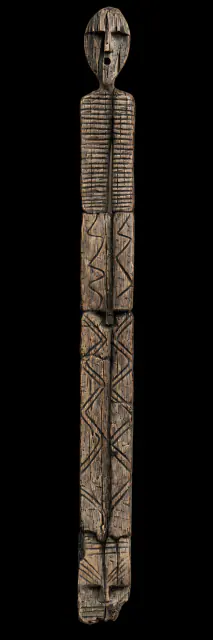
C. 10,000 BCE · approximation; debated dating
Shigir Idol
Prehistory
Approximation expressed in the record; dating debated.
Read the record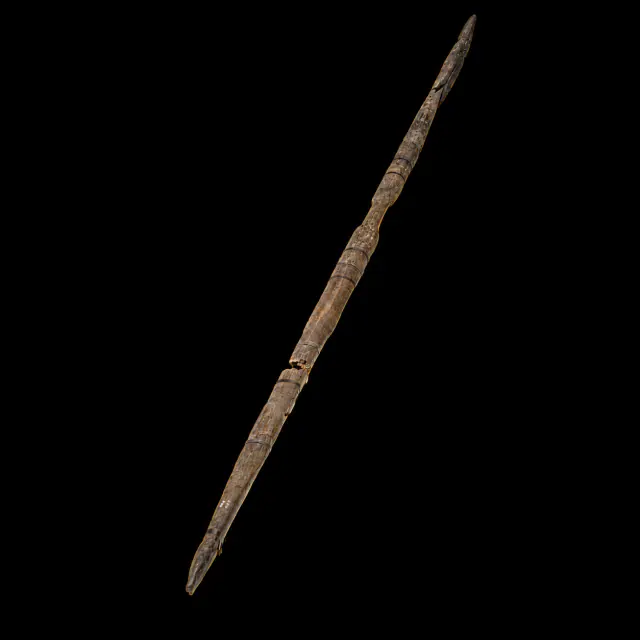 You are viewing
≈7000 BCE
Holmegaard bow
Prehistory
Date of the Holmegård bow; the Albuñol strings compared in the record date to ≈5300–4900 BCE.
Current record
ca. 3000 BCE
Abydos Boats
Ancient Egypt
Approximate dating of the set of boats.
Read the record
2600–2400 BCE
Royal Game of Ur
Sumer
Approximate dating according to the record.
Read the record
ca. 2600–2400 BCE
Standard of Ur
Sumer
Unknown function; The scenes do not prove that it was a banner.
Read the record
1330–1295 BCE · end of the 18th dynasty
Maya's cubit
Ancient Egypt
Approximate dating according to the record.
Read the record
c. 1600–1000 BCE, in several phases
Wooden faces
Maya worlds
Deposit made in several phases; not simultaneous manufacture.
Read the record
Second half of the 7th century BCE
Mazarrón 1
Phoenicians
Second half of the 7th century BCE
Read the record
Second half of the 7th century BCE
Mazarrón 2
Phoenicians
Date of the shipwreck and its context; the cargo brings together several objects.
Read the record
5th–4th centuries BCE
Bow and arrows in a case
Scythians and Saka
Typological set of slings; no date for a single specimen.
Read the record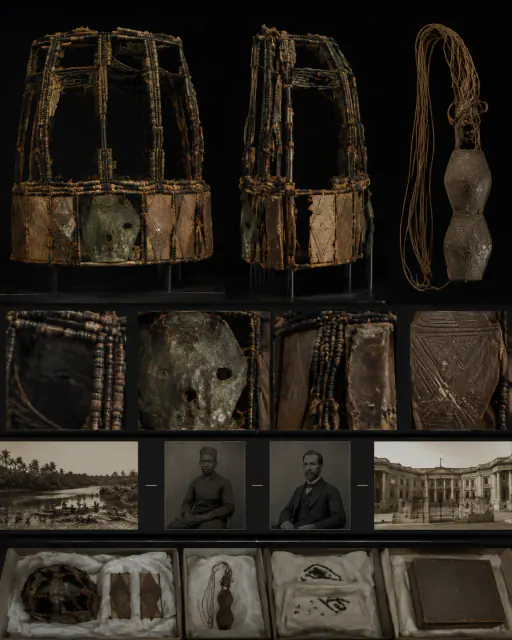
ca. 1760
Kuba ndop
Bantu-speaking worlds
Approximate dating according to the record.
Read the record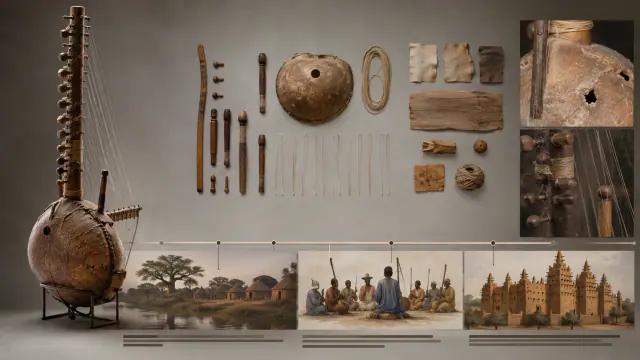
19th century
19th-century kora
Mande Worlds
The century of the surviving instrument, not the origin of the musical tradition.
Read the record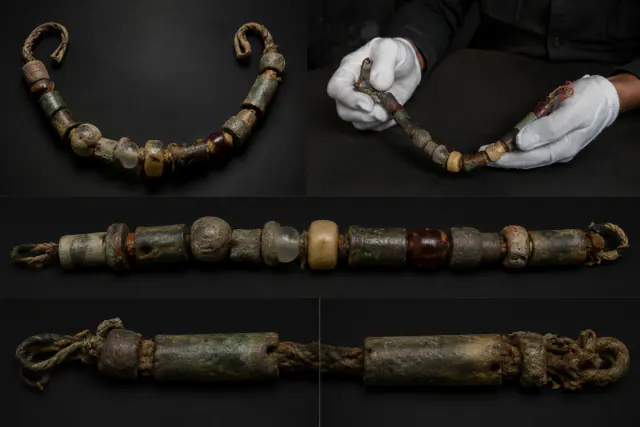
19th–20th centuries
Lukasa
Bantu-speaking worlds
Date range of the catalogued object, not the origin of the memory tradition.
Read the record
Also connected, without a comparable date (4)
These objects are not placed after the others: an unknown date does not mean a more recent object.
- Memory in performanceBantu-speaking worlds · 19th–20th centuries and transmitted practice
- Rice on stiltsYayoi Japan · Especially 1st–3rd centuries CE
- Rome learns in terracottaEtruscans and Rome · End of the sixth century BCE
- Tools in relationBatwa / Twa histories · ca. 1947
A closer look
About 2 min to read · 3 sections. Further reading and sources · free access. Editorial review recorded: .
Choosing the right wood
With no yew available, Danish hunters turned to slender elm trunks. The national museum explains that they placed the more flexible sapwood on the back of the bow and the harder heartwood on the opposite face. Bows of this type, as tall as a person, are known from several Danish Stone Age settlements.
- Museum · National Museum of Denmark · the world’s oldest bowsAccess recorded: .
An arrow was more than a sharpened stick
The arrows from Albuñol combine different materials: the study identified reed and olive wood in the shafts, as well as birch bark tar as a coating. Preserved feathers, fibres and adhesive substances allow investigation of the assembly, not just the point. The extraordinary dryness of the site thus returns parts that usually disappear and shows how much knowledge would remain invisible if only stone had been preserved. The selection of components responds to different properties; recognising them does not mean we know a single recipe for all Neolithic archery.
- Research · Scientific Reports · Neolithic archery from Albuñol (2024)Access recorded: .
Why two distant finds are compared
Holmegård preserved the wood but not the string; Albuñol preserved strings but no bow. Bringing them together in one record helps to imagine the complete weapon without claiming that they were the same: they are separated by more than fifteen hundred years and about 2,400 kilometres. Each find answers its own questions.
- Museum · National Museum of Denmark · the world’s oldest bowsAccess recorded: .
- Research · Scientific Reports · Neolithic archery from Albuñol (2024)Access recorded: .
Location and territory
APPROXIMATE LOCATION
Holmegård bog · Zealand, DenmarkApproximate marker for the bog where the bow was found. The sinew strings compared in this record come from Cueva de los Murciélagos in Albuñol (Granada).Where it is held
National Museum of Denmark (Nationalmuseet)
Item or group in the record · Documented collection
It presents the Holmegård bows as among the oldest and best-preserved in Europe. Their current display is not verified here.
Museo Arqueológico Nacional (MAN)
Component of the group · Documented collection
The study places the string CM-591b in the MAN. It does not unequivocally identify the current repository of CM-P287, which was excavated in 2022.
The holding institution is documented; public display may change. Check its official record before visiting.
Sources and references
Did you enjoy this exhibit?
Your opinion helps us improve the museum. You can change it whenever you like.
Loading your rating…