
 English
 Español
 Français
 Italiano
 Deutsch
 Русский
 Português
 Polski
 Română
 Svenska
 Norsk bokmål
 Suomi
 Türkçe
 العربية
 简体中文
 한국어
 हिन्दी
 Ελληνικά
11 · Mobility · shooting without stirrups
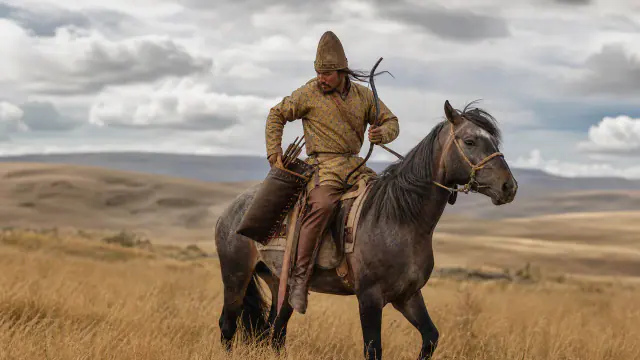
Bow and arrows in a case
The gorytos of the Scythian horseman
A single case protected a composite bow and arrows, ready for use from the side.
Museum documentation · free public access, no account required.
Generated reconstruction · Declared visual hypothesis
Declared visual reconstruction for museographic context; it is not a photograph of the original nor documentary evidence.
History and context
The gorytos combined quiver and bow case in a compact outfit. Luxury metal plates could cover ceremonial versions, while leather and wood made the everyday versions functional for horsemen and hunters.
The effectiveness of mounted archery did not depend on stirrups, which would arrive much later. Saddle, balance, training and composite bow allowed shooting in motion; the object explains a bodily technology, not a supposed nomadic invincibility.
The object from the Oxus Treasure is a pierced gold applique of only 3.5 by 2.5 centimetres and four grams. It has the form of a bird’s head with a curved beak and serpentine neck; five loops allowed it to be sewn or fixed.
The British Museum considers it probable that it decorated the upper part of a gorytos by comparison with reliefs from Persepolis, but records both the findspot Takht-i Kuwad and the Scythian attribution with a question mark.
Evidence and interpretation
Documented fact: The British Museum preserves a gorytos fitting attributed to the Scythian and Achaemenid worlds, and ancient images show combined cases. Interpretation and caution: Not every luxury fitting was used in battle nor does it allow reconstruction of a universal tactic. Expanded documented fact: Gold applique, fifth–fourth centuries BCE, Oxus provenance not completely secure; it could have been fastened to leather or fabric of a bow case. Expanded interpretation and caution: It is not a complete quiver-bow case nor does it demonstrate its internal mechanism. The attribution ‘Scythian (?)’ and the findspot ‘Takht-i Kuwad (?)’ must remain visible.
Catalogue facts
- Narrative date
- 5th–4th centuries BCE
- Location
- Eurasian steppes; Oxus piece, Central Asia
- Material
- Gold or bronze on leather and wood bow case
- Context
- Equestrian archery equipment and prestige
- Curatorial reading
- The documented fact and its interpretation appear separately in the evidence block.
- Dimensions
- 3.5 × 2.5 cm; 4 g
- Fastening
- Five rear loops
- Cataloguing
- Scythian (?) and Takht-i Kuwad (?) in the British Museum
- Documentary coverage
- 3 museum, heritage, primary corpus or research sources for this stop.
- In this grouping
- Applique probably attributed to a bow and arrow case: no complete gorytos is preserved here nor is its war use proven.
A SHARED TOPIC, DIFFERENT MOMENTS
Objects connected through time
Follow a topic across the collections. A shared tag is a way to compare objects, not proof that one culture influenced another.
The order uses the midpoint of each approximate date range; ranges can overlap. Spacing does not represent elapsed time. Swipe, scroll or use the arrows. With the sequence focused, use ← / →, Home or End.
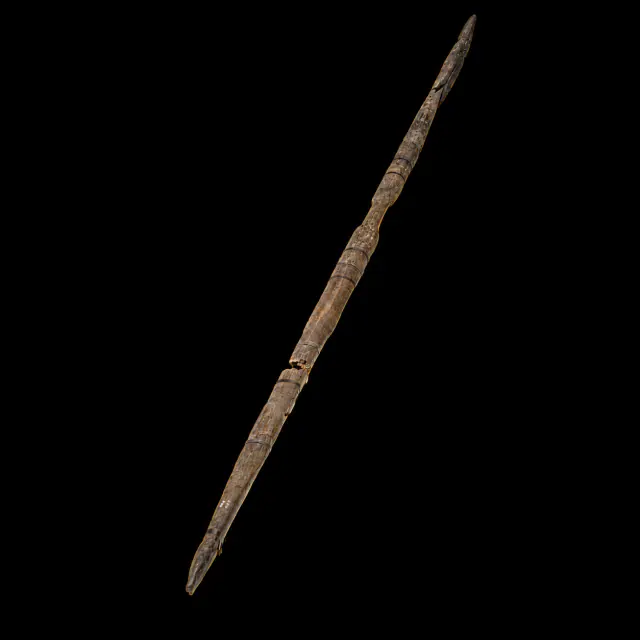
Archery2 dated objects
A closer look
About 1 min to read · 1 section. Further reading and sources · free access. Editorial review recorded: .
The small plaque passed through several collections
The British Museum record allows tracing part of the modern history of the applique. It notes Alexander Cunningham as a previous owner, Francis Charles Burton in the acquisition chain and its entry via the legacy of Augustus Wollaston Franks in 1897. It also retains references to its display in the gold ornaments room from 1900 and, later, in spaces devoted to Persia and Iran. These are museological circulation data, distinct from the uncertain archaeological provenance. They explain how a tiny piece ended up being studied within the set known as the Oxus Treasure.
- Museum · British Museum · Gorytus fitting, 1897,1231.39Access recorded: .
Where it is held
The British Museum
Item or group in the record · Documented collection
The holding institution is documented; public display may change. Check its official record before visiting.
Sources and references
Did you enjoy this exhibit?
Your opinion helps us improve the museum. You can change it whenever you like.
Loading your rating…