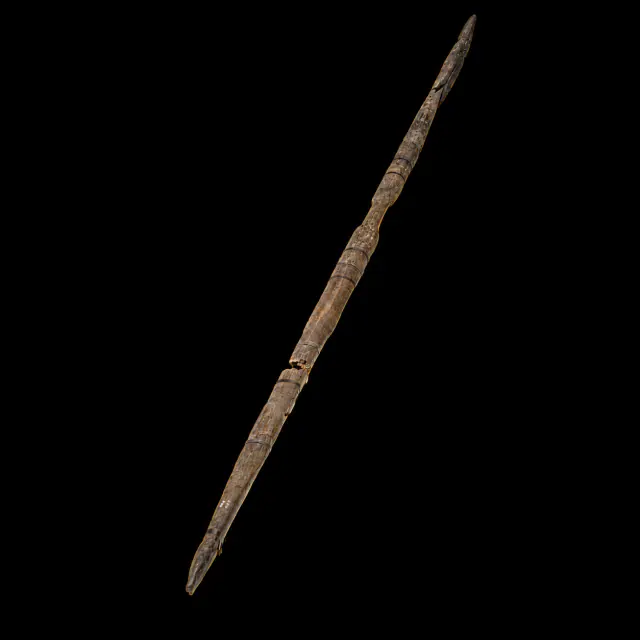
Declared visual reconstruction for museographic context; it is not a photograph of the original nor documentary evidence.
History and context
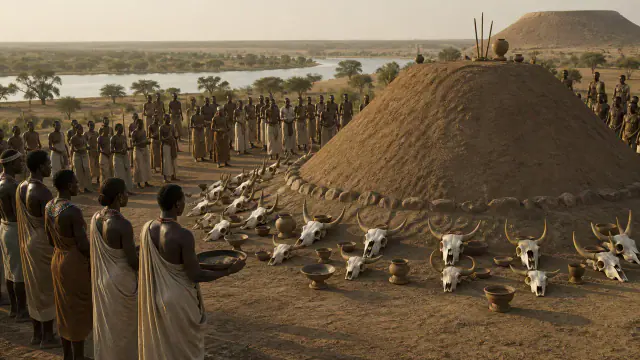
Large Kerma tumuli were associated with livestock deposits, evidence that links pastoralism, prestige and funerary ritual. The animals are not mere burial decoration: they speak of resources and social relations.
The scene remains sober. A deposit may record offering, feast, status or several things at once; it does not allow automatic translation of an identity or belief.
Skulls, horns and livestock sacrifices turned herds into funerary architecture. The animal represented food, mobility, wealth and social relation.
Mass deposition was also deliberate economic loss. That cost helped distinguish elite funerals and summoned communal labour.
Evidence and interpretation
Documented fact: The necropolises of Kerma include tumuli and livestock deposits; the British Museum highlights this association. Interpretation and caution: The number of cattle does not linearly equate to individual wealth nor allow reconstruction of a specific ceremony.
Documented expansion: Bovine livestock and offerings are frequent in Kerma art and funerary contexts and in other Sudanese cultures.
Expanded interpretation and caution: Not every cow was sacrificed in the same way nor did livestock have a single religious meaning.
Catalogue facts
Narrative date
c. 2050–1500 BCE
Location
Kerma, Sudan
Material
Livestock remains, earth and ceramic
Context
Funerary ritual and prestige
Curatorial reading
The documented fact and its interpretation appear separately in the evidence block.
Economy
Riverine pastoralism and agriculture
Context
Tumuli and funerary offerings
Documentary coverage
2 museum, heritage, primary corpus or research sources for this stop.
A SHARED TOPIC, DIFFERENT MOMENTS
Objects connected through time
Follow a topic across the collections. A shared tag is a way to compare objects, not proof that one culture influenced another.
The order uses the midpoint of each approximate date range; ranges can overlap. Spacing does not represent elapsed time. Swipe, scroll or use the arrows. With the sequence focused, use ← / →, Home or End.
THE CURRENT OBJECT
Its date is not sufficiently established to place it on the timeline. We keep it here, separate from the dated objects.
About 1 min to read · 1 section. Further reading and sources · free access. Editorial review recorded: .
Horns modified in life
Some Kerma cattle skulls retain deliberate horn modifications: in some, both horns grew parallel forwards; in others, one horn deviated while the second kept its direction. Dubosson’s study distinguishes these traces from simple natural differences. Not all animals were treated thus. Ethnoarchaeological comparisons help investigate possible procedures, but do not authorise transferring to Kerma the meaning the practice holds among present-day communities. The evidence adds care and transformation of the living animal to the account of its funerary deposition.

 English
 Español
 Français
 Italiano
 Deutsch
 Русский
 Português
 Polski
 Română
 Svenska
 Norsk bokmål
 Suomi
 Türkçe
 العربية
 简体中文
 한국어
 हिन्दी
 Ελληνικά
 You are viewing