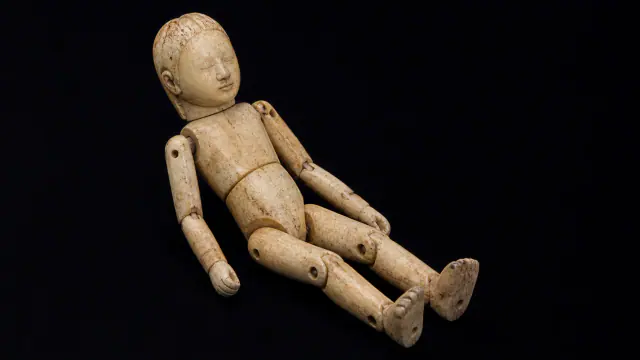
The holes in its pieces suggest they could be joined. We do not know if it was used as a puppet.
Museum documentation · free public access, no account required.
CONTRIBUTED RECREATION · VISUAL INTERPRETATION
Reconstruction · Declared visual hypothesis
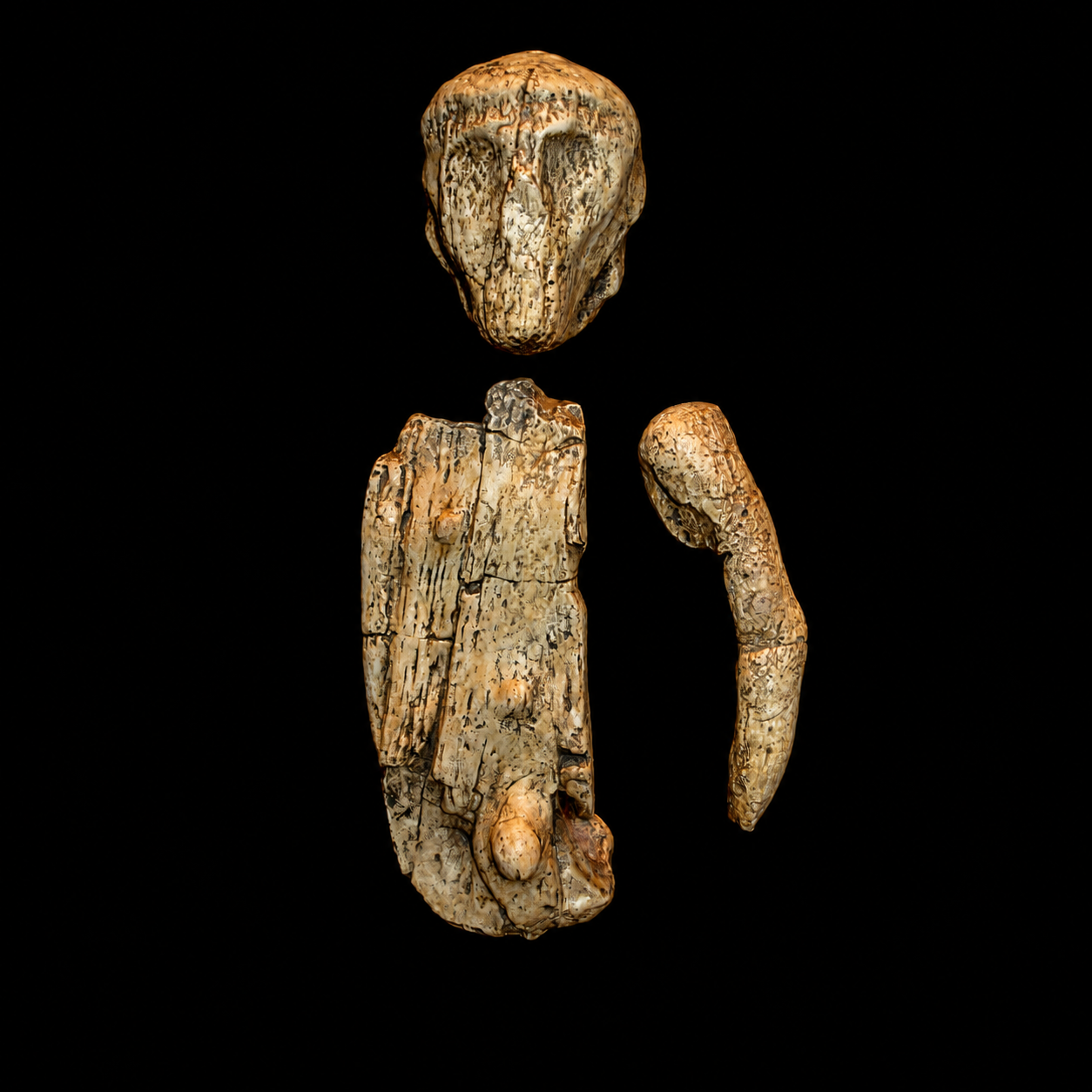
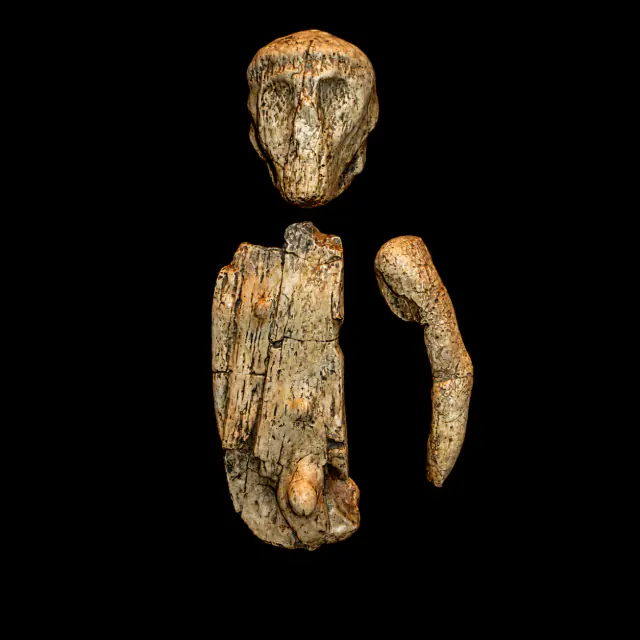
User-supplied image for the project to replace the previous illustration. Shows the head, torso and one arm separately. Not presented as an authenticated photograph of the original nor as a scale replica; texture and details are interpretive.
Explore in 3D
Load the model only when you want to explore it. Drag or use the arrow keys to turn it; + and − zoom. Closing it releases its memory.
Digital reconstruction supplied by the project and generated with Tripo. Not an archaeological scan nor a metric replica; gallery scale adapted for display. Reproduction of the Brno II man. Supplied geometry preserved intact; finish and fragment arrangement are interpretive and do not demonstrate how the figurine was articulated or used.
History and context
A grave discovered in 1891 in Francouzská, Brno, preserved the head, torso and one arm of an anthropomorphic figure carved in ivory, traditionally described as male. The separate pieces and perforations suggest other parts could have been joined and moved.
Calling it the "oldest puppet" creates an immediate effect, but presupposes strings, manipulation and performance that were not preserved. The funerary association allows it to be dated; the figure was not directly dated.
Evidence and interpretation
The burial gave 23,680 ± 200 14C BP and is prudently summarised as ≈28,000 cal BP. Perforations and fragments allow articulation to be proposed; use, movement and relationship with shamanism are not proven.
Catalogue facts
Date
≈28,000 years cal BP · by funerary association
Location
Brno II · Francouzská, Czech Republic
Material
Mammoth ivory
Preserved
Head 6.7 cm · torso 13.5 cm · one arm
A SHARED TOPIC, DIFFERENT MOMENTS
Objects connected through time
Follow a topic across the collections. A shared tag is a way to compare objects, not proof that one culture influenced another.
The order uses the midpoint of each approximate date range; ranges can overlap. Spacing does not represent elapsed time. Swipe, scroll or use the arrows. With the sequence focused, use ← / →, Home or End.
About 4 min to read · 7 sections. Further reading and sources · free access. Editorial review recorded: .
The figurine did not appear alone
The anthropological review of the burial brings together stone discs, small discs of various materials and hundreds of dentalium shells alongside the ivory figurine. The initial discovery occurred during drainage works and left no detailed description of the skeleton's position. That contrast matters: the assemblage allows us to speak of a deposition rich in objects, but its documentation limits precise reconstructions of the rite. The figurine's possible articulation is a technical question; turning the buried person into a puppeteer or religious specialist would be another claim, not demonstrated.
Brno II belongs to the world of the Upper Palaeolithic hunter-gatherers of Central Europe. The region is known for open-air settlements, stone and animal-material tools, ornaments and prepared burials. The figurine is part of that diversity: it is not the only indication that these communities devoted time to making things that went beyond an edge or a point.
Regional comparison allows a concrete question: were the same objects chosen for graves as those that circulated in the places where people lived?
A study published in 2024 examined ceramic figurines from several Moravian sites. Its authors highlighted that, despite the abundance of ceramic fragments in Pavlovian settlements, they knew of no ceramic figurines in their burials. Brno II, by contrast, contained an ivory figurine. They proposed an intentional selection of the materials deposited. This is an interpretation of the assemblage, not a rule we can attribute without exception to all Prehistory. It helps us think about distinct decisions for living, making and bidding farewell to a person.
Skeletal studies identify a robust adult male. That does not give us his name, his responsibilities or the relationship he had with whoever carved the figurine. The 2005 review compared fragments of his bones with other Gravettian individuals to estimate body dimensions and study bone alterations.
No biography survives to complete those data. The idea that he was a shaman is an interpretive proposal; neither the skeleton's robustness nor a singular figurine allow us to assign him a trade or religious authority by themselves.
The buried person's skull offers an important example. An old mount suggested a post-mortem deformation. On reconstructing it anew, Jan Jelínek verified that the strange appearance came from the mount. It was not a trait of that person.
This review explains why researchers return to study old collections. It is not always necessary to discover another tomb: preserving the fragments and documentation allows a previous explanation to be corrected. The ivory figurine must be observed with that same care, distinguishing its preserved parts from any proposed mount.
The radiocarbon date cited for Brno II was obtained from the human remains, not the figurine. The date helps situate the burial; the archaeological association allows it to be linked to the object. They are two different steps.
Nor should a radiocarbon age be read as if it were an exact number of calendar years. That is why the record retains the approximate character of the chronology and specifies that the figurine is dated by its funerary context. The analysis does not identify when carving began nor how long it may have been used before being buried.
The Anthropos Institute of the Moravian Museum brings together archaeology, anthropology and palaeontology. Its collections include both crafted objects and human and animal remains; it also preserves comparative material for identifying ancient bones. That organisation allows a piece to be studied alongside the people, materials and environment with which it relates.
In this record you can start with the silhouette, but it is worth returning to the context. An isolated fragment allows a form to be recognised; its association with other remains is what opens questions about work, ornaments and funerary practices.

 English
 Español
 Français
 Italiano
 Deutsch
 Русский
 Português
 Polski
 Română
 Svenska
 Norsk bokmål
 Suomi
 Türkçe
 العربية
 简体中文
 한국어
 हिन्दी
 Ελληνικά
 You are viewing