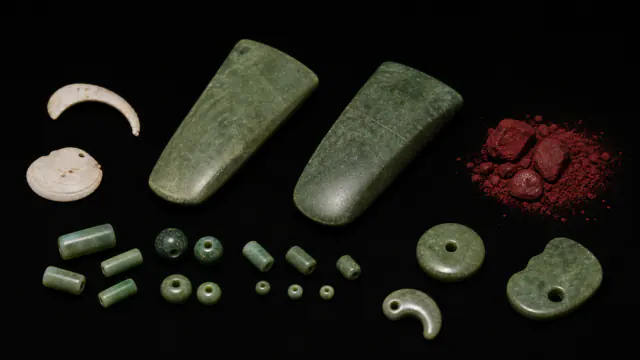
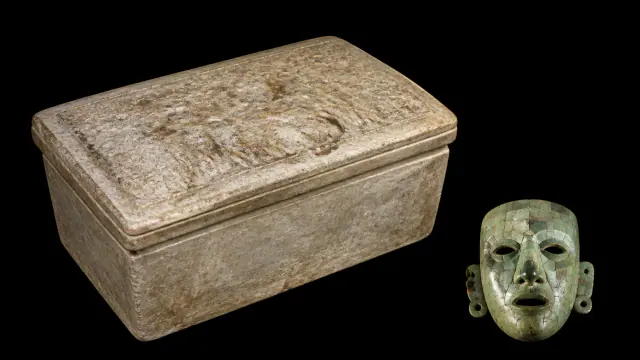
Declared visual reconstruction; not a photograph of the original nor documentary evidence.
History and context
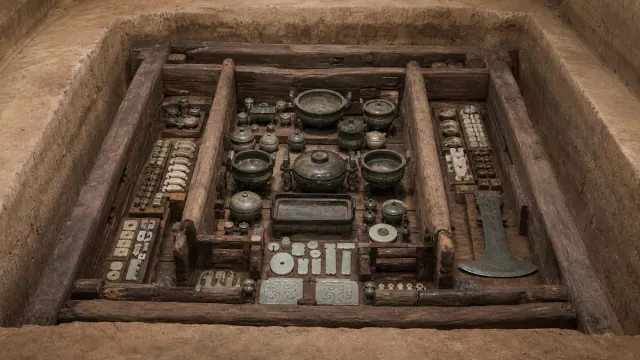
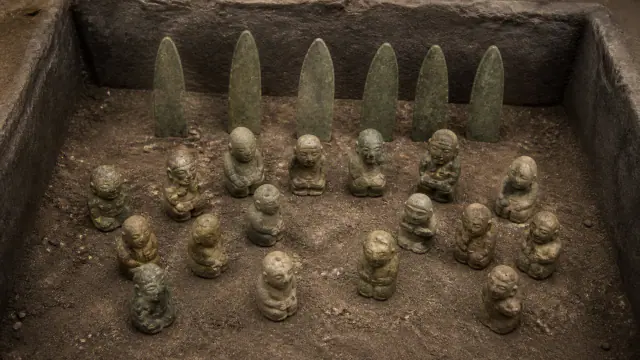
Sixteen small stone figures were placed in front of a row of six vertical axes and then buried. Their distinct materials and colours turn the assemblage into a miniature assembly: someone faces the group, others form an irregular line.
The deposit was reopened in antiquity and re-covered, a sign that its location remained known. Coronation, council, ancestors or mythic event are modern readings; the power of the work also lies in that none has closed the scene.
Sixteen figurines of stones of different tones were planted in a composition facing six vertical celts. The separation of one figure from the group and the alignment of the others produce a deliberate narrative tension even without knowing the represented episode.
After covering the assemblage, someone reopened the deposit in antiquity and sealed it again. That re-entry shows the location remained in social memory; it also prevents treating the find as an intact instant of a unique ceremony.
Evidence and interpretation
Documented fact: Offering 4 at La Venta brings together sixteen figures and six axes/celts deliberately arranged and buried, c. 800–600 BCE. Interpretation and caution: identifying a concrete ceremony or characters is speculative; the figures do not constitute a literal snapshot.
Expanded documentation: Offering 4 of the A Complex contains sixteen figures and six celts placed deliberately, buried and subject to an ancient reopening.
Expanded interpretation and caution: Council, coronation, judgement and ancestral gathering are possible readings of the scene, not verified identifications of its characters.
Catalogue facts
Narrative date
c. 800–600 BCE
Location
A Complex of La Venta, Tabasco, Mexico
Material
Jadeite, serpentine and other green stones
Context
Ritual deposit, memory and social representation
Curatorial reading
The documented fact and its interpretation appear separately in the evidence block.
Evidence
Archaeological context, materiality and chronology.
Caution
Do not convert stylistic diffusion or contact into political domination.
Documentary coverage
4 museum, heritage, primary corpus or research sources for this stop.
A SHARED TOPIC, DIFFERENT MOMENTS
Objects connected through time
Follow a topic across the collections. A shared tag is a way to compare objects, not proof that one culture influenced another.
The order uses the midpoint of each approximate date range; ranges can overlap. Spacing does not represent elapsed time. Swipe, scroll or use the arrows. With the sequence focused, use ← / →, Home or End.
About 1 min to read · 1 section. Further reading and sources · free access. Editorial review recorded: .
Distinct materials and paint remnants
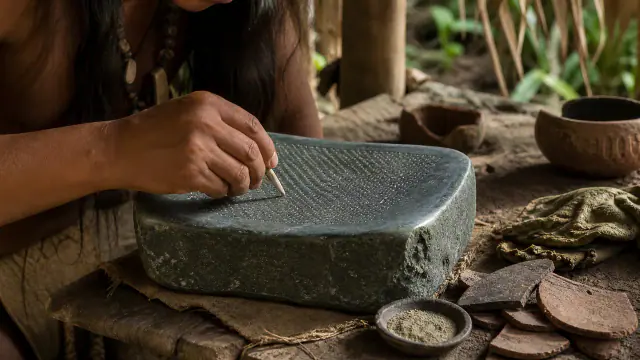
Analysis of the sixteen figurines of Offering 4 identified thirteen of serpentine, two of jade and one of granite, corresponding to the figure occupying the main position. Fourteen show a loincloth and two appear nude. One of the axes retains fine incisions and red pigment, also detected in body and face lines. The scene did not depend solely on placement: differences of stone, dress and colour could contribute to distinguishing participants. Material identification allows refining that reading, but does not turn a prominent position into a political office whose name we know.

 English
 Español
 Français
 Italiano
 Deutsch
 Русский
 Português
 Polski
 Română
 Svenska
 Norsk bokmål
 Suomi
 Türkçe
 العربية
 简体中文
 한국어
 हिन्दी
 Ελληνικά
 You are viewing