
 English
 Español
 Français
 Italiano
 Deutsch
 Русский
 Português
 Polski
 Română
 Svenska
 Norsk bokmål
 Suomi
 Türkçe
 العربية
 简体中文
 한국어
 हिन्दी
 Ελληνικά
08 · A Complex · Massive offering
The invisible mosaic
A green stone mask built to be hidden again
The green stone blocks were placed to form designs and then covered with clay.
Museum documentation · free public access, no account required.
Generated reconstruction · Declared visual hypothesis
Declared visual reconstruction for museographic context; it is not a photograph of the original nor documentary evidence.
History and context
At La Venta, pavements of serpentine blocks were laid out forming geometric designs or schematic faces. After placing them with enormous care, their creators covered them with clay: the act of composing and concealing mattered more than displaying the surface.
The material had travelled to the Gulf plain and remained immobilised beneath the soil. Burying so much valuable stone turned architecture into a reserve of memory and commitment, but we do not know what those who deposited it called themselves.
Hundreds of serpentine blocks were cut to comparable sizes and laid out to form large designs beneath Complex A. The investment included importing the rock, regularising each piece and mounting an image too extensive to be taken in from ground level.
The pavement was covered with clay shortly after being laid, so manufacture and concealment belonged to the same programme. Calling it a mask helps recognise a facial symmetry, although it may fix as a portrait what also admits geometric or cosmological readings.
Evidence and interpretation
Documented fact: excavations at La Venta uncovered massive offerings comprising pavements of rectangular greenstone blocks that had been deliberately buried. Interpretation and caution: calling them “masks” describes a visual resemblance; their supernatural identity, function and original audience remain debated. Additional documented evidence: excavations at La Venta recorded pavements of carefully arranged serpentine blocks buried as massive offerings. Further interpretation and caution: deliberate burial does not mean emergency concealment, and the supposed face does not by itself identify a specific supernatural being.
Catalogue facts
- Narrative date
- c. 900–600 BCE
- Location
- A Complex of La Venta, Tabasco, Mexico
- Material
- Serpentine blocks · clay
- Context
- Ritual of concealment and material value
- Curatorial reading
- The documented fact and its interpretation appear separately in the evidence block.
- Evidence
- Archaeological context, materiality and chronology.
- Caution
- Do not convert stylistic diffusion or contact into political domination.
- Documentary coverage
- 4 museum, heritage, primary corpus or research sources for this stop.
A SHARED TOPIC, DIFFERENT MOMENTS
Objects connected through time
Follow a topic across the collections. A shared tag is a way to compare objects, not proof that one culture influenced another.
The order uses the midpoint of each approximate date range; ranges can overlap. Spacing does not represent elapsed time. Swipe, scroll or use the arrows. With the sequence focused, use ← / →, Home or End.
Greenstone8 dated objects
ca. 1200 BCE
Fu Hao’s burial goods
Ancient China
Approximate date of the grave goods; their objects have different histories.
Read the record
Proposed c. 1000–900 BCE
Overlapping datesThe Cascajal Block
Maya worlds
Proposed dating and discussed context; no confirmed reading of the signs.
Read the record
c. 1000–600 BCE
Overlapping datesLas Limas
Maya worlds
Approximate dating according to the record.
Read the record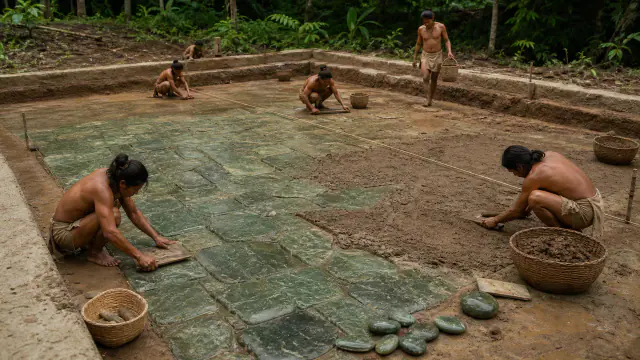 You are viewing
c. 900–600 BCE
The invisible mosaic
Maya worlds
Approximate dating according to the record.
Current record
c. 900–600 BCE
Overlapping datesMotagua jade
Maya worlds
Approximate dating according to the record.
Read the record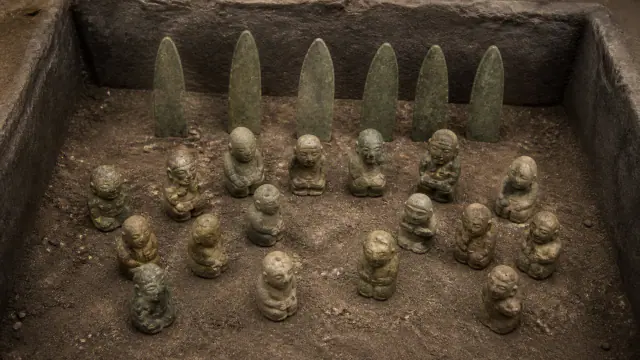
c. 800–600 BCE
Overlapping datesOffering 4
Maya worlds
Date of the deposit of Offering 4.
Read the record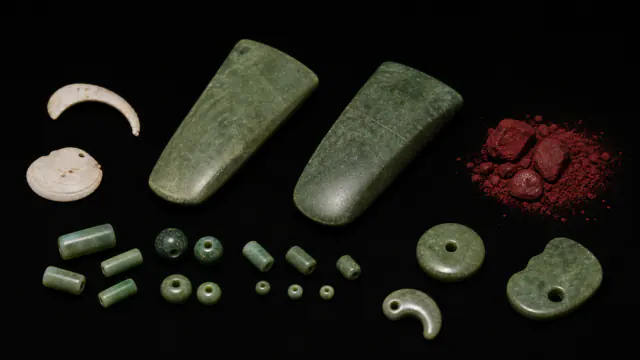
ca. 600–400 BCE
Overlapping datesLa Venta grave goods
Maya worlds
Date of the funerary assemblage.
Read the record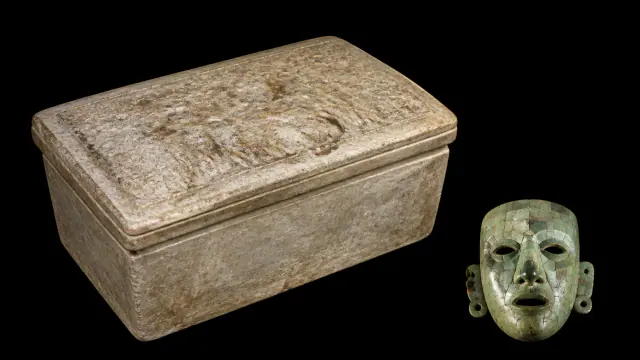
sealed on 28 August 683 CE
Pakal’s grave goods
Maya worlds
Date of tomb sealing; not manufacture of all grave goods pieces.
Read the record
A closer look
About 1 min to read · 1 section. Further reading and sources · free access. Editorial review recorded: .
The deposit was also a vertical construction
The massive offerings at La Venta did not consist only of flat drawings of green stone. INAH describes large cavities, around fifteen by nineteen metres and up to seven metres deep, with tonnes of serpentine and clay and sand fill. Within those fills, additional votive sets could be placed; Offering 4 was associated with the fill of Massive Offering 3. The vertical dimension helps imagine the work of excavation, transport and closure. It also obliges us to distinguish the visible design of a pavement from the complete stratified deposit to which it belonged.
Location and territory
LOCATED SITE
La Venta · MexicoMarker of the archaeological complex.Sources and references
Did you enjoy this exhibit?
Your opinion helps us improve the museum. You can change it whenever you like.
Loading your rating…