
 English
 Español
 Français
 Italiano
 Deutsch
 Русский
 Português
 Polski
 Română
 Svenska
 Norsk bokmål
 Suomi
 Türkçe
 العربية
 简体中文
 한국어
 हिन्दी
 Ελληνικά
11 · Proposed writing · Open debate
The Cascajal Block
Sixty-two signs and a lost context
The signs could belong to a very ancient writing, but the circumstances of the discovery leave doubts.
Museum documentation · free public access, no account required.
Generated reconstruction · Contextual correspondence
Declared visual reconstruction for museographic context; it is not a photograph of the original nor documentary evidence.
History and context
A concave face of serpentine gathers 62 signs, several repeated and arranged in sequences. Its researchers proposed that they form an Olmec writing from the first millennium BCE, earlier than other known systems on the continent.
The block appeared among debris removed by works, not in an intact stratigraphic excavation. That loss does not invalidate the object, but reduces the certainty of its date and function; moreover, no parallel inscription allows it to be read yet.
The prepared face of the block contains 62 signs, with repetitions and groupings that motivated the proposal of writing. Its arrangement does not imitate a simple decorative strip, but a unique piece does not allow establishing with certainty the reading direction, phonetic values, or language.
The find was recovered among materials removed by works near Lomas de Tacamichapa. The stylistic and ceramic associations support a proposed date at the end of San Lorenzo; however, the loss of stratigraphy obliges, nevertheless, to present the argument alongside its uncertainty.
Evidence and interpretation
Documented fact: the block has 62 signs and was recorded near Lomas de Tacamichapa, associated by materials and style to the final phase of San Lorenzo. Interpretation and caution: its condition as writing and continental primacy were defended in a scientific publication, but the secondary context, the unique piece, and the lack of decipherment maintain debate. Expanded documentation: The serpentine block conserves 62 signs, several repeated, and was published as a possible early Olmec writing associated with c. 1000–900 BCE. Expanded interpretation and caution: Secondary context, absence of comparable texts, and lack of decipherment prevent presenting it as the oldest writing in the Americas without nuance.
Catalogue facts
- Narrative date
- Proposed c. 1000–900 BCE
- Location
- Lomas de Tacamichapa, Veracruz, Mexico
- Material
- Incised serpentine block
- Context
- Possible early writing and limits of the archaeological context
- Curatorial reading
- The documented fact and its interpretation appear separately in the evidence block.
- Evidence
- Archaeological context, materiality and chronology.
- Caution
- Do not convert stylistic diffusion or contact into political domination.
- Documentary coverage
- 4 museum, heritage, primary corpus or research sources for this stop.
A SHARED TOPIC, DIFFERENT MOMENTS
Objects connected through time
Follow a topic across the collections. A shared tag is a way to compare objects, not proof that one culture influenced another.
The order uses the midpoint of each approximate date range; ranges can overlap. Spacing does not represent elapsed time. Swipe, scroll or use the arrows. With the sequence focused, use ← / →, Home or End.
Greenstone8 dated objects
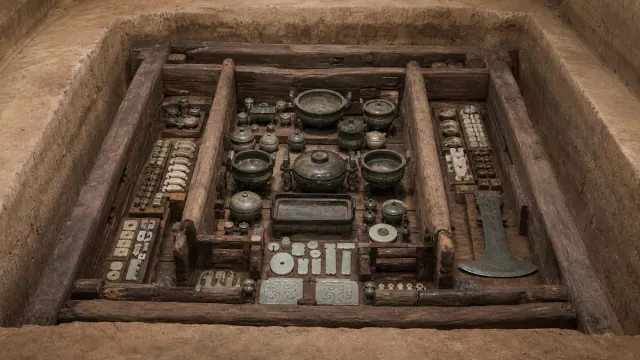
ca. 1200 BCE
Fu Hao’s burial goods
Ancient China
Approximate date of the grave goods; their objects have different histories.
Read the record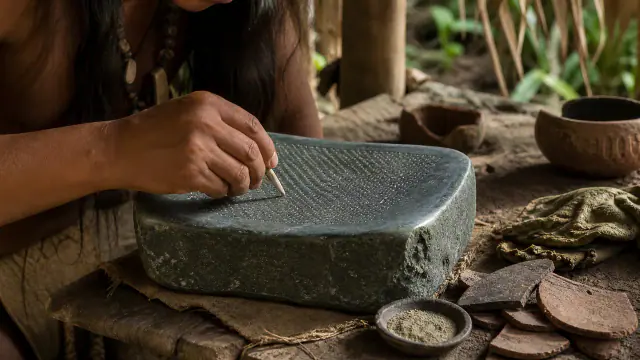 You are viewing
Proposed c. 1000–900 BCE
The Cascajal Block
Maya worlds
Proposed dating and discussed context; no confirmed reading of the signs.
Current record
c. 1000–600 BCE
Overlapping datesLas Limas
Maya worlds
Approximate dating according to the record.
Read the record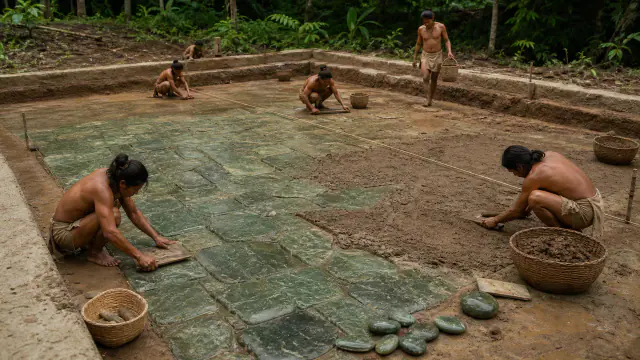
c. 900–600 BCE
Overlapping datesThe invisible mosaic
Maya worlds
Approximate dating according to the record.
Read the record
c. 900–600 BCE
Overlapping datesMotagua jade
Maya worlds
Approximate dating according to the record.
Read the record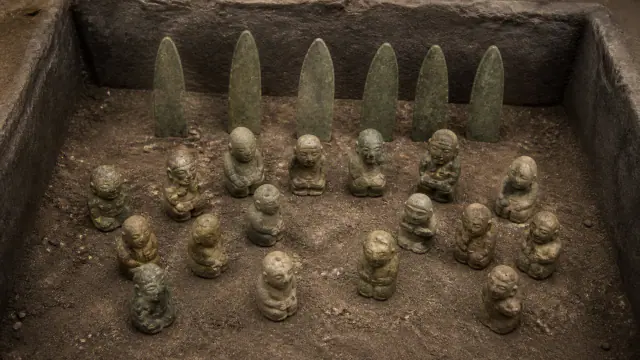
c. 800–600 BCE
Offering 4
Maya worlds
Date of the deposit of Offering 4.
Read the record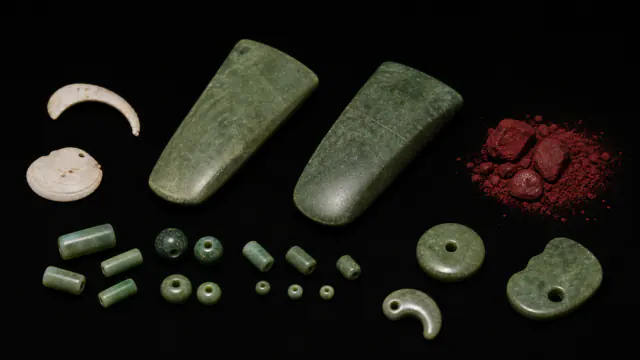
ca. 600–400 BCE
La Venta grave goods
Maya worlds
Date of the funerary assemblage.
Read the record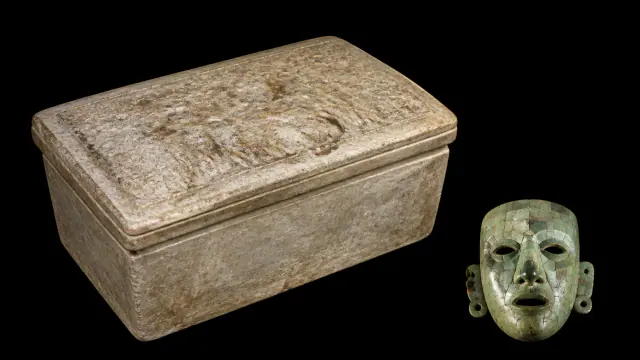
sealed on 28 August 683 CE
Pakal’s grave goods
Maya worlds
Date of tomb sealing; not manufacture of all grave goods pieces.
Read the record
A closer look
About 1 min to read · 1 section. Further reading and sources · free access. Editorial review recorded: .
Check the surface without inventing a translation
A study disseminated in 2019 combined variable illumination photography, X-ray fluorescence, and electron microscopy to examine Cascajal. The composition proved compatible with serpentine and a uniform patina was recognised. Moulds of the incisions allowed comparing manufacturing traces with Olmec objects of secure archaeological provenance; the new images also improved the drawing of the signs. The authors consider that these results support its authenticity and attribution to the Formative. That conclusion is distinct from decipherment: analysing stone and marks can reinforce an attribution without automatically recovering language, reading direction, or content.
Sources and references
Did you enjoy this exhibit?
Your opinion helps us improve the museum. You can change it whenever you like.
Loading your rating…