
 English
 Español
 Français
 Italiano
 Deutsch
 Русский
 Português
 Polski
 Română
 Svenska
 Norsk bokmål
 Suomi
 Türkçe
 العربية
 简体中文
 한국어
 हिन्दी
 Ελληνικά
09 · Green stone · Mesoamerican networks
Motagua jade
An axe that never struck, transformed into a maize sprout
Jadeite from the Motagua valley travelled long distances and required much work to carve and polish.
Museum documentation · free public access, no account required.
Generated reconstruction · Declared visual hypothesis
Declared visual reconstruction for museographic context; it is not a photograph of the original nor documentary evidence.
History and context
Jadeite came from the Motagua valley, in present-day Guatemala, and required prolonged abrasion, drilling and polishing. A large celt could retain the silhouette of a tool, although its edge and delicate design set it apart from everyday work.
In the Met piece, a supernatural profile and a sprout emerge from the upper cleft. The reading links green stone, maize and renewal; when these celts were buried, the image of a mineral seed gained strength without needing to be seen.
The celt form preserves the memory of a tool, but the polishing, drilling and incision shift this piece into the ceremonial realm. Its surface turned an extremely hard material into a support for a supernatural silhouette and a sprout emerging from the cleft.
Jadeite geologically originates from the Motagua basin, far from the great Gulf centres. Between quarry and deposit, multiple communities could have intervened; the material route demonstrates long-distance connection without revealing a single caravan or Olmec control over the source.
Evidence and interpretation
Documented fact: Olmec jadeite was imported over long distances, and the Met celt dates to 900–600 BCE, with incised motifs that specialists associate with maize. Interpretation and caution: “maize god” is an identification based on iconographic comparison; we do not know the Olmec name or have a translation of the signs. Additional documented evidence: the Met celt, dated c. 900–600 BCE, is carved from imported jadeite and bears incised motifs compared with maize and transformation. Further interpretation and caution: “maize god” is a retrospective iconographic identification; it does not provide the being’s Olmec name or a translation of the image.
Catalogue facts
- Narrative date
- c. 900–600 BCE
- Location
- Mesoamerica; Motagua basin jadeite, Guatemala
- Material
- Carved, drilled and polished jadeite
- Context
- Long-distance exchange and agricultural symbolism
- Curatorial reading
- The documented fact and its interpretation appear separately in the evidence block.
- Evidence
- Archaeological context, materiality and chronology.
- Caution
- Do not convert stylistic diffusion or contact into political domination.
- Documentary coverage
- 4 museum, heritage, primary corpus or research sources for this stop.
A SHARED TOPIC, DIFFERENT MOMENTS
Objects connected through time
Follow a topic across the collections. A shared tag is a way to compare objects, not proof that one culture influenced another.
The order uses the midpoint of each approximate date range; ranges can overlap. Spacing does not represent elapsed time. Swipe, scroll or use the arrows. With the sequence focused, use ← / →, Home or End.
Greenstone8 dated objects
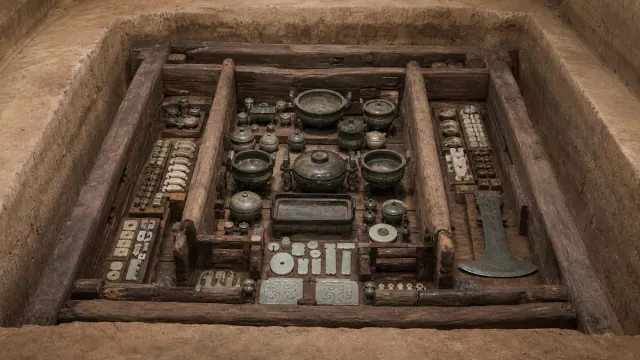
ca. 1200 BCE
Fu Hao’s burial goods
Ancient China
Approximate date of the grave goods; their objects have different histories.
Read the record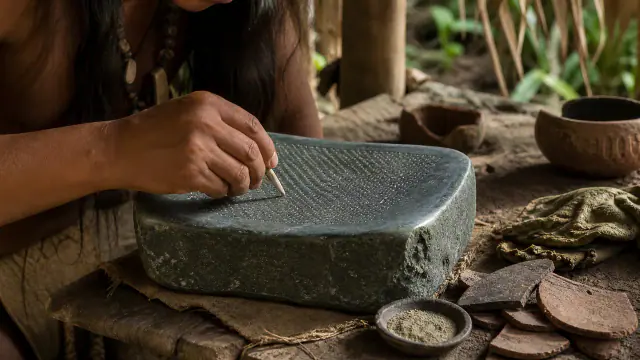
Proposed c. 1000–900 BCE
Overlapping datesThe Cascajal Block
Maya worlds
Proposed dating and discussed context; no confirmed reading of the signs.
Read the record
c. 1000–600 BCE
Overlapping datesLas Limas
Maya worlds
Approximate dating according to the record.
Read the record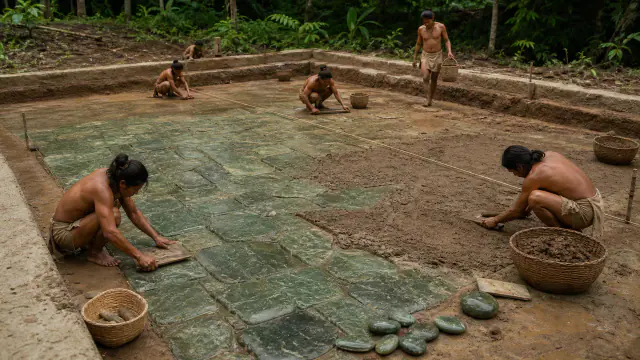
c. 900–600 BCE
Overlapping datesThe invisible mosaic
Maya worlds
Approximate dating according to the record.
Read the record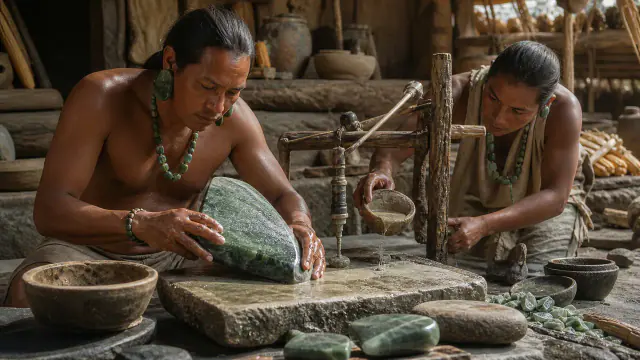 You are viewing
c. 900–600 BCE
Motagua jade
Maya worlds
Approximate dating according to the record.
Current record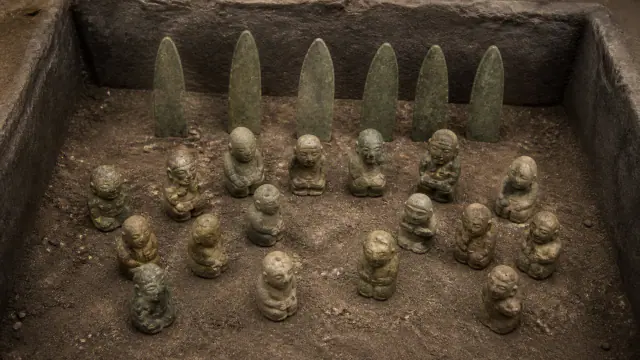
c. 800–600 BCE
Overlapping datesOffering 4
Maya worlds
Date of the deposit of Offering 4.
Read the record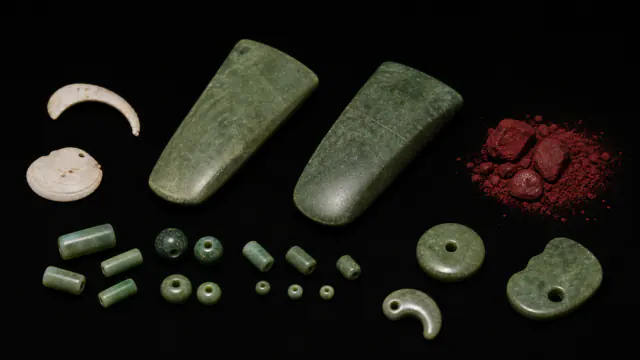
ca. 600–400 BCE
Overlapping datesLa Venta grave goods
Maya worlds
Date of the funerary assemblage.
Read the record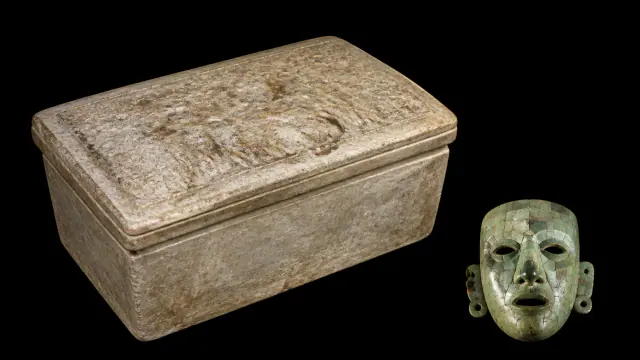
sealed on 28 August 683 CE
Pakal’s grave goods
Maya worlds
Date of tomb sealing; not manufacture of all grave goods pieces.
Read the record
A closer look
About 1 min to read · 1 section. Further reading and sources · free access. Editorial review recorded: .
From broken edge to pendant
The current Met label identifies the piece as a celt modified to become a pendant. Its edge was dulled in antiquity and a later perforation allowed it to be suspended from a belt set. Among the incisions appears a hand separated from the body, with a knot at the wrist and details such as the thumbnail. The transformation adds a material biography to the maize motif: the object did not necessarily have a single function. Its possible graphic value is discussed by comparison, but it does not allow reading the hand as a known Olmec word.
- Museum · The Met · Modified celt-pendant with incised motifsAccess recorded: .
Where it is held
The Metropolitan Museum of Art
Item or group in the record · Documented collection
The holding institution is documented; public display may change. Check its official record before visiting.
Sources and references
Did you enjoy this exhibit?
Your opinion helps us improve the museum. You can change it whenever you like.
Loading your rating…