EASTERN GRAVETTIAN · ≈23,000–21,000 YEARS
Kostenki I A broken figure buried face down
We can study its breaks and how it was deposited. Its meaning and relationship with possible rituals remain uncertain.
ON THIS PAGE
History and context Evidence and facts Objects connected through time Explore in 3D Further reading Location and territory Where it is held Sources and references Comments Museum documentation · free public access, no account required.
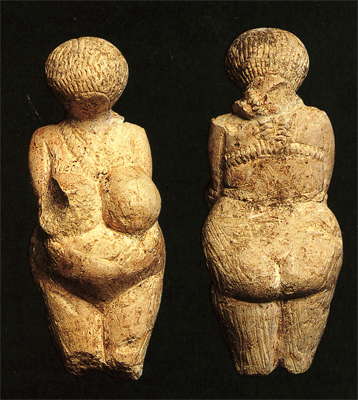
⛶ Enlarge imagePHOTOGRAPH OF KOSTENKI I FIGURINE · Don Hitchcock / Wikimedia Commons · CC BY-SA 4.0 Documentary original · Contextual correspondence
Front and back views of a figurine from Kostenki I taken by Don Hitchcock. The photographic source does not indicate an inventory number; correspondence with specimen 2928/12 is considered probable by visual comparison with the MARQ photograph.
Don Hitchcock · State Hermitage Museum · Inventory: Kostenki I; número de inventario no indicado en la fuente fotográfica · CC BY-SA 4.0
View full image: PHOTOGRAPH OF KOSTENKI I FIGURINE · Don Hitchcock / Wikimedia Commons · CC BY-SA 4.0 PHOTOGRAPH OF KOSTENKI I FIGURINE · Don Hitchcock / Wikimedia Commons · CC BY-SA 4.0 Documentary original · Contextual correspondence
Front and back views of a figurine from Kostenki I taken by Don Hitchcock. The photographic source does not indicate an inventory number; correspondence with specimen 2928/12 is considered probable by visual comparison with the MARQ photograph.
Don Hitchcock · State Hermitage Museum · Inventory: Kostenki I; número de inventario no indicado en la fuente fotográfica · CC BY-SA 4.0
Explore in 3D
Explore in 3D
Load the model only when you want to explore it. Drag or use the arrow keys to turn it; + and − zoom. Closing it releases its memory.
User-supplied digital reconstruction; file metadata declares Tripo. It is not an archaeological scan or a metric replica; the supplied geometry is preserved intact. The model is displayed enlarged about five times so that it can be examined in the gallery: the original measures 10.3 cm. All the figurines in this section use the same enlargement, so they keep their relative sizes. The model does not exactly reproduce the ancient breaks or the position in which the figure was deposited.
History and context The ochred limestone figurine, inventory 2928/12, appeared in 1983 in a semi-subterranean dwelling at Kostenki I, in the Russian oblast of Voronezh. It was deposited face down and preserves ancient breaks.
It has been interpreted as a pregnant figure or ritually broken. The context allows a narrative of deliberate deposition; it does not allow us to hear the intention of whoever made it.
Evidence and interpretation Material, ochre, dimensions, Russian provenance, position and ancient breaks are documented. Pregnancy, ritual destruction and meaning are hypotheses.
Catalogue facts
Date ≈23,000–21,000 years
Location Kostenki I · Voronezh, Russia
Inventory Hermitage 2928/12
Material and measurements Limestone with ochre · 10.3 × 3.5 cm Limestone12 Pigments23 Figurines20 Human imagery73
The order uses the midpoint of each approximate date range; ranges can overlap. Spacing does not represent elapsed time. Swipe, scroll or use the arrows. With the sequence focused, use ← / →, Home or End.
Earlier Later
≈29,500 years
Willendorf Prehistory
Approximate catalogue age; editorial reference 2026 for ordering only, not calibrated dating.
Read the record You are viewing ≈23,000–21,000 years
Kostenki I Prehistory
Approximate catalogue age; editorial reference 2026 for ordering only, not calibrated dating.
Current record Eighth millennium BCE · context dating, not direct dating of the stone
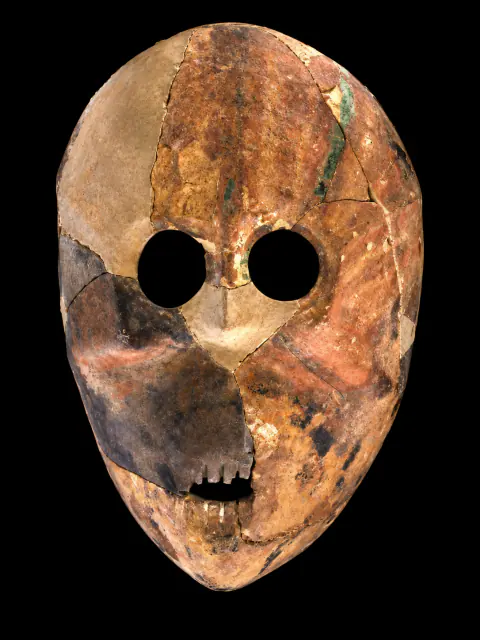
Nahal Hemar mask Prehistory
Context dating, not direct dating of the stone.
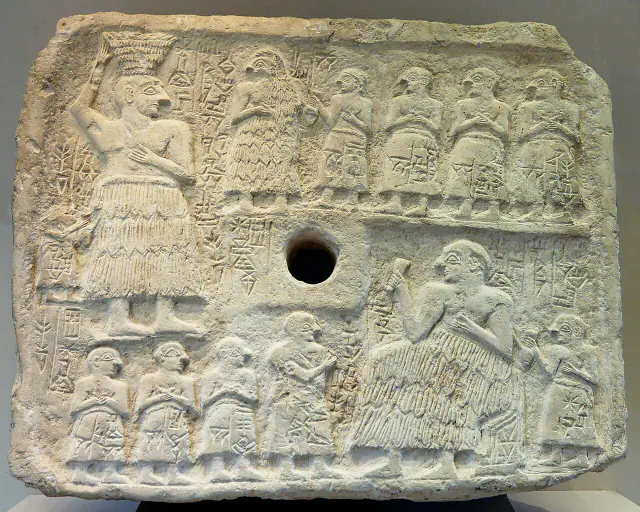
Read the record Mid-3rd millennium BCE · reign of Ur-Nanshe
Ur-Nanshe relief Sumer
The full 3rd millennium BCE provides broad limits for chronological ordering; the record specifies the middle of the millennium, in the reign of Ur-Nanshe.
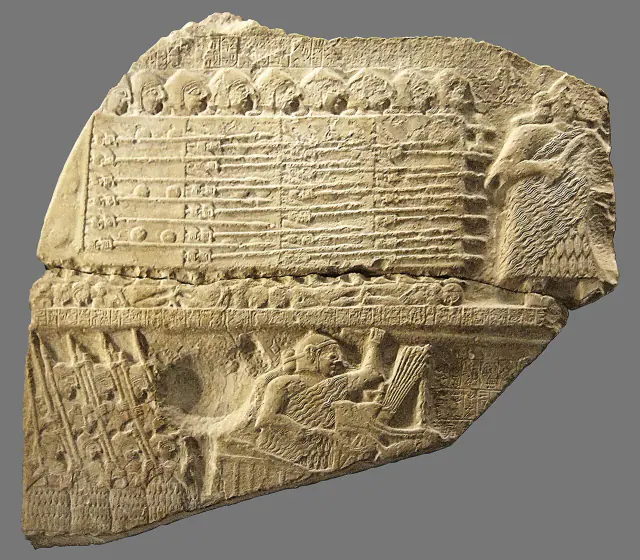
Read the record Towards 2450–2425 BCE
Stele of the Vultures Sumer
Approximate dating according to the record.
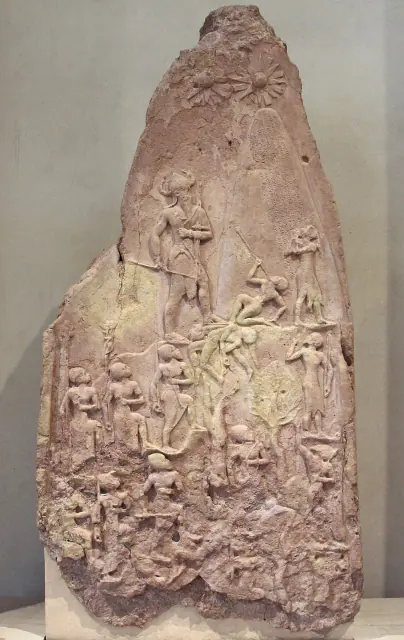
Read the record Reign of Naram-Sin, 2254–2218 BCE
Naram-Sin Stele Sumer
Reign interval associated with the piece; the Elamite reuse is later.
Read the record c. 11th–10th century BCE
The voice of Ahiram Phoenicians
Approximate dating according to the record.
Read the record 825 BCE
Black Obelisk Sumer
Approximate dating according to the record.
Read the record 6th–5th centuries BCE, mainly under Darius and Xerxes
Twenty-three delegations Achaemenid Persia
Interval of the monumental programme under several reigns.
Read the record 1st century BCE–1st century CE
Betatun altar Iberians
Interval crossing the era change; there is no year zero.
Read the record 292 CE
The date of 292 Maya worlds
Long Count date translated into the Common Era.
Read the record 2 / 11 In the centre: Kostenki I
Also connected, without a comparable date (1) These objects are not placed after the others: an unknown date does not mean a more recent object.
Before Persia Achaemenid Persia · Central core c. seventeenth century BCE; Neo-Elamite additions between the ninth and sixth centuries BCE You can scroll the first group without JavaScript. The other topics are also available below.
Pigments Engraved ochre from Blombos · ≈77,000–75,000 years · PrehistoryWillendorf · ≈29,500 years · PrehistoryBefore the San · ≈25.500–23.500 BCE · San historiesBefore the name San · ≈25.500–23.500 BCE · San historiesAltamira · Assemblage ≈36,000–13,000 BP · bison ≈18,400–15,300 cal BP · PrehistoryLascaux · ≈23,500–21,000 cal BP · debated contextual estimate · PrehistoryKostenki I · ≈23,000–21,000 years · Prehistory — You are viewingCueva de las Manos · Sequence ≈9300–1300 BP · PrehistoryQueen of the Night · 19th–18th centuries BCE · SumerCeramic stand 1010 · 8th–7th centuries BCE · orientalizing · IberiansBanquet under leopards · Around 480–470 BCE · Etruscans and RomeThe Karwa textile · 4th–3rd centuries BCE · Pre-Inca culturesThe walls of San Bartolo · c. 100 BCE · Maya worldsVenus in the codex · Preserved manuscript: Postclassic, probably 13th–14th centuries; earlier knowledge · Maya worldsWithout a comparable date (not part of the chronological order):
Bhimbetka · Mesolithic–historical and medieval period · PrehistoryBlue that does not yield · Documented use from the Classic, c. 300–1500 CE · Maya worldsEland Cave · Regional tradition of ≈4,000 years · up to historical period · PrehistoryGame Pass Shelter · Regional rock art chronology · panel not dated in isolation · San historiesKakadu · Regional corpus ≈20,000 BP–contemporary era · PrehistoryLeang Karampuang · Minimum 51,200 years · dating published in 2024 · PrehistoryQuinkan Country · Regional art up to ≈27,000 BP · modern continuity · PrehistorySierra de San Francisco · Broad tradition with direct dates ≈5290–295 BP · PrehistoryTassili n’Ajjer · Corpus ≈6000 BCE–first centuries CE · PrehistoryFigurines Hohle Fels · ≈40,000 years · Aurignacian · PrehistoryWillendorf · ≈29,500 years · PrehistoryBrno II Articulated Figure · ≈28,000 years cal BP · by funerary association · PrehistoryDolní Věstonice I · ≈29,000–27,000 years · PrehistoryLespugue · ≈28,000 years · PrehistoryKostenki I · ≈23,000–21,000 years · Prehistory — You are viewingZaraysk Bison · ≈23,000–21,000 years · PrehistoryWorshiper of Tell Asmar · Towards 2900–2600 BCE · SumerOffering 4 · c. 800–600 BCE · Maya worldsKushite king · c. 721–664 BCE · Nubia, Kerma and KushThe so-called ‘Priest of Cádiz’ · 7th century BCE · PhoeniciansThe so-called ‘Priest of Cádiz’ · 7th century BCE · IberiansShabti of Psamtek · 570–526 BCE · Ancient EgyptLa Venta grave goods · ca. 600–400 BCE · Maya worldsLady of Ibiza · 4th–3rd centuries BCE · PhoeniciansLady of Ibiza · 4th–3rd centuries BCE · IberiansThracian Gladiator from Cádiz · 67–100 CE · Etruscans and RomeWithout a comparable date (not part of the chronological order):
Human imagery Lion-man · ≈40,000 years · Aurignacian · PrehistoryHohle Fels · ≈40,000 years · Aurignacian · PrehistoryWillendorf · ≈29,500 years · PrehistoryBrno II Articulated Figure · ≈28,000 years cal BP · by funerary association · PrehistoryDolní Věstonice I · ≈29,000–27,000 years · PrehistoryLespugue · ≈28,000 years · PrehistoryKostenki I · ≈23,000–21,000 years · Prehistory — You are viewingShigir Idol · C. 10,000 BCE · approximation; debated dating · PrehistoryNahal Hemar mask · Eighth millennium BCE · context dating, not direct dating of the stone · PrehistoryEl Miradero spatula-idols · ≈4000–3800 cal BCE · PrehistoryWarka Mask · End of the 4th millennium BCE · SumerCueva de las Manos · Sequence ≈9300–1300 BP · PrehistoryUruk Vase · ca. 3300–3000 BCE · SumerWorshiper of Tell Asmar · Towards 2900–2600 BCE · SumerStandard of Ur · ca. 2600–2400 BCE · SumerStatue of Ebih-Il · Towards 2400 BCE · SumerAkkadian sovereign head · Akkadian period · 23rd century BCE · SumerBassetki Statue · Akkadian period · 23rd century BCE · SumerBefore Pre-Inca Cultures · Kotosh-Mito Tradition, c. 2200–1500 BCE; the enclosure is usually situated around 1800 BCE. · Pre-Inca culturesQueen of the Night · 19th–18th centuries BCE · SumerBull-leaping · c. 1600–1450 BCE · Greek worldsWooden faces · c. 1600–1000 BCE, in several phases · Maya worldsHead 2 · c. 1200–900 BCE · Maya worldsIvory in Nimrud · 9th–8th centuries BCE · PhoeniciansLas Limas · c. 1000–600 BCE · Maya worldsAstarte from El Carambolo · 8th century BCE · PhoeniciansAstarte from El Carambolo · 8th century BCE · IberiansLamassu of Khorsabad · Reign of Sargon II · 721–705 BCE · SumerThe Lanzón · c. 900–500 BCE · Pre-Inca culturesOffering 4 · c. 800–600 BCE · Maya worldsKushite king · c. 721–664 BCE · Nubia, Kerma and KushThe so-called ‘Priest of Cádiz’ · 7th century BCE · PhoeniciansThe so-called ‘Priest of Cádiz’ · 7th century BCE · IberiansHeads on the wall · c. 800–300 BCE · Pre-Inca culturesShabti of Psamtek · 570–526 BCE · Ancient EgyptTwo voices in an urn · 530–520 BCE · Etruscans and RomeThe god on the roof · Towards 510–500 BCE · Etruscans and RomeGlazed brick guards · 522–486 BCE · Achaemenid PersiaTwenty-three delegations · 6th–5th centuries BCE, mainly under Darius and Xerxes · Achaemenid PersiaBanquet under leopards · Around 480–470 BCE · Etruscans and RomeThe statue was the urn · First half of the 4th century BCE · IberiansA battle on a comb · Early 4th century BCE · Scythians and SakaThe Kul-Oba vase · 4th century BCE · Greek worldsThe Solokha gold comb · 4th century BCE · Greek worldsFaces of the Steppe · Second half of the 4th century BCE · Scythians and SakaLady of Ibiza · 4th–3rd centuries BCE · PhoeniciansPunic head pendant · Mid 4th–3rd centuries BCE · PhoeniciansLady of Ibiza · 4th–3rd centuries BCE · IberiansThe Raimondi Stele · c. 400–200 BCE according to MNAAHP · Pre-Inca culturesChão de Lamas pectoral · 3rd–2nd centuries BCE · concealed in the early 1st century BCE · IberiansVas dels Guerrers · 3rd–early 2nd century BCE · IberiansWarriors' Vase · 3rd–2nd centuries BCE · IberiansThe dismantled cauldron · 2nd–1st centuries BCE · Celtic worldsThe walls of San Bartolo · c. 100 BCE · Maya worldsGladiators Cup of Chavagnes · 25–75 CE · Etruscans and RomeThracian Gladiator from Cádiz · 67–100 CE · Etruscans and RomeTorreáguila fountain spout · 101–125 CE · Etruscans and RomeArticulated doll from Tarragona · Late 3rd–4th century CE · Etruscans and RomeSeven heads · c. 500–700 CE · Bantu-speaking worldsSeated figure · 13th century, date attributed by the museum · Mande WorldsKongo crucifix · 16th–17th centuries · Bantu-speaking worldsKuba ndop · ca. 1760 · Bantu-speaking worldsWithout a comparable date (not part of the chronological order):
Before Persia · Central core c. seventeenth century BCE; Neo-Elamite additions between the ninth and sixth centuries BCE · Achaemenid PersiaBhimbetka · Mesolithic–historical and medieval period · PrehistoryEland Cave · Regional tradition of ≈4,000 years · up to historical period · PrehistoryFour offerers · Iberian period · individual dating according to catalogue · IberiansGame Pass Shelter · Regional rock art chronology · panel not dated in isolation · San historiesLararium of Vilauba · Roman period · Etruscans and RomeLeang Karampuang · Minimum 51,200 years · dating published in 2024 · PrehistoryQuinkan Country · Regional art up to ≈27,000 BP · modern continuity · PrehistorySierra de San Francisco · Broad tradition with direct dates ≈5290–295 BP · PrehistoryTassili n’Ajjer · Corpus ≈6000 BCE–first centuries CE · PrehistoryThe Thracian Horseman · Roman era · diffusion especially in the 2nd–3rd centuries CE · ThraciansA closer look About 1 min to read · 1 section. Further reading and sources · free access. Editorial review recorded: September 5, 2026 .
A body that appears naked retains ornaments The MARQ record describes bands across the chest and shoulders, bracelets and a treatment of the nape resembling a braided base. The cuts and reliefs are visible; relating them to leather, fibres or strings of beads is a reconstruction of materials that do not accompany the figure. These details turn the surface into more than anatomy. They may help investigate forms of bodily presentation, but do not allow us to dress a real person with certainty or identify their position within the community.
Location and territory Physical world map with routes of human evolution Present-day world coastline from Natural Earth in an equirectangular projection. The overlaid markers let you explore each milestone. Map base: Natural Earth 1:110m · public domain · present-day reference coastline LOCATED SITE
Kostenki I · Russia Approximate site marker in Voronezh oblast. Where it is held Item or group in the record · Documented collection
Inventory 2928/12; display may rotate.
The holding institution is documented; public display may change. Check its official record before visiting.
See Kostenki I in the museum Find this record in its gallery and save your route, favourites and places to explore later.
Open this exhibit in the museum → Museum access requires a free account. You can read this page's documentation without registering.
Did you enjoy this exhibit? Your opinion helps us improve the museum. You can change it whenever you like.
Loading your rating…

 English
 Español
 Français
 Italiano
 Deutsch
 Русский
 Português
 Polski
 Română
 Svenska
 Norsk bokmål
 Suomi
 Türkçe
 العربية
 简体中文
 한국어
 हिन्दी
 Ελληνικά
 You are viewing